{"title":"Investigating the influence of hexafluorobutyl methacrylate on the properties of core–shell polyacrylate latex pressure sensitive adhesives and films","authors":"Chaobo Wu, Cheng Fang","doi":"10.1007/s13726-025-01482-2","DOIUrl":null,"url":null,"abstract":"<div><p>The increasing global focus on sustainability and environmental protection has driven significant developments in research on waterborne pressure-sensitive adhesives (PSAs). Among these, hexafluorobutyl methacrylate (HFMA)-modified core–shell polyacrylates show great potential as waterborne PSAs but are hindered by limited understanding of HFMA's effect on PSA properties. To address this challenge, we successfully synthesized a series of core–shell polyacrylate latex PSAs using (meth)acrylates as the primary monomer and HFMA as the modifying monomer, employing a monomer-starved seeded semi-continuous emulsion polymerization process. Comprehensive characterizations, including FTIR, XPS, DSC and TEM, confirmed the successful incorporation of HFMA into the latex copolymer and the formation of core–shell structures. Notably, increasing the HFMA content from 0 to 20 wt% significantly reduced the water absorption rate of the latex films from 15 to 4 wt% and decreased the surface tension from 42 to 34 mN/m. Concurrently, the water contact angle and water whitening resistance were greatly enhanced. Additionally, the loop tack and peel strength of the modified PSAs were improved by 81 and 89%, respectively. Furthermore, all PSA samples demonstrated high shear strength (> 72 h) and gel content (> 69 wt%), achieving a remarkable balance between cohesion and adhesion. This work offered a novel approach for designing waterborne PSAs with excellent water whitening resistance and high cohesion, broadening the possibilities for sustainable adhesive applications.</p><h3>Graphical abstract</h3><div><figure><div><div><picture><source><img></source></picture></div></div></figure></div></div>","PeriodicalId":601,"journal":{"name":"Iranian Polymer Journal","volume":"34 11","pages":"1917 - 1928"},"PeriodicalIF":2.8000,"publicationDate":"2025-03-28","publicationTypes":"Journal Article","fieldsOfStudy":null,"isOpenAccess":false,"openAccessPdf":"https://link.springer.com/content/pdf/10.1007/s13726-025-01482-2.pdf","citationCount":"0","resultStr":null,"platform":"Semanticscholar","paperid":null,"PeriodicalName":"Iranian Polymer Journal","FirstCategoryId":"92","ListUrlMain":"https://link.springer.com/article/10.1007/s13726-025-01482-2","RegionNum":3,"RegionCategory":"化学","ArticlePicture":[],"TitleCN":null,"AbstractTextCN":null,"PMCID":null,"EPubDate":"","PubModel":"","JCR":"Q3","JCRName":"POLYMER SCIENCE","Score":null,"Total":0}
引用次数: 0
Abstract
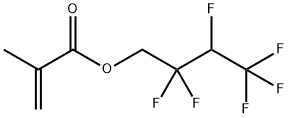
The increasing global focus on sustainability and environmental protection has driven significant developments in research on waterborne pressure-sensitive adhesives (PSAs). Among these, hexafluorobutyl methacrylate (HFMA)-modified core–shell polyacrylates show great potential as waterborne PSAs but are hindered by limited understanding of HFMA's effect on PSA properties. To address this challenge, we successfully synthesized a series of core–shell polyacrylate latex PSAs using (meth)acrylates as the primary monomer and HFMA as the modifying monomer, employing a monomer-starved seeded semi-continuous emulsion polymerization process. Comprehensive characterizations, including FTIR, XPS, DSC and TEM, confirmed the successful incorporation of HFMA into the latex copolymer and the formation of core–shell structures. Notably, increasing the HFMA content from 0 to 20 wt% significantly reduced the water absorption rate of the latex films from 15 to 4 wt% and decreased the surface tension from 42 to 34 mN/m. Concurrently, the water contact angle and water whitening resistance were greatly enhanced. Additionally, the loop tack and peel strength of the modified PSAs were improved by 81 and 89%, respectively. Furthermore, all PSA samples demonstrated high shear strength (> 72 h) and gel content (> 69 wt%), achieving a remarkable balance between cohesion and adhesion. This work offered a novel approach for designing waterborne PSAs with excellent water whitening resistance and high cohesion, broadening the possibilities for sustainable adhesive applications.
期刊介绍:
Iranian Polymer Journal, a monthly peer-reviewed international journal, provides a continuous forum for the dissemination of the original research and latest advances made in science and technology of polymers, covering diverse areas of polymer synthesis, characterization, polymer physics, rubber, plastics and composites, processing and engineering, biopolymers, drug delivery systems and natural polymers to meet specific applications. Also contributions from nano-related fields are regarded especially important for its versatility in modern scientific development.

 求助内容:
求助内容: 应助结果提醒方式:

 京公网安备 11010802042870号


