
Robust B–H perdeuteration of polyhedral boron clusters with D2O by Pd(II)-catalytic electrophilic H/D exchange and intermolecular Pd migration
IF 19.6
1区 化学
Q1 CHEMISTRY, MULTIDISCIPLINARY
引用次数: 0
Abstract
The selective B–H functionalization of carboranes has received considerable attention because of their wide applications in functional materials, catalysis, and pharmaceuticals. Deuterium-labeling experiments and kinetic-isotope-effect experiments are two important tools for mechanistic studies on the selective B–H activation of carboranes. Thus, developing an effective method for the synthesis of perdeuterated carboranes is highly desirable. Herein, we present a practical method for synthesizing perdeuterated carboranes via Pd(II)-catalyzed B–H activation by using D2O as a deuterium source. This protocol features extraordinary functional-group tolerance, high levels of deuterium incorporation, and ease of scaling. Mechanistic studies illustrate that the deuteration reaction proceeds via Pd(II)-catalytic electrophilic H/D exchange and subsequent intermolecular Pd migration. The same degree of deuterium incorporation across all boron vertices indicates that the Pd-migration step is faster than the electrophilic palladation step. Additionally, the versatility of this method is reflected in the deuteration of other boron clusters.
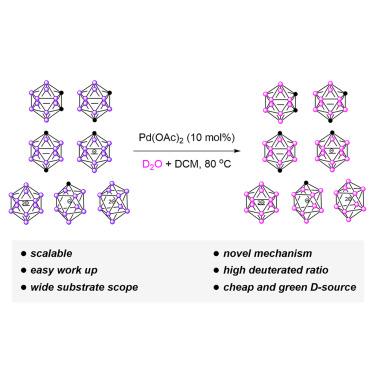

通过Pd(II)催化亲电H/D交换和分子间Pd迁移,D2O对多面体硼团簇进行稳健的B-H过氘
碳硼烷的选择性B-H功能化由于其在功能材料、催化和药物等方面的广泛应用而受到了广泛的关注。氘标记实验和动力学同位素效应实验是碳硼烷选择性B-H活化机理研究的两个重要工具。因此,开发一种合成过氘化碳硼烷的有效方法是非常需要的。本文提出了一种以D2O为氘源,通过Pd(II)催化B-H活化合成过氘化碳硼烷的实用方法。该方案具有非凡的官能团耐受性,高水平的氘掺入,并易于缩放。机理研究表明,氘化反应是通过Pd(II)催化亲电H/D交换和随后的分子间Pd迁移进行的。所有硼顶点的氘掺入程度相同,表明pd迁移步骤比亲电钯化步骤快。此外,这种方法的通用性反映在其他硼团簇的氘化。
本文章由计算机程序翻译,如有差异,请以英文原文为准。
求助全文
约1分钟内获得全文
求助全文
来源期刊
Chem
Environmental Science-Environmental Chemistry
CiteScore
32.40
自引率
1.30%
发文量
281
期刊介绍:
Chem, affiliated with Cell as its sister journal, serves as a platform for groundbreaking research and illustrates how fundamental inquiries in chemistry and its related fields can contribute to addressing future global challenges. It was established in 2016, and is currently edited by Robert Eagling.
 求助内容:
求助内容: 应助结果提醒方式:

 京公网安备 11010802042870号


