
Unlocking marginal SDG dynamics: A KRLS machine learning analysis of AI technologies and solar energy
IF 12.7
1区 地球科学
Q1 GEOSCIENCES, MULTIDISCIPLINARY
引用次数: 0
Abstract
Studies quantifying AI’s impact on Sustainable Development Goals (SDGs) often rely on proxies that inaccurately reflect AI progress. Moreover, focusing solely on environmental and growth indicators provides an incomplete picture of AI’s overall contribution to the SDGs, as the SDG framework encompasses a broader set of interconnected goals. Therefore, this study unveils the marginal impacts of AI and solar energy (SEN) directly on the SDG Index (SDGI) by using the Kernel-Based Regularized Least Squares (KRLS) machine learning approach for the 10 largest economies from 2000‒2022. While the study found an overall positive average marginal impact of AI on the SDG Index, indicating significant progress driven by AI technologies, the analysis across different quantiles revealed variability. Specifically, at the 25th quantile, AI appears to hinder SDG progress. This could be due to negative externalities from AI adoption, like its use in accelerating non-renewable energy production and resource-intensive consumption, or from countries’ insufficient technological application capabilities. However, at higher quantiles (likely representing countries with better SDG achievement and greater AI maturity), the marginal effects of AI become increasingly positive, suggesting its beneficial use in areas that support SDGs. Marginal effects of SEN on SDGI are found to be positive, showing a positive connection between SDGs’ achievements and solar energy adoption. The marginal effects of economic globalization (EGB) and institutional productive capacity (INP) on SDGI are found to be positive. Finally, policies to boost AI and solar energy adoption, as well as exploring potential applications of AI across various sectors for sustainable development, are discussed.
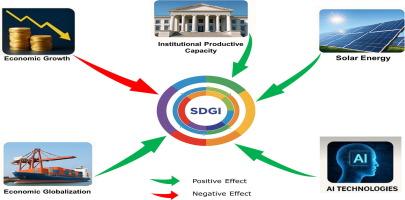
解锁边际可持续发展目标动态:人工智能技术和太阳能的KRLS机器学习分析
量化人工智能对可持续发展目标(sdg)影响的研究往往依赖于不能准确反映人工智能进展的代理。此外,仅仅关注环境和增长指标不能全面反映人工智能对可持续发展目标的总体贡献,因为可持续发展目标框架包含了一系列更广泛的相互关联的目标。因此,本研究通过使用基于核的正则化最小二乘(KRLS)机器学习方法,揭示了2000年至2022年10个最大经济体的人工智能和太阳能(SEN)直接对可持续发展目标指数(SDGI)的边际影响。虽然该研究发现人工智能对可持续发展目标指数的总体平均边际影响为正,表明人工智能技术推动了重大进展,但不同分位数的分析显示了差异。具体而言,在第25分位数,人工智能似乎阻碍了可持续发展目标的进展。这可能是由于人工智能应用带来的负面外部性,比如人工智能在加速不可再生能源生产和资源密集型消费方面的应用,或者是由于各国技术应用能力不足。然而,在更高的分位数(可能代表可持续发展目标取得更好成就和人工智能成熟度更高的国家),人工智能的边际效应变得越来越积极,这表明它在支持可持续发展目标的领域得到了有益的使用。SEN对SDGI的边际效应为正,表明可持续发展目标的成就与太阳能的采用呈正相关。经济全球化(EGB)和制度生产能力(INP)对可持续发展指数的边际效应为正。最后,讨论了促进人工智能和太阳能采用的政策,以及探索人工智能在各个领域的潜在应用,以促进可持续发展。
本文章由计算机程序翻译,如有差异,请以英文原文为准。
求助全文
约1分钟内获得全文
求助全文
来源期刊
Geoscience frontiers
Earth and Planetary Sciences-General Earth and Planetary Sciences
CiteScore
17.80
自引率
3.40%
发文量
147
审稿时长
35 days
期刊介绍:
Geoscience Frontiers (GSF) is the Journal of China University of Geosciences (Beijing) and Peking University. It publishes peer-reviewed research articles and reviews in interdisciplinary fields of Earth and Planetary Sciences. GSF covers various research areas including petrology and geochemistry, lithospheric architecture and mantle dynamics, global tectonics, economic geology and fuel exploration, geophysics, stratigraphy and paleontology, environmental and engineering geology, astrogeology, and the nexus of resources-energy-emissions-climate under Sustainable Development Goals. The journal aims to bridge innovative, provocative, and challenging concepts and models in these fields, providing insights on correlations and evolution.
 求助内容:
求助内容: 应助结果提醒方式:

 京公网安备 11010802042870号


