Priscila de Cássia da Silva, Bruna de Macedo Lima, Camila Sales Nascimento, Anna Carolina Pinheiro Lage, Celso Pinto de Melo, Carlos Eduardo Calzavara-Silva, Érica Alessandra Rocha Alves
{"title":"Therapeutic potential of iron oxide nanoparticles for cutaneous leishmaniasis: a systematic review of <i>in vitro</i> and <i>in viv</i>o studies.","authors":"Priscila de Cássia da Silva, Bruna de Macedo Lima, Camila Sales Nascimento, Anna Carolina Pinheiro Lage, Celso Pinto de Melo, Carlos Eduardo Calzavara-Silva, Érica Alessandra Rocha Alves","doi":"10.1590/1678-9199-JVATITD-2025-0004","DOIUrl":null,"url":null,"abstract":"<p><p>The treatment of cutaneous leishmaniasis (CL) is challenged by limited therapeutic options, high drug toxicity, and frequent treatment failure. In this context, iron oxide nanoparticles (IONPs) have emerged as promising therapeutic alternatives. This review summarizes experimental findings on the <i>in vitro</i> and <i>in vivo</i> anti-<i>Leishmania</i> activity of IONPs, highlighting their potential as a treatment for CL. A systematic search of PubMed, ScienceDirect, and Scopus identified 16 studies evaluating the anti-<i>Leishmania</i> effects of IONPs across various CL models. The studies assessed IONPs' physicochemical properties (size, shape, polydispersity index, and zeta potential), functionalization strategies, and efficacy against axenic and intracellular <i>Leishmania</i> forms, as well as in animal models. Most studies investigated spherical IONPs ranging from 5 to 90 nm, with polydispersity index values between 0.2 and 1.0 and zeta potentials from -13 mV to +35 mV. Functionalization improved dispersion and enabled antimicrobial conjugation. IONPs reduced axenic <i>Leishmania</i> viability, decreased intracellular parasitism, and lowered parasite loads in infected mouse lesions. <i>In vitro</i>, parasite death was linked to lysosomal rupture, oxidative stress, apoptosis, necrosis, and nitric oxide production by macrophages. <i>In vivo</i>, treated animals exhibited reduced parasite burdens, milder lesions, and enhanced IFN-γ production, suggesting improved immune responses. Despite these promising effects, issues such as formulation optimization, biocompatibility, and evaluation of pharmacokinetics and pharmacodynamics remain to be addressed. IONPs represent a novel and promising dual-action therapeutic strategy for CL, combining antiparasitic effects with immune modulation. However, important knowledge gaps persist regarding their mechanisms of action, long-term safety, efficacy across different <i>Leishmania</i> species and clinical scenarios. Further research is needed to advance IONPs as a safe and effective treatment for CL.</p>","PeriodicalId":17565,"journal":{"name":"Journal of Venomous Animals and Toxins Including Tropical Diseases","volume":"31 ","pages":"e20250004"},"PeriodicalIF":2.5000,"publicationDate":"2025-10-03","publicationTypes":"Journal Article","fieldsOfStudy":null,"isOpenAccess":false,"openAccessPdf":"https://www.ncbi.nlm.nih.gov/pmc/articles/PMC12500319/pdf/","citationCount":"0","resultStr":null,"platform":"Semanticscholar","paperid":null,"PeriodicalName":"Journal of Venomous Animals and Toxins Including Tropical Diseases","FirstCategoryId":"3","ListUrlMain":"https://doi.org/10.1590/1678-9199-JVATITD-2025-0004","RegionNum":3,"RegionCategory":"医学","ArticlePicture":[],"TitleCN":null,"AbstractTextCN":null,"PMCID":null,"EPubDate":"2025/1/1 0:00:00","PubModel":"eCollection","JCR":"Q4","JCRName":"TOXICOLOGY","Score":null,"Total":0}
引用次数: 0
Abstract
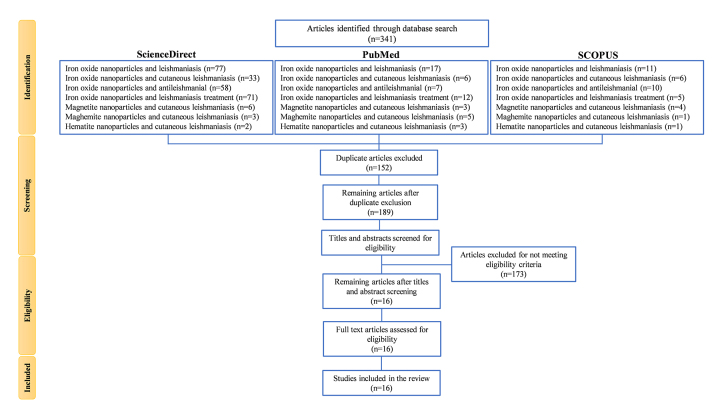
The treatment of cutaneous leishmaniasis (CL) is challenged by limited therapeutic options, high drug toxicity, and frequent treatment failure. In this context, iron oxide nanoparticles (IONPs) have emerged as promising therapeutic alternatives. This review summarizes experimental findings on the in vitro and in vivo anti-Leishmania activity of IONPs, highlighting their potential as a treatment for CL. A systematic search of PubMed, ScienceDirect, and Scopus identified 16 studies evaluating the anti-Leishmania effects of IONPs across various CL models. The studies assessed IONPs' physicochemical properties (size, shape, polydispersity index, and zeta potential), functionalization strategies, and efficacy against axenic and intracellular Leishmania forms, as well as in animal models. Most studies investigated spherical IONPs ranging from 5 to 90 nm, with polydispersity index values between 0.2 and 1.0 and zeta potentials from -13 mV to +35 mV. Functionalization improved dispersion and enabled antimicrobial conjugation. IONPs reduced axenic Leishmania viability, decreased intracellular parasitism, and lowered parasite loads in infected mouse lesions. In vitro, parasite death was linked to lysosomal rupture, oxidative stress, apoptosis, necrosis, and nitric oxide production by macrophages. In vivo, treated animals exhibited reduced parasite burdens, milder lesions, and enhanced IFN-γ production, suggesting improved immune responses. Despite these promising effects, issues such as formulation optimization, biocompatibility, and evaluation of pharmacokinetics and pharmacodynamics remain to be addressed. IONPs represent a novel and promising dual-action therapeutic strategy for CL, combining antiparasitic effects with immune modulation. However, important knowledge gaps persist regarding their mechanisms of action, long-term safety, efficacy across different Leishmania species and clinical scenarios. Further research is needed to advance IONPs as a safe and effective treatment for CL.
期刊介绍:
Journal of Venomous Animals and Toxins including Tropical Diseases (JVATiTD) is a non-commercial academic open access publication dedicated to research on all aspects of toxinology, venomous animals and tropical diseases. Its interdisciplinary content includes original scientific articles covering research on toxins derived from animals, plants and microorganisms. Topics of interest include, but are not limited to:systematics and morphology of venomous animals;physiology, biochemistry, pharmacology and immunology of toxins;epidemiology, clinical aspects and treatment of envenoming by different animals, plants and microorganisms;development and evaluation of antivenoms and toxin-derivative products;epidemiology, clinical aspects and treatment of tropical diseases (caused by virus, bacteria, algae, fungi and parasites) including the neglected tropical diseases (NTDs) defined by the World Health Organization.



 求助内容:
求助内容: 应助结果提醒方式:

 京公网安备 11010802042870号


