
Strategies to address non-proportional hazards between survival curves - Lessons from phase III trials in hepatocellular carcinoma
IF 33
1区 医学
Q1 GASTROENTEROLOGY & HEPATOLOGY
引用次数: 0
Abstract
Background & Aims
Non-proportional hazards (NPH) can lead to discrepancies between interim (IA) and final analyses (FA) in randomized controlled trials (RCTs) of hepatocellular carcinoma (HCC). We assessed the impact of NPH in pivotal HCC trials and proposed strategies for more robust analyses.
Methods
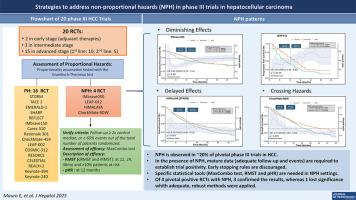
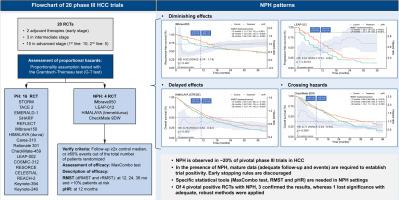
Phase III pivotal HCC RCTs (2008–2024) were reviewed. Proportional hazards were tested using the Grambsch-Therneau method. For trials with NPH, we proposed an optimal IA timing (twice the estimated median of the primary endpoint in the control arm) or a minimum event threshold (≥60%). In NPH scenarios, the MaxCombo test, restricted mean survival time (rRMST), and piecewise hazard ratios were applied.
Results
NPH was present in 4/20 (20%) phase III trials in HCC, all involving immunotherapies, and displayed three patterns: 1) diminishing effects, 2) delayed effects, and 3) crossing hazards. Two RCTs (IMbrave050, LEAP-012) reported positive IA results with diminishing effects. In IMbrave050, discrepancies were observed when comparing IA and FA using MaxCombo analysis (p = 0.02 and p = 0.33, respectively), rRMST at 12 and 36 months (1.11 [p <0.001] and 1.08 [p = 0.08], respectively) and piecewise hazard ratios before vs. after 12 months (0.59 [95% CI 0.43-0.73] vs. 1.12 [95% CI 0.88-1.37]). In LEAP-012, results were consistent across 12 and 24 months (MaxCombo test p <0.001) and rRMST (1.20 [p <0.001) and 1.27 [p <0.001]). HIMALAYA and Checkmate 9DW reported positive results, which were confirmed by MaxCombo test. HIMALAYA showed delayed effects (rRMST at 12 and 36 months: 1.04 [p = 0.13] and 1.15 [p = 0.004]), while CheckMate 9DW displayed crossing hazards (rRMST at 12 and 36 months: 0.95 [p = 0.07] and 1.12 [p = 0.03]).
Conclusion
NPH contributed to discrepancies between IA and FA in IMbrave050. Robust IA require a minimum follow-up duration or event count before prematurely stopping RCTs in the presence of NPH.
Impact and implications
Non-proportional hazards (NPH) impact phase III randomized controlled trials in hepatocellular carcinoma, particularly in immunotherapy trials, potentially causing discrepancies between the interim and final analyses. In fact, halting trials at the interim analysis can be premature when NPH is present. Thus, we propose a framework to ensure study maturity based on follow-up duration and event accruals to optimize interim analyses in the presence of NPH. Whenever NPH is identified, distinct statistical tools should be used to assess reliable differences between arms (MaxCombo) and to assess the effect size (restricted mean survival time and piecewise hazard ratios) for regulatory decisions and clinical guidance. Implementing these strategies can improve trial design, and better support clinical decision-making.
解决生存曲线之间非比例风险的策略——来自肝细胞癌III期试验的经验教训
在肝细胞癌(HCC)的随机临床试验(RCT)中,非比例风险(NPH)可能导致中期(IA)和最终分析(FA)之间的差异。我们分析了NPH在关键HCC试验中的影响,并提出了可靠分析的策略。方法选择2008-2024年肝细胞癌III期肝细胞癌随机对照试验。Grambsch-Therneau测试评估了比例风险。对于NPH,我们提出了最佳IA时间(对照组主要终点估计中位数的两倍)或事件大小(≥60%)。在NPH情况下,采用MaxCombo试验,限制平均生存时间(rRMST)和分段HR (pHR)。结果在4/20(20%)涉及免疫治疗的HCC III期试验中,snph均存在,并表现出3种模式:1)递减效应,2)延迟效应,3)交叉危害。两项随机对照试验(IMbrave050, LEAP-012)报告了阳性IA结果,但影响逐渐减弱。在IMbrave050中,使用MaxCombo分析比较IA和FA(分别为p=0.02和p=0.33), 12个月和36个月的rRMST[分别为1.11 (p= 0.001)和1.08 (p=0.08)]和12个月前/后的pHR [0.59 (95%CI 0.43-0.73)和1.12 (95%CI 0.88-1.37)]时观察到差异。在LEAP-012中,观察到12个月和24个月的结果一致(MaxCombo测试p<;0.001)和rRMST [1.20 (p<0.001)和1.27 (p<0.001)]。喜玛拉雅和Checkmate 9DW报告阳性结果,MaxCombo测试证实了这一点。喜马拉雅表现出延迟效应[12和36个月时的rRMST: 1.04 (p=0.13)和1.15 (p=0.004)],而CheckMate 9DW表现出交叉危险[12和36个月时的rRMST: 0.95 (p=0.07)和1.12 (p=0.03)]。结论nph引起了IMbrave050中期和后期疗效分析的差异。在过早停止NPH的RCT之前,稳健的IA需要最小的随访时间或事件数。影响和意义非比例风险(NPH)影响肝细胞癌(HCC)的III期随机对照试验,特别是免疫治疗试验,可能导致中期和最终分析之间的差异。事实上,当NPH存在时,在中期分析时停止试验可能为时过早。因此,我们提出了一个基于随访时间和事件应计额来确保研究成熟度的框架,以优化NPH存在时的中期分析。每当确定NPH时,应使用不同的统计工具来评估各组之间的可靠差异(MaxCombo),并评估效应大小[限制平均生存时间(RMST)和分段风险比(pHR)],以进行监管决策和临床指导。实施这些策略可以改进试验设计,更好地支持HCC管理决策。
本文章由计算机程序翻译,如有差异,请以英文原文为准。
求助全文
约1分钟内获得全文
求助全文
来源期刊
Journal of Hepatology
医学-胃肠肝病学
CiteScore
46.10
自引率
4.30%
发文量
2325
审稿时长
30 days
期刊介绍:
The Journal of Hepatology is the official publication of the European Association for the Study of the Liver (EASL). It is dedicated to presenting clinical and basic research in the field of hepatology through original papers, reviews, case reports, and letters to the Editor. The Journal is published in English and may consider supplements that pass an editorial review.
 求助内容:
求助内容: 应助结果提醒方式:

 京公网安备 11010802042870号


