{"title":"Prevalence of posttraumatic stress symptoms among physicians - A meta-analysis.","authors":"Jana Reinhardt, Katja Linde, Anette Kersting","doi":"10.1192/j.eurpsy.2025.10084","DOIUrl":null,"url":null,"abstract":"<p><strong>Background: </strong>The medical profession is associated with high demands and occupational stressors - including confrontation with illness and death, extended work hours, and high workload - which may increase the risk of traumatization and posttraumatic stress disorder (PTSD). This systematic review aimed to synthesize evidence on prevalence of PTSD among physicians and examine potential moderators, including the COVID-19 pandemic, specialties, and geographic regions.</p><p><strong>Methods: </strong>A systematic search was conducted in PubMed, Web of Science, PsychINFO, and PubPsych up to April 2025. Included studies were English-language, peer-reviewed, observational studies, reporting PTSD prevalence in physicians, using validated instruments. Studies focusing on preselected PTSD cases or mixed healthcare samples were excluded. Data extraction included study methodology, measurement tools, geographic region, specialty, and survey timing (pre-/\"post\"-COVID). Risk of bias was assessed using the <i>JBI critical appraisal checklist for prevalence studies.</i> Quantitative synthesis and moderator analyses were performed. The review was registered with PROSPERO (ID CRD42023401984).</p><p><strong>Results: </strong>Based on 81 studies (<i>N</i> = 41,051), the pooled PTSD prevalence using a random-effects model was 14.9% (95% CI [0.132-0.168]). Prevalence estimates were lower in high-income (13.6%) compared to middle-income countries (21.1%) (<i>p</i> < 0.036). Studies employing brief screening tools (≤10 items) yielded significantly lower prevalence estimates (10.2%) than those using longer instruments (16.4%) (<i>p</i> < 0.027). No other significant moderators were identified.</p><p><strong>Conclusion: </strong>PTSD prevalence among physicians is elevated relative to the general population, with notable variation across regions and measurement approaches. Future research should address gaps in representativeness and geographic coverage to improve prevalence estimates and guide prevention strategies.</p>","PeriodicalId":520621,"journal":{"name":"European psychiatry : the journal of the Association of European Psychiatrists","volume":"68 1","pages":"e132"},"PeriodicalIF":6.7000,"publicationDate":"2025-09-19","publicationTypes":"Journal Article","fieldsOfStudy":null,"isOpenAccess":false,"openAccessPdf":"https://www.ncbi.nlm.nih.gov/pmc/articles/PMC12538191/pdf/","citationCount":"0","resultStr":null,"platform":"Semanticscholar","paperid":null,"PeriodicalName":"European psychiatry : the journal of the Association of European Psychiatrists","FirstCategoryId":"1085","ListUrlMain":"https://doi.org/10.1192/j.eurpsy.2025.10084","RegionNum":0,"RegionCategory":null,"ArticlePicture":[],"TitleCN":null,"AbstractTextCN":null,"PMCID":null,"EPubDate":"","PubModel":"","JCR":"","JCRName":"","Score":null,"Total":0}
引用次数: 0
Abstract
Background: The medical profession is associated with high demands and occupational stressors - including confrontation with illness and death, extended work hours, and high workload - which may increase the risk of traumatization and posttraumatic stress disorder (PTSD). This systematic review aimed to synthesize evidence on prevalence of PTSD among physicians and examine potential moderators, including the COVID-19 pandemic, specialties, and geographic regions.
Methods: A systematic search was conducted in PubMed, Web of Science, PsychINFO, and PubPsych up to April 2025. Included studies were English-language, peer-reviewed, observational studies, reporting PTSD prevalence in physicians, using validated instruments. Studies focusing on preselected PTSD cases or mixed healthcare samples were excluded. Data extraction included study methodology, measurement tools, geographic region, specialty, and survey timing (pre-/"post"-COVID). Risk of bias was assessed using the JBI critical appraisal checklist for prevalence studies. Quantitative synthesis and moderator analyses were performed. The review was registered with PROSPERO (ID CRD42023401984).
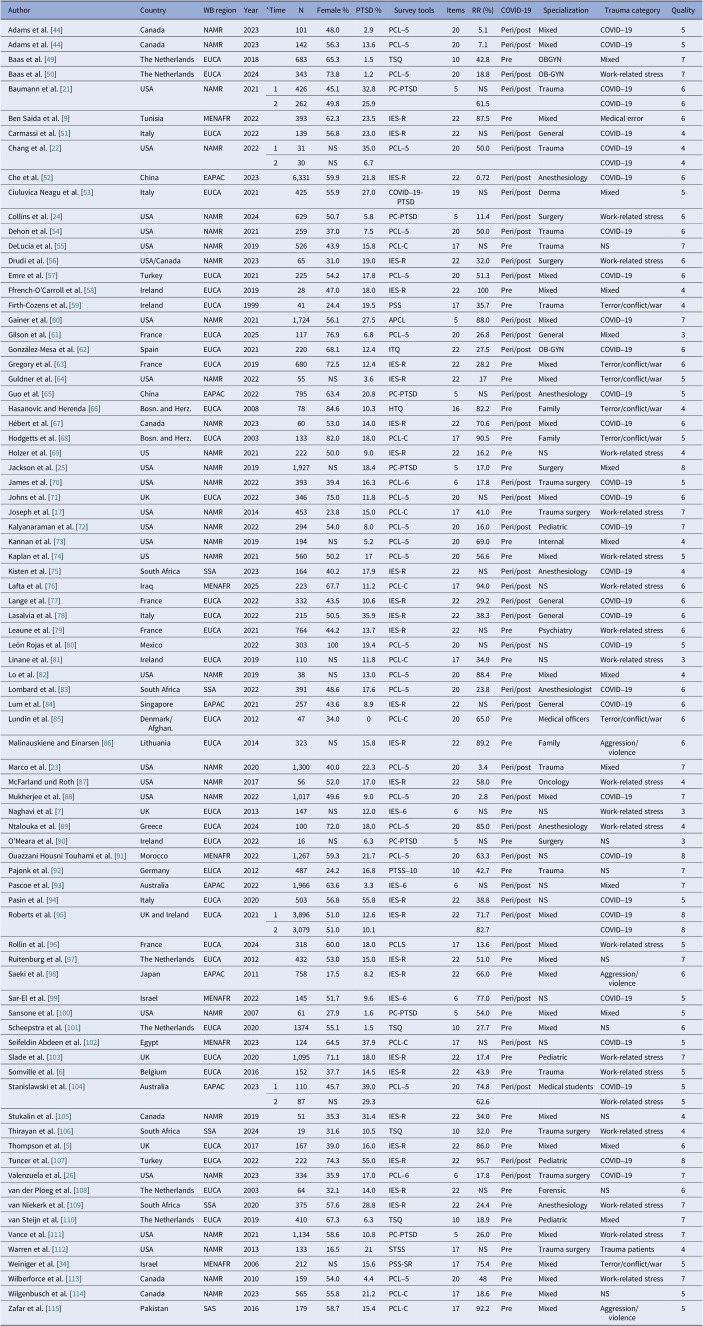
Results: Based on 81 studies (N = 41,051), the pooled PTSD prevalence using a random-effects model was 14.9% (95% CI [0.132-0.168]). Prevalence estimates were lower in high-income (13.6%) compared to middle-income countries (21.1%) (p < 0.036). Studies employing brief screening tools (≤10 items) yielded significantly lower prevalence estimates (10.2%) than those using longer instruments (16.4%) (p < 0.027). No other significant moderators were identified.
Conclusion: PTSD prevalence among physicians is elevated relative to the general population, with notable variation across regions and measurement approaches. Future research should address gaps in representativeness and geographic coverage to improve prevalence estimates and guide prevention strategies.




 求助内容:
求助内容: 应助结果提醒方式:

 京公网安备 11010802042870号


