Katharina Thiel, Kira Flinkenflügel, Dominik Grotegerd, Christoph Jurischka, Julia Hubbert, Tim Hahn, Elisabeth J Leehr, Hannah Meinert, Elisabeth Schrammen, Florian Thomas-Odenthal, Paula Usemann, Lea Teutenberg, Benjamin Straube, Nina Alexander, Hamidreza Jamalabadi, Andreas Jansen, Frederike Stein, Michael Bauer, Andrea Pfennig, Eva Mennigen, Philipp Kanske, Katharina Förster, Igor Nenadić, Tilo Kircher, Susanne Meinert, Udo Dannlowski
{"title":"Disease progression in bipolar disorder in relation to white matter microstructure: A comprehensive approach based on staging models.","authors":"Katharina Thiel, Kira Flinkenflügel, Dominik Grotegerd, Christoph Jurischka, Julia Hubbert, Tim Hahn, Elisabeth J Leehr, Hannah Meinert, Elisabeth Schrammen, Florian Thomas-Odenthal, Paula Usemann, Lea Teutenberg, Benjamin Straube, Nina Alexander, Hamidreza Jamalabadi, Andreas Jansen, Frederike Stein, Michael Bauer, Andrea Pfennig, Eva Mennigen, Philipp Kanske, Katharina Förster, Igor Nenadić, Tilo Kircher, Susanne Meinert, Udo Dannlowski","doi":"10.1192/j.eurpsy.2025.10105","DOIUrl":null,"url":null,"abstract":"<p><strong>Background: </strong>Bipolar disorder (BD) is assumed to follow a progressive course, conceptualized through staging models. It is unclear whether white matter (WM) microstructure abnormalities, central to BD pathophysiology, parallel this development throughout disease progression. This study explored the link between WM and disease progression in BD, using a comprehensive approach based on clinical staging models.</p><p><strong>Methods: </strong>This cross-sectional diffusion tensor-imaging study included 153 BD patients and 153 healthy controls (HCs) matched for age, sex, and study site. Using tract-based spatial statistics (TBSS), we examined associations between WM integrity and three criteria: (1) number of manic episodes, (2) remission quality between episodes, and (3) inter-episode global functioning.</p><p><strong>Results: </strong>Analyses revealed significant fractional anisotropy (FA) differences between early and late stages of BD based on the number of manic episodes (<i>p</i><sub>tfce-FWE</sub> = 0.003), but not on remission quality (<i>p</i><sub>tfce-FWE</sub> = 0.075). However, compared to HC, BD patients with persistent symptoms between episodes showed more widespread FA differences (<i>p</i><sub>tfce-FWE</sub> < 0.001) than those with stable remission (<i>p</i><sub>tfce-FWE</sub> = 0.031). Regression analyses indicated a positive association between global functioning and FA in euthymic BD patients (<i>p<sub>tfce-FWE</sub></i> < 0.001).</p><p><strong>Conclusions: </strong>Results indicated more severe WM disruptions in patients at advanced stages compared to earlier stages of the disease. While these findings may imply changes occurring with disease progression, the cross-sectional design cannot rule out that they instead reflect stable clinical subtypes of varying severity. The results highlight the clinical relevance of WM alterations and the need for longitudinal studies to better understand the neurobiology and complexity of BD.</p>","PeriodicalId":520621,"journal":{"name":"European psychiatry : the journal of the Association of European Psychiatrists","volume":" ","pages":"e148"},"PeriodicalIF":6.7000,"publicationDate":"2025-09-15","publicationTypes":"Journal Article","fieldsOfStudy":null,"isOpenAccess":false,"openAccessPdf":"https://www.ncbi.nlm.nih.gov/pmc/articles/PMC12538178/pdf/","citationCount":"0","resultStr":null,"platform":"Semanticscholar","paperid":null,"PeriodicalName":"European psychiatry : the journal of the Association of European Psychiatrists","FirstCategoryId":"1085","ListUrlMain":"https://doi.org/10.1192/j.eurpsy.2025.10105","RegionNum":0,"RegionCategory":null,"ArticlePicture":[],"TitleCN":null,"AbstractTextCN":null,"PMCID":null,"EPubDate":"","PubModel":"","JCR":"","JCRName":"","Score":null,"Total":0}
引用次数: 0
Abstract
Background: Bipolar disorder (BD) is assumed to follow a progressive course, conceptualized through staging models. It is unclear whether white matter (WM) microstructure abnormalities, central to BD pathophysiology, parallel this development throughout disease progression. This study explored the link between WM and disease progression in BD, using a comprehensive approach based on clinical staging models.
Methods: This cross-sectional diffusion tensor-imaging study included 153 BD patients and 153 healthy controls (HCs) matched for age, sex, and study site. Using tract-based spatial statistics (TBSS), we examined associations between WM integrity and three criteria: (1) number of manic episodes, (2) remission quality between episodes, and (3) inter-episode global functioning.
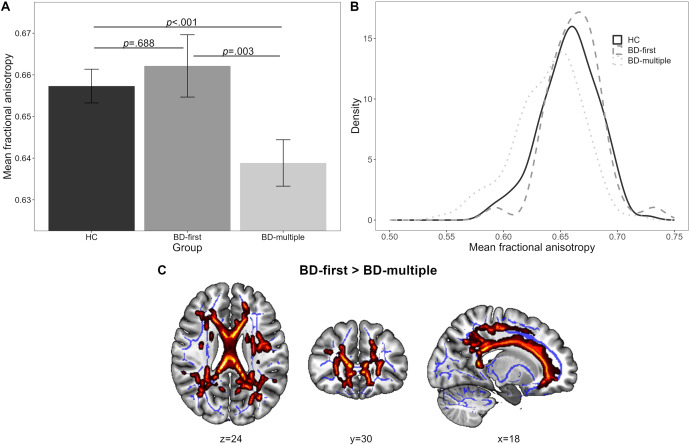
Results: Analyses revealed significant fractional anisotropy (FA) differences between early and late stages of BD based on the number of manic episodes (ptfce-FWE = 0.003), but not on remission quality (ptfce-FWE = 0.075). However, compared to HC, BD patients with persistent symptoms between episodes showed more widespread FA differences (ptfce-FWE < 0.001) than those with stable remission (ptfce-FWE = 0.031). Regression analyses indicated a positive association between global functioning and FA in euthymic BD patients (ptfce-FWE < 0.001).
Conclusions: Results indicated more severe WM disruptions in patients at advanced stages compared to earlier stages of the disease. While these findings may imply changes occurring with disease progression, the cross-sectional design cannot rule out that they instead reflect stable clinical subtypes of varying severity. The results highlight the clinical relevance of WM alterations and the need for longitudinal studies to better understand the neurobiology and complexity of BD.




 求助内容:
求助内容: 应助结果提醒方式:

 京公网安备 11010802042870号


