Long-lasting effects on cognition and mental health in patients with post COVID-19 condition following a mild SARS-CoV-2 infection: A longitudinal case-control study.
Goran Papenberg, Marika C Möller, Gabriela Markovic, Kristian Borg, Jonas Stenberg, Stina Hedström, Frida Smids, Emil Norrman, Andrea Aejmelaeus-Lindström, Grégoria Kalpouzos, Erika J Laukka
{"title":"Long-lasting effects on cognition and mental health in patients with post COVID-19 condition following a mild SARS-CoV-2 infection: A longitudinal case-control study.","authors":"Goran Papenberg, Marika C Möller, Gabriela Markovic, Kristian Borg, Jonas Stenberg, Stina Hedström, Frida Smids, Emil Norrman, Andrea Aejmelaeus-Lindström, Grégoria Kalpouzos, Erika J Laukka","doi":"10.1192/j.eurpsy.2025.10108","DOIUrl":null,"url":null,"abstract":"<p><strong>Background: </strong>The prevalence of prolonged symptoms following a severe acute respiratory syndrome coronavirus 2 (SARS-CoV-2) infection represents a significant health challenge with potentially severe individual and societal costs. Our study investigates the long-term cognitive and mental health consequences associated with post-coronavirus disease 2019 (COVID-19) condition (PCC) following a mild SARS-CoV-2 infection.</p><p><strong>Methods: </strong>We conducted longitudinal assessments of cognitive performance and mental health in 50 post-COVID-19 patients and 48 matched healthy controls across 10 months, starting on average 2 years after infection. Cognitive function was evaluated using a comprehensive neuropsychological battery of standardized tests, while mental health was assessed via self-reported questionnaires. Data were analyzed with linear mixed models.</p><p><strong>Results: </strong>Initial group differences in cognitive performance were observed for memory, executive functioning, and perceptual speed, with worse performance in patients. Improvement across the follow-up period occurred for most tasks, with PCC patients displaying greater improvement compared to healthy controls for some memory and executive function tasks, reaching performance levels of the control group. Fatigue and mental health measures remained elevated in the patient group, with worsening in general fatigue and a small improvement in fatigue after cognitive testing. Factors such as male sex, absence of burnout history, and lower depression scores at baseline predicted cognitive recovery in the patient group.</p><p><strong>Conclusions: </strong>Our study underscores the importance of addressing cognitive and psychological effects following mild SARS-CoV-2 infection, as persistent fatigue, low mental health, and cognitive impairments significantly impact individuals' ability to return to their pre-COVID professional and personal lives.</p>","PeriodicalId":520621,"journal":{"name":"European psychiatry : the journal of the Association of European Psychiatrists","volume":" ","pages":"e141"},"PeriodicalIF":6.7000,"publicationDate":"2025-09-12","publicationTypes":"Journal Article","fieldsOfStudy":null,"isOpenAccess":false,"openAccessPdf":"https://www.ncbi.nlm.nih.gov/pmc/articles/PMC12538188/pdf/","citationCount":"0","resultStr":null,"platform":"Semanticscholar","paperid":null,"PeriodicalName":"European psychiatry : the journal of the Association of European Psychiatrists","FirstCategoryId":"1085","ListUrlMain":"https://doi.org/10.1192/j.eurpsy.2025.10108","RegionNum":0,"RegionCategory":null,"ArticlePicture":[],"TitleCN":null,"AbstractTextCN":null,"PMCID":null,"EPubDate":"","PubModel":"","JCR":"","JCRName":"","Score":null,"Total":0}
引用次数: 0
Abstract
Background: The prevalence of prolonged symptoms following a severe acute respiratory syndrome coronavirus 2 (SARS-CoV-2) infection represents a significant health challenge with potentially severe individual and societal costs. Our study investigates the long-term cognitive and mental health consequences associated with post-coronavirus disease 2019 (COVID-19) condition (PCC) following a mild SARS-CoV-2 infection.
Methods: We conducted longitudinal assessments of cognitive performance and mental health in 50 post-COVID-19 patients and 48 matched healthy controls across 10 months, starting on average 2 years after infection. Cognitive function was evaluated using a comprehensive neuropsychological battery of standardized tests, while mental health was assessed via self-reported questionnaires. Data were analyzed with linear mixed models.
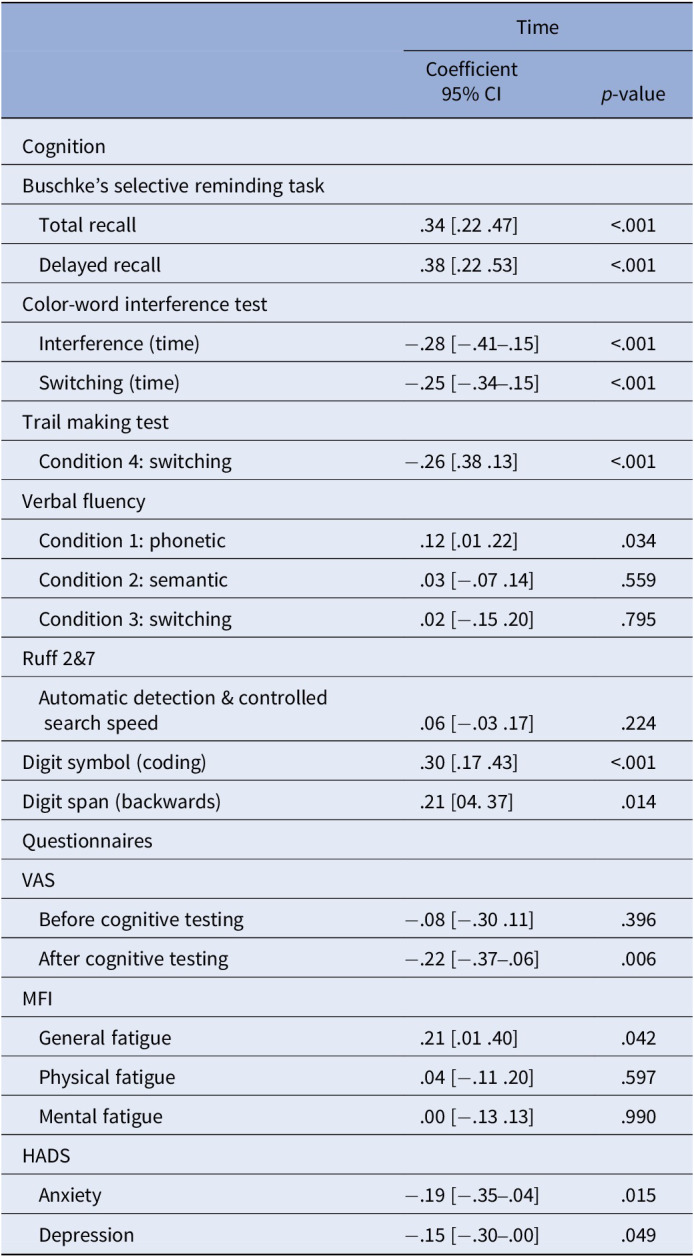
Results: Initial group differences in cognitive performance were observed for memory, executive functioning, and perceptual speed, with worse performance in patients. Improvement across the follow-up period occurred for most tasks, with PCC patients displaying greater improvement compared to healthy controls for some memory and executive function tasks, reaching performance levels of the control group. Fatigue and mental health measures remained elevated in the patient group, with worsening in general fatigue and a small improvement in fatigue after cognitive testing. Factors such as male sex, absence of burnout history, and lower depression scores at baseline predicted cognitive recovery in the patient group.
Conclusions: Our study underscores the importance of addressing cognitive and psychological effects following mild SARS-CoV-2 infection, as persistent fatigue, low mental health, and cognitive impairments significantly impact individuals' ability to return to their pre-COVID professional and personal lives.




 求助内容:
求助内容: 应助结果提醒方式:

 京公网安备 11010802042870号


