{"title":"Diagnostic Value of Serum miR-17-5p in Type 2 Diabetes Mellitus and Its Predictive Value for Chronic Complications.","authors":"Ping Gu, Dan Yu, Yu Zhang, Xiaoying Chai","doi":"10.2147/DMSO.S542183","DOIUrl":null,"url":null,"abstract":"<p><strong>Purpose: </strong>This study aims to explore the clinical significance of miR-17-5p in T2DM and its chronic complications.</p><p><strong>Patients and methods: </strong>A total of 100 patients with T2DM and 90 healthy controls were included. The expression of miR-17-5p was detected by reverse transcription-polymerase chain reaction. A receiver operating characteristic curve was plotted to evaluate the diagnostic value of miR-17-5p for T2DM. Pearson correlation analysis was used to explore the correlation between miR-17-5p and blood glucose indicators in T2DM patients. The Kaplan-Meier curve and multivariate Cox regression analysis were employed to analyze the factors influencing chronic complications. Liposome-mediated transfection technology was used to transfect miR-17-5p mimics and inhibitors into endothelial progenitor cells (EPCs) respectively, to achieve overexpression and knockdown of miR-17-5p in cells. On this basis, we further investigate the potential molecular mechanism by which miR-17-5p is involved in the occurrence and development of chronic complications inT2DM.</p><p><strong>Results: </strong>Serum miR-17-5p was significantly downregulated in T2DM patients (vs healthy controls, P<0.001). The AUC for distinguishing T2DM patients from healthy individuals was 0.932. The expression of this miRNA was significantly negatively correlated with FBG (r=-0.718) and HbA1c (r=-0.695) (P<0.001). Follow-up showed that low expression of miR-17-5p was closely associated with T2DM chronic complications (complication group vs non-complication group, P<0.001), with an AUC of 0.866 for distinguishing the presence from the absence of complications. Kaplan-Meier analysis indicated that individuals with low miR-17-5p expression had a higher risk of complications (Log-rank P=0.009). Mechanistically, miR-17-5p targets FBXO48 and affects the functions of EPCs.</p><p><strong>Conclusion: </strong>The expression of miR-17-5p is reduced in T2DM. It influences the functions of EPCs by targeting <i>FBXO48</i>, and may be involved in the occurrence and development of chronic complications of T2DM.</p>","PeriodicalId":11116,"journal":{"name":"Diabetes, Metabolic Syndrome and Obesity: Targets and Therapy","volume":"18 ","pages":"3237-3247"},"PeriodicalIF":3.0000,"publicationDate":"2025-09-04","publicationTypes":"Journal Article","fieldsOfStudy":null,"isOpenAccess":false,"openAccessPdf":"https://www.ncbi.nlm.nih.gov/pmc/articles/PMC12417209/pdf/","citationCount":"0","resultStr":null,"platform":"Semanticscholar","paperid":null,"PeriodicalName":"Diabetes, Metabolic Syndrome and Obesity: Targets and Therapy","FirstCategoryId":"3","ListUrlMain":"https://doi.org/10.2147/DMSO.S542183","RegionNum":3,"RegionCategory":"医学","ArticlePicture":[],"TitleCN":null,"AbstractTextCN":null,"PMCID":null,"EPubDate":"2025/1/1 0:00:00","PubModel":"eCollection","JCR":"Q3","JCRName":"ENDOCRINOLOGY & METABOLISM","Score":null,"Total":0}
引用次数: 0
Abstract
Purpose: This study aims to explore the clinical significance of miR-17-5p in T2DM and its chronic complications.
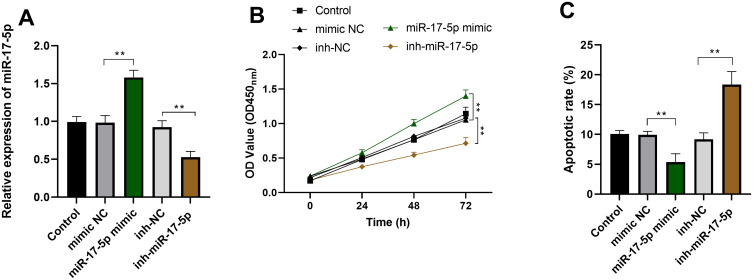
Patients and methods: A total of 100 patients with T2DM and 90 healthy controls were included. The expression of miR-17-5p was detected by reverse transcription-polymerase chain reaction. A receiver operating characteristic curve was plotted to evaluate the diagnostic value of miR-17-5p for T2DM. Pearson correlation analysis was used to explore the correlation between miR-17-5p and blood glucose indicators in T2DM patients. The Kaplan-Meier curve and multivariate Cox regression analysis were employed to analyze the factors influencing chronic complications. Liposome-mediated transfection technology was used to transfect miR-17-5p mimics and inhibitors into endothelial progenitor cells (EPCs) respectively, to achieve overexpression and knockdown of miR-17-5p in cells. On this basis, we further investigate the potential molecular mechanism by which miR-17-5p is involved in the occurrence and development of chronic complications inT2DM.
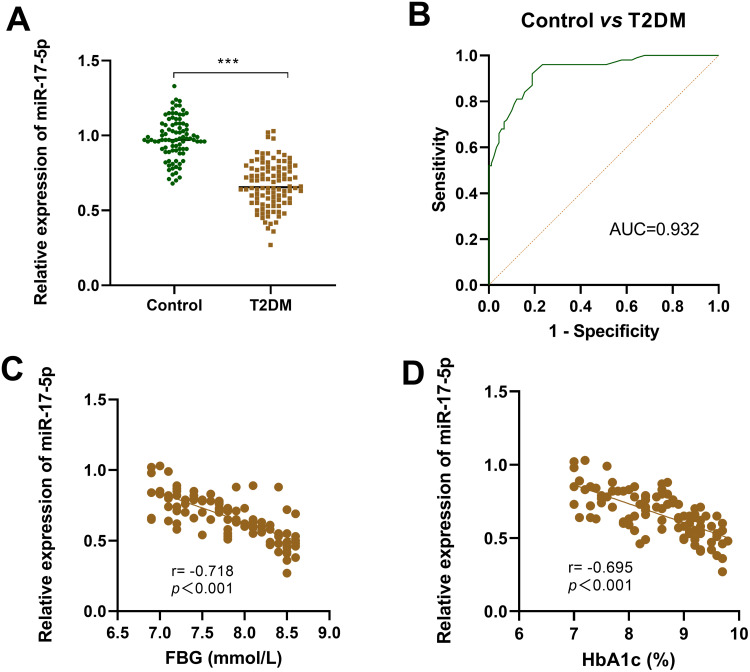
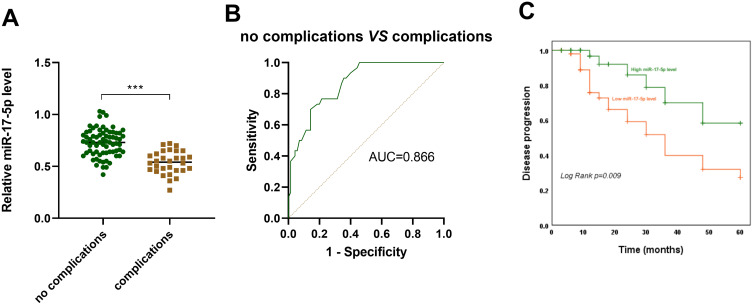
Results: Serum miR-17-5p was significantly downregulated in T2DM patients (vs healthy controls, P<0.001). The AUC for distinguishing T2DM patients from healthy individuals was 0.932. The expression of this miRNA was significantly negatively correlated with FBG (r=-0.718) and HbA1c (r=-0.695) (P<0.001). Follow-up showed that low expression of miR-17-5p was closely associated with T2DM chronic complications (complication group vs non-complication group, P<0.001), with an AUC of 0.866 for distinguishing the presence from the absence of complications. Kaplan-Meier analysis indicated that individuals with low miR-17-5p expression had a higher risk of complications (Log-rank P=0.009). Mechanistically, miR-17-5p targets FBXO48 and affects the functions of EPCs.
Conclusion: The expression of miR-17-5p is reduced in T2DM. It influences the functions of EPCs by targeting FBXO48, and may be involved in the occurrence and development of chronic complications of T2DM.
期刊介绍:
An international, peer-reviewed, open access, online journal. The journal is committed to the rapid publication of the latest laboratory and clinical findings in the fields of diabetes, metabolic syndrome and obesity research. Original research, review, case reports, hypothesis formation, expert opinion and commentaries are all considered for publication.


 求助内容:
求助内容: 应助结果提醒方式:

 京公网安备 11010802042870号

