Min-I Su, Chia-Ying Hsiao, Jui-Chu Ma, Che-Ming Chang
{"title":"Code Status Transitions of Patients with Aneurysmal Subarachnoid Hemorrhage in the Intensive Care Unit.","authors":"Min-I Su, Chia-Ying Hsiao, Jui-Chu Ma, Che-Ming Chang","doi":"10.1089/pmr.2025.0015","DOIUrl":null,"url":null,"abstract":"<p><strong>Background: </strong>Aneurysmal subarachnoid hemorrhage (aSAH) carries high mortality rates and often requires critical family decisions about code status when complications occur. The American Heart Association provides treatment guidelines but acknowledges a significant knowledge gap regarding do-not-resuscitate or do-not-intubate (DNR/DNI) decisions in patients with aSAH, challenging clinicians in identifying appropriate timing for these discussions.</p><p><strong>Aim: </strong>To identify demographic and clinical physiological factors associated with code status transition in adults with aSAH admitted to the intensive care unit, supporting value-based decision making through more informed and timely discussions between health care providers and families that align with patients' core values and preferences.</p><p><strong>Methods: </strong>Retrospective cohort study analyzing Medical Information Mart for Intensive Care IV database (2008-2022) data from 731 patients with aSAH. Researchers collected demographics, vital signs, laboratory tests, disease severity scores, and code status transition, performing univariate and multivariate Cox regression analyses to identify significant predictors.</p><p><strong>Results: </strong>Among patients initially with full-code status, 25.8% transitioned to DNR/DNI during hospitalization. Multivariate analysis identified four independent predictors: advanced age (hazard ratio [HR] = 1.024), lower mean blood pressure (HR = 0.987), higher simplified acute physiology score II (SAPS II) score (HR = 1.018, each one-point increase raises transition risk by 1.8%), and hospice services (HR = 6.951). Patients with code status limitations received less invasive therapy, more hospice services, and had higher mortality rates.</p><p><strong>Conclusion: </strong>Age, blood pressure, SAPS II, and hospice services predict code status transitions in patients with aSAH. Identifying high-risk patients enables timely code status discussions, ensuring treatment aligns with patient values and improving family decision making during critical situations.</p>","PeriodicalId":74394,"journal":{"name":"Palliative medicine reports","volume":"6 1","pages":"324-332"},"PeriodicalIF":1.3000,"publicationDate":"2025-06-04","publicationTypes":"Journal Article","fieldsOfStudy":null,"isOpenAccess":false,"openAccessPdf":"https://www.ncbi.nlm.nih.gov/pmc/articles/PMC12410325/pdf/","citationCount":"0","resultStr":null,"platform":"Semanticscholar","paperid":null,"PeriodicalName":"Palliative medicine reports","FirstCategoryId":"1085","ListUrlMain":"https://doi.org/10.1089/pmr.2025.0015","RegionNum":0,"RegionCategory":null,"ArticlePicture":[],"TitleCN":null,"AbstractTextCN":null,"PMCID":null,"EPubDate":"2025/1/1 0:00:00","PubModel":"eCollection","JCR":"Q4","JCRName":"HEALTH CARE SCIENCES & SERVICES","Score":null,"Total":0}
引用次数: 0
Abstract
Background: Aneurysmal subarachnoid hemorrhage (aSAH) carries high mortality rates and often requires critical family decisions about code status when complications occur. The American Heart Association provides treatment guidelines but acknowledges a significant knowledge gap regarding do-not-resuscitate or do-not-intubate (DNR/DNI) decisions in patients with aSAH, challenging clinicians in identifying appropriate timing for these discussions.
Aim: To identify demographic and clinical physiological factors associated with code status transition in adults with aSAH admitted to the intensive care unit, supporting value-based decision making through more informed and timely discussions between health care providers and families that align with patients' core values and preferences.
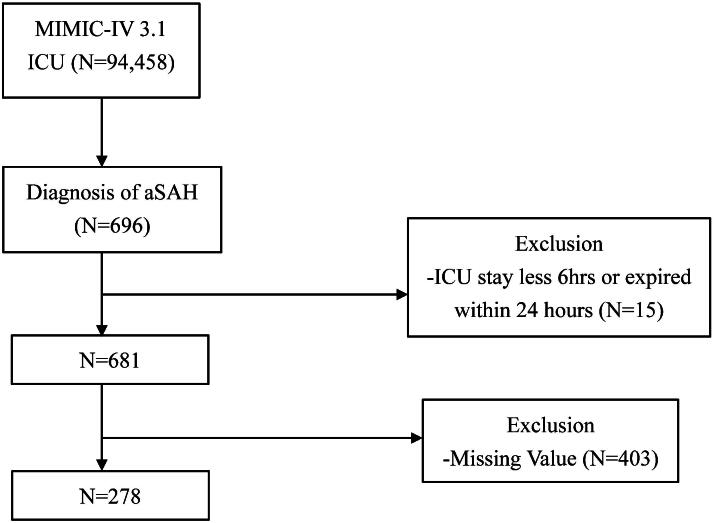
Methods: Retrospective cohort study analyzing Medical Information Mart for Intensive Care IV database (2008-2022) data from 731 patients with aSAH. Researchers collected demographics, vital signs, laboratory tests, disease severity scores, and code status transition, performing univariate and multivariate Cox regression analyses to identify significant predictors.
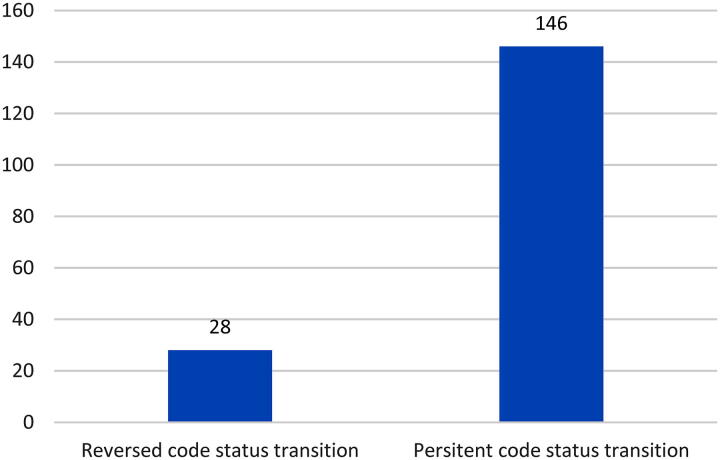
Results: Among patients initially with full-code status, 25.8% transitioned to DNR/DNI during hospitalization. Multivariate analysis identified four independent predictors: advanced age (hazard ratio [HR] = 1.024), lower mean blood pressure (HR = 0.987), higher simplified acute physiology score II (SAPS II) score (HR = 1.018, each one-point increase raises transition risk by 1.8%), and hospice services (HR = 6.951). Patients with code status limitations received less invasive therapy, more hospice services, and had higher mortality rates.
Conclusion: Age, blood pressure, SAPS II, and hospice services predict code status transitions in patients with aSAH. Identifying high-risk patients enables timely code status discussions, ensuring treatment aligns with patient values and improving family decision making during critical situations.


 求助内容:
求助内容: 应助结果提醒方式:

 京公网安备 11010802042870号


