{"title":"Mechanochemistry of phosphate esters with external electric fields†","authors":"Zhaoran Zhu and James P. Ewen","doi":"10.1039/D5MR00064E","DOIUrl":null,"url":null,"abstract":"<p >The growth of tribofilms from the mechanochemical decomposition of lubricant additives is crucial to prevent wear of sliding metal surfaces. For some applications, such as electric vehicles and wind turbines, lubricants can be exposed to electric fields, which may affect tribofilm growth. Experimental tribometer results have shown conflicting results regarding antiwear tribofilm growth and wear under external electric potentials. Moreover, the effect of electric fields on the mechanochemical decomposition of lubricant additives remains unclear. Here, we use nonequilibrium molecular dynamics (NEMD) simulations to study the mechanochemical growth of a polyphosphate tribofilm from trialkyl phosphate molecules under external electrostatic fields. The decomposition rate of phosphate esters increases exponentially with the applied stress and temperature. The electric field generally accelerates the molecular decomposition, both by enhancing the interfacial stress and reducing the steric hindrance for nucleophilic substitution. The Bell model is used to analyse the electro-, mechano- and temperature-dependent decomposition process. Under weak electric fields, the activation energy for molecular decomposition increases due to the competition between electric field- and shear-induced deformations. For stronger fields, the activation energy decreases linearly with increased electric field strength and this dominates over the shear-induced molecular rotation. The resultant non-monotonic variation in the activation energy for molecular decomposition with electric field strength explains the conflicting effects of electric potential on tribofilm growth observed experimentally. The activation volume decreases linearly with increasing electric field strength, indicating a reduced dependence of the decomposition on shear stress as the electric field dominates. Asymmetric tribofilm growth is observed between surfaces with external electric fields, which is consistent with the experimental observations. This study presents atomistic insights for the coupling of electro- and mechano-catalysis of an industrially-important molecular decomposition process.</p>","PeriodicalId":101140,"journal":{"name":"RSC Mechanochemistry","volume":" 5","pages":" 732-744"},"PeriodicalIF":3.3000,"publicationDate":"2025-07-10","publicationTypes":"Journal Article","fieldsOfStudy":null,"isOpenAccess":false,"openAccessPdf":"https://pubs.rsc.org/en/content/articlepdf/2025/mr/d5mr00064e?page=search","citationCount":"0","resultStr":null,"platform":"Semanticscholar","paperid":null,"PeriodicalName":"RSC Mechanochemistry","FirstCategoryId":"1085","ListUrlMain":"https://pubs.rsc.org/en/content/articlelanding/2025/mr/d5mr00064e","RegionNum":0,"RegionCategory":null,"ArticlePicture":[],"TitleCN":null,"AbstractTextCN":null,"PMCID":null,"EPubDate":"","PubModel":"","JCR":"","JCRName":"","Score":null,"Total":0}
引用次数: 0
Abstract
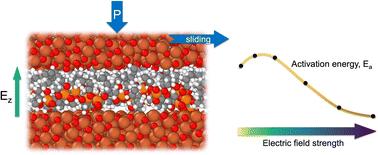
The growth of tribofilms from the mechanochemical decomposition of lubricant additives is crucial to prevent wear of sliding metal surfaces. For some applications, such as electric vehicles and wind turbines, lubricants can be exposed to electric fields, which may affect tribofilm growth. Experimental tribometer results have shown conflicting results regarding antiwear tribofilm growth and wear under external electric potentials. Moreover, the effect of electric fields on the mechanochemical decomposition of lubricant additives remains unclear. Here, we use nonequilibrium molecular dynamics (NEMD) simulations to study the mechanochemical growth of a polyphosphate tribofilm from trialkyl phosphate molecules under external electrostatic fields. The decomposition rate of phosphate esters increases exponentially with the applied stress and temperature. The electric field generally accelerates the molecular decomposition, both by enhancing the interfacial stress and reducing the steric hindrance for nucleophilic substitution. The Bell model is used to analyse the electro-, mechano- and temperature-dependent decomposition process. Under weak electric fields, the activation energy for molecular decomposition increases due to the competition between electric field- and shear-induced deformations. For stronger fields, the activation energy decreases linearly with increased electric field strength and this dominates over the shear-induced molecular rotation. The resultant non-monotonic variation in the activation energy for molecular decomposition with electric field strength explains the conflicting effects of electric potential on tribofilm growth observed experimentally. The activation volume decreases linearly with increasing electric field strength, indicating a reduced dependence of the decomposition on shear stress as the electric field dominates. Asymmetric tribofilm growth is observed between surfaces with external electric fields, which is consistent with the experimental observations. This study presents atomistic insights for the coupling of electro- and mechano-catalysis of an industrially-important molecular decomposition process.


 求助内容:
 应助结果提醒方式:


 京公网安备 11010802042870号


