Yuquan Qu, Sander Veraverbeke, Diego G. Miralles, Jingfang Fan, Harry Vereecken, Carsten Montzka
{"title":"Fuels Mediate the Influence of Climate Teleconnections on Wildfires in Dryland Ecosystems","authors":"Yuquan Qu, Sander Veraverbeke, Diego G. Miralles, Jingfang Fan, Harry Vereecken, Carsten Montzka","doi":"10.1111/gcb.70406","DOIUrl":null,"url":null,"abstract":"<p>Climate teleconnections modulate regional wildfire occurrence. Understanding the underlying mechanisms is critical for sub-seasonal to annual wildfire predictions since the magnitude of certain teleconnection climate modes (TCMs) intensifies or they may undergo phase shifts. Here, we study how TCMs govern wildfire activity and compare the effects of weather and fuels in mediating the influence of TCMs on wildfires. Globally, burned area (BA) is predictable by a single TCM in 25.4% of the burnable (vegetated) regions, with Australia and eastern Siberia identified as the two hot spots with the highest probability out of a total of 10. Tropical oceans are the primary sources of teleconnection-driven variability in global BA. Our study finds that in dryland hot spots such as Australia, the Horn of Africa, and the northern Middle East, the lagged mediating effects of fuels outweigh the immediate mediating effects of weather. Whereas in hot spots with dense vegetation, like northeastern South America and Southeast Asia, the immediate mediating effects of weather are generally more dominant. In other hot spots, fuels can still serve as a key pathway through which specific TCMs influence wildfire activity. This study highlights the important role of fuels in transmitting the delayed impacts of TCMs-induced weather anomalies on regional wildfire activity. This study also underlines the importance of refining fuel management strategies and integrating fuel conditions in teleconnection-related wildfire attribution and prediction frameworks, which is crucial given the projected changing patterns of teleconnections.</p>","PeriodicalId":175,"journal":{"name":"Global Change Biology","volume":"31 8","pages":""},"PeriodicalIF":12.5000,"publicationDate":"2025-08-06","publicationTypes":"Journal Article","fieldsOfStudy":null,"isOpenAccess":false,"openAccessPdf":"https://onlinelibrary.wiley.com/doi/epdf/10.1111/gcb.70406","citationCount":"0","resultStr":null,"platform":"Semanticscholar","paperid":null,"PeriodicalName":"Global Change Biology","FirstCategoryId":"93","ListUrlMain":"https://onlinelibrary.wiley.com/doi/10.1111/gcb.70406","RegionNum":1,"RegionCategory":"环境科学与生态学","ArticlePicture":[],"TitleCN":null,"AbstractTextCN":null,"PMCID":null,"EPubDate":"","PubModel":"","JCR":"Q1","JCRName":"BIODIVERSITY CONSERVATION","Score":null,"Total":0}
引用次数: 0
Abstract
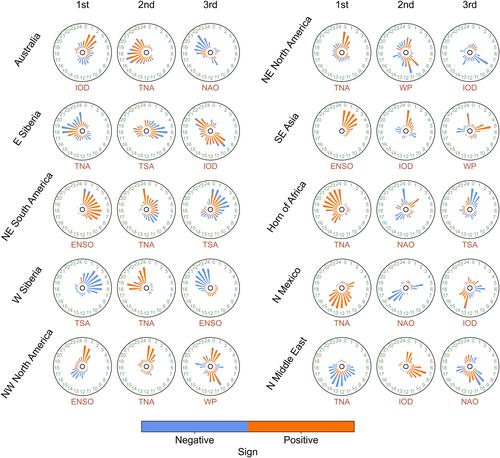
Climate teleconnections modulate regional wildfire occurrence. Understanding the underlying mechanisms is critical for sub-seasonal to annual wildfire predictions since the magnitude of certain teleconnection climate modes (TCMs) intensifies or they may undergo phase shifts. Here, we study how TCMs govern wildfire activity and compare the effects of weather and fuels in mediating the influence of TCMs on wildfires. Globally, burned area (BA) is predictable by a single TCM in 25.4% of the burnable (vegetated) regions, with Australia and eastern Siberia identified as the two hot spots with the highest probability out of a total of 10. Tropical oceans are the primary sources of teleconnection-driven variability in global BA. Our study finds that in dryland hot spots such as Australia, the Horn of Africa, and the northern Middle East, the lagged mediating effects of fuels outweigh the immediate mediating effects of weather. Whereas in hot spots with dense vegetation, like northeastern South America and Southeast Asia, the immediate mediating effects of weather are generally more dominant. In other hot spots, fuels can still serve as a key pathway through which specific TCMs influence wildfire activity. This study highlights the important role of fuels in transmitting the delayed impacts of TCMs-induced weather anomalies on regional wildfire activity. This study also underlines the importance of refining fuel management strategies and integrating fuel conditions in teleconnection-related wildfire attribution and prediction frameworks, which is crucial given the projected changing patterns of teleconnections.
期刊介绍:
Global Change Biology is an environmental change journal committed to shaping the future and addressing the world's most pressing challenges, including sustainability, climate change, environmental protection, food and water safety, and global health.
Dedicated to fostering a profound understanding of the impacts of global change on biological systems and offering innovative solutions, the journal publishes a diverse range of content, including primary research articles, technical advances, research reviews, reports, opinions, perspectives, commentaries, and letters. Starting with the 2024 volume, Global Change Biology will transition to an online-only format, enhancing accessibility and contributing to the evolution of scholarly communication.

 求助内容:
求助内容: 应助结果提醒方式:

 京公网安备 11010802042870号


