Huijuan Hao, Yongping Shan, Panpan Li, Mingxiu Zhan, Hongkun Fan, Feng Liu, Bo Zhang, Wanming Chen, Wentao Jiao*, Yongguang Yin, Hyeong-Moo Shin and John P. Giesy,
{"title":"Heuristic Topological Graph Convolutional Network for Risk Prediction of Potentially Toxic Elements in Cultivated Soils","authors":"Huijuan Hao, Yongping Shan, Panpan Li, Mingxiu Zhan, Hongkun Fan, Feng Liu, Bo Zhang, Wanming Chen, Wentao Jiao*, Yongguang Yin, Hyeong-Moo Shin and John P. Giesy, ","doi":"10.1021/acs.est.5c06872","DOIUrl":null,"url":null,"abstract":"<p >Contamination of cultivated soils with potentially toxic elements (PTEs) poses a growing threat to global food security. Although existing risk assessments have examined the accumulation and toxicity of PTEs, their dynamic interplay with multidimensional drivers has remained inadequately characterized. Here, an innovative heuristic graph convolutional network (GCN) model is introduced by integrating adaptive graph topology with quantified directional feedback optimization to improve ecological risk prediction. Leveraging 466 spatially resolved soil samples and 28 environmental drivers of a typical rice production area Yangtze River Basin in China, the heuristic GCN model outperformed traditional approaches by 23.1% in predictive accuracy. A three-phase heuristic algorithm pruned 85.5% of spurious edges in the topological graph, and GCN adaptively quantified the directional feedback between environmental drivers and ecological risk. Topological networks and feature importance analysis jointly identified pH, base saturation, calcium carbonate, exchangeable bases, and soil organic carbon as pivotal regulators acting alongside geological factors. By linking mechanistic soil chemistry with machine-learning-based causal inference, our model supports streamlinedly simplified, directionally quantified, and dynamically adapted ecological risk prediction. This enables the screening of the most efficient pathway of risk management and provides more precise and integrated strategies for ecological risk control in agroecosystems.</p>","PeriodicalId":36,"journal":{"name":"环境科学与技术","volume":"59 31","pages":"16685–16696"},"PeriodicalIF":12.2000,"publicationDate":"2025-07-29","publicationTypes":"Journal Article","fieldsOfStudy":null,"isOpenAccess":false,"openAccessPdf":"","citationCount":"0","resultStr":null,"platform":"Semanticscholar","paperid":null,"PeriodicalName":"环境科学与技术","FirstCategoryId":"1","ListUrlMain":"https://pubs.acs.org/doi/10.1021/acs.est.5c06872","RegionNum":1,"RegionCategory":"环境科学与生态学","ArticlePicture":[],"TitleCN":null,"AbstractTextCN":null,"PMCID":null,"EPubDate":"","PubModel":"","JCR":"Q1","JCRName":"ENGINEERING, ENVIRONMENTAL","Score":null,"Total":0}
引用次数: 0
Abstract
Contamination of cultivated soils with potentially toxic elements (PTEs) poses a growing threat to global food security. Although existing risk assessments have examined the accumulation and toxicity of PTEs, their dynamic interplay with multidimensional drivers has remained inadequately characterized. Here, an innovative heuristic graph convolutional network (GCN) model is introduced by integrating adaptive graph topology with quantified directional feedback optimization to improve ecological risk prediction. Leveraging 466 spatially resolved soil samples and 28 environmental drivers of a typical rice production area Yangtze River Basin in China, the heuristic GCN model outperformed traditional approaches by 23.1% in predictive accuracy. A three-phase heuristic algorithm pruned 85.5% of spurious edges in the topological graph, and GCN adaptively quantified the directional feedback between environmental drivers and ecological risk. Topological networks and feature importance analysis jointly identified pH, base saturation, calcium carbonate, exchangeable bases, and soil organic carbon as pivotal regulators acting alongside geological factors. By linking mechanistic soil chemistry with machine-learning-based causal inference, our model supports streamlinedly simplified, directionally quantified, and dynamically adapted ecological risk prediction. This enables the screening of the most efficient pathway of risk management and provides more precise and integrated strategies for ecological risk control in agroecosystems.
期刊介绍:
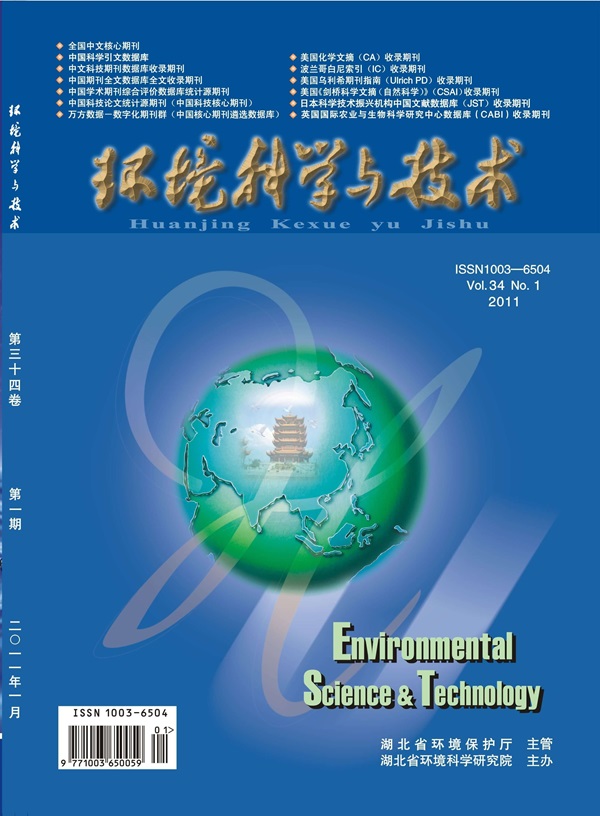
Environmental Science & Technology (ES&T) is a co-sponsored academic and technical magazine by the Hubei Provincial Environmental Protection Bureau and the Hubei Provincial Academy of Environmental Sciences.
Environmental Science & Technology (ES&T) holds the status of Chinese core journals, scientific papers source journals of China, Chinese Science Citation Database source journals, and Chinese Academic Journal Comprehensive Evaluation Database source journals. This publication focuses on the academic field of environmental protection, featuring articles related to environmental protection and technical advancements.


 求助内容:
求助内容: 应助结果提醒方式:

 京公网安备 11010802042870号


