
Three-step biosynthesis of salicylic acid from benzoyl-CoA in plants
IF 56.1
1区 综合性期刊
Q1 MULTIDISCIPLINARY SCIENCES
引用次数: 0
Abstract
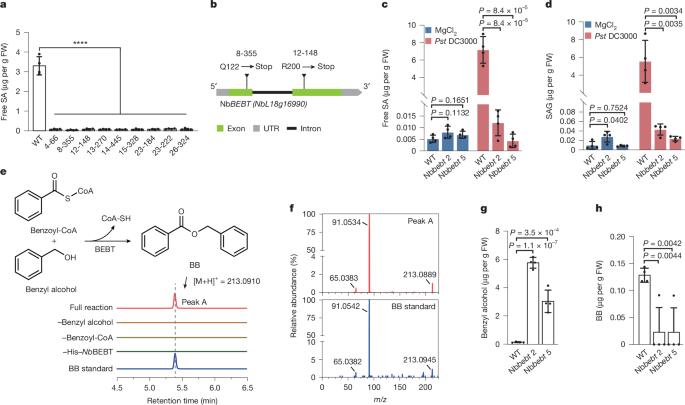
Salicylic acid (SA) is the active ingredient in willow bark that has been used for anti-inflammation and pain relief for centuries. Aspirin, a derivative of SA, is the most widely used medication in human history. SA also acts as a key plant defence hormone1–4. Although SA was known to be produced from chorismate in the model plant Arabidopsis5,6, how it is biosynthesized in plant families outside Brassicaceae remains unclear. Here we report the identification of a conserved pathway for SA biosynthesis in seed plants. Using Nicotiana benthamiana as a model, we identified three key steps for the biosynthesis of SA. First, ligation of benzoyl coenzyme A (CoA) and benzyl alcohol by benzoyl-CoA:benzyl alcohol benzoyl transferase (BEBT) gives rise to benzyl benzoate, which is then hydroxylated by benzyl benzoate oxidase (BBO) to produce benzyl salicylate. Subsequent cleavage of benzyl salicylate by benzyl salicylate hydrolase (BSH) yields SA. Notably, genes encoding these three enzymes are present in a broad range of plants, and the genes from dicots such as willow, poplar and soybean as well as the monocot rice can complement the phenotype of SA-deficient mutants of N. benthamiana. Moreover, knockout analysis of the Oryza sativa OsBEBT, OsBBO and OsBSH genes reveals that they are required for SA biosynthesis in rice. Our findings suggest that the SA biosynthesis pathway is highly conserved in plants. The salicylic acid (SA) biosynthesis pathway—involving ligation of benzoyl coenzyme A and benzyl alcohol to give benzyl benzoate; hydroxylation of benzyl benzoate to give benzyl salicylate; and cleavage of benzyl salicylate to give SA—is highly conserved in plants.
植物苯甲酰辅酶a三步合成水杨酸的研究。
水杨酸(SA)是柳树皮中的活性成分,几个世纪以来一直用于抗炎和缓解疼痛。阿司匹林是SA的衍生物,是人类历史上使用最广泛的药物。SA也是一种关键的植物防御激素。虽然已知模式植物拟南芥(arabidopsis)中的藻酸盐可以产生SA 5,6,但在芸苔科以外的植物科中SA是如何生物合成的尚不清楚。在这里,我们报道了在种子植物中SA生物合成的一个保守途径的鉴定。以本拟烟(Nicotiana benthamiana)为模型,确定了SA生物合成的三个关键步骤。首先,苯甲酰辅酶A (CoA)与苯甲酰辅酶A结合:苯甲酰醇苯甲酰转移酶(BEBT)生成苯甲酰,然后苯甲酰氧化酶(BBO)将苯甲酰氧化酶羟基化,生成水杨酸苄酯。随后水杨酸苄酯水解酶(BSH)裂解水杨酸苄酯生成SA。值得注意的是,编码这三种酶的基因存在于广泛的植物中,来自柳树、杨树和大豆等双科植物以及单子叶水稻的基因可以补充N. benthamiana缺乏sa突变体的表型。此外,对水稻OsBEBT、OsBBO和OsBSH基因的敲除分析表明,这三个基因是水稻SA生物合成所必需的。我们的研究结果表明,SA生物合成途径在植物中是高度保守的。
本文章由计算机程序翻译,如有差异,请以英文原文为准。
求助全文
约1分钟内获得全文
求助全文
来源期刊
Nature
综合性期刊-综合性期刊
CiteScore
90.00
自引率
1.20%
发文量
3652
审稿时长
3 months
期刊介绍:
Nature is a prestigious international journal that publishes peer-reviewed research in various scientific and technological fields. The selection of articles is based on criteria such as originality, importance, interdisciplinary relevance, timeliness, accessibility, elegance, and surprising conclusions. In addition to showcasing significant scientific advances, Nature delivers rapid, authoritative, insightful news, and interpretation of current and upcoming trends impacting science, scientists, and the broader public. The journal serves a dual purpose: firstly, to promptly share noteworthy scientific advances and foster discussions among scientists, and secondly, to ensure the swift dissemination of scientific results globally, emphasizing their significance for knowledge, culture, and daily life.
 求助内容:
求助内容: 应助结果提醒方式:

 京公网安备 11010802042870号


