Optimal bone-implant contact sites in the zygomatic region for quad zygomatic implants placement: a retrospective study in Vietnamese patients on CBCT.
Mi Nguyen-Tra Le, Tri Minh Tran, Phuc Ngoc Nguyen, Hung Chi Vo, Lam Hung Tran
{"title":"Optimal bone-implant contact sites in the zygomatic region for quad zygomatic implants placement: a retrospective study in Vietnamese patients on CBCT.","authors":"Mi Nguyen-Tra Le, Tri Minh Tran, Phuc Ngoc Nguyen, Hung Chi Vo, Lam Hung Tran","doi":"10.1038/s41405-025-00350-8","DOIUrl":null,"url":null,"abstract":"<p><strong>Introduction: </strong>Zygomatic implants represent a reliable treatment modality for patients with severe maxillary bone resorption, eliminating the need for bone grafting and enabling immediate loading. This study utilized cone beam computed tomography (CBCT) to identify optimal zygomatic bone regions for implant placement by assessing bone-implant contact (BIC) while minimizing intrusion risks into the infratemporal fossa (ITF). Additionally, differences in zygomatic characteristics between males and females were investigated to address the limited evidence regarding the influence of biological sex on BIC and implant stability.</p><p><strong>Methods: </strong>This retrospective study analyzed CBCT scans from 20 fully edentulous patients (9 male and 11 female) with severe maxillary resorption. Zygomatic bone thickness, length, and BIC were measured at 12 anatomical points across the superior, middle, and inferior regions using standardized CBCT imaging and Nobel Clinician software. Virtual implants were placed to evaluate intrusion into the infratemporal fossa. Statistical analyses, including Kruskal-Wallis and Mann-Whitney U tests, were conducted to compare zygomatic measurements across regions and between genders.</p><p><strong>Results: </strong>The greatest bone thicknesses in the superior, middle, and inferior regions were observed at Point A<sub>1</sub> (8.53 ± 1.63 mm), Point B<sub>1</sub> (6.97 ± 1.01 mm), and Point C<sub>0</sub> (6.36 ± 1.02 mm), respectively. Point A<sub>3</sub> (17.65 ± 2.24 mm) in the anterior region and Point B<sub>1</sub> (13.34 ± 2.35 mm) in the posterior region were identified as optimal implant sites, providing the highest BICs while minimizing intrusion risks. Zygomatic thickness and BIC at these optimal sites were significantly greater in males than females (p < 0.01).</p><p><strong>Conclusion: </strong>Point A<sub>3</sub> and Point B<sub>1</sub> are the most suitable sites for zygomatic implant placement. Quad zygomatic implants may achieve enhanced primary stability in males than in females due to greater zygomatic bone thickness and BIC.</p>","PeriodicalId":36997,"journal":{"name":"BDJ Open","volume":"11 1","pages":"61"},"PeriodicalIF":2.5000,"publicationDate":"2025-06-20","publicationTypes":"Journal Article","fieldsOfStudy":null,"isOpenAccess":false,"openAccessPdf":"https://www.ncbi.nlm.nih.gov/pmc/articles/PMC12181228/pdf/","citationCount":"0","resultStr":null,"platform":"Semanticscholar","paperid":null,"PeriodicalName":"BDJ Open","FirstCategoryId":"1085","ListUrlMain":"https://doi.org/10.1038/s41405-025-00350-8","RegionNum":0,"RegionCategory":null,"ArticlePicture":[],"TitleCN":null,"AbstractTextCN":null,"PMCID":null,"EPubDate":"","PubModel":"","JCR":"Q2","JCRName":"DENTISTRY, ORAL SURGERY & MEDICINE","Score":null,"Total":0}
引用次数: 0
Abstract
Introduction: Zygomatic implants represent a reliable treatment modality for patients with severe maxillary bone resorption, eliminating the need for bone grafting and enabling immediate loading. This study utilized cone beam computed tomography (CBCT) to identify optimal zygomatic bone regions for implant placement by assessing bone-implant contact (BIC) while minimizing intrusion risks into the infratemporal fossa (ITF). Additionally, differences in zygomatic characteristics between males and females were investigated to address the limited evidence regarding the influence of biological sex on BIC and implant stability.
Methods: This retrospective study analyzed CBCT scans from 20 fully edentulous patients (9 male and 11 female) with severe maxillary resorption. Zygomatic bone thickness, length, and BIC were measured at 12 anatomical points across the superior, middle, and inferior regions using standardized CBCT imaging and Nobel Clinician software. Virtual implants were placed to evaluate intrusion into the infratemporal fossa. Statistical analyses, including Kruskal-Wallis and Mann-Whitney U tests, were conducted to compare zygomatic measurements across regions and between genders.
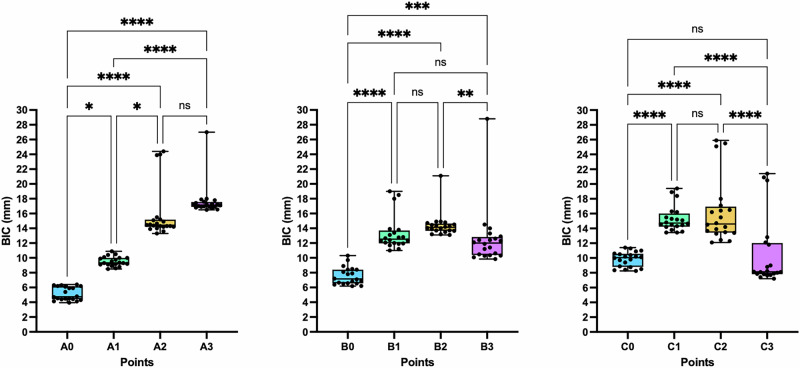
Results: The greatest bone thicknesses in the superior, middle, and inferior regions were observed at Point A1 (8.53 ± 1.63 mm), Point B1 (6.97 ± 1.01 mm), and Point C0 (6.36 ± 1.02 mm), respectively. Point A3 (17.65 ± 2.24 mm) in the anterior region and Point B1 (13.34 ± 2.35 mm) in the posterior region were identified as optimal implant sites, providing the highest BICs while minimizing intrusion risks. Zygomatic thickness and BIC at these optimal sites were significantly greater in males than females (p < 0.01).
Conclusion: Point A3 and Point B1 are the most suitable sites for zygomatic implant placement. Quad zygomatic implants may achieve enhanced primary stability in males than in females due to greater zygomatic bone thickness and BIC.




 求助内容:
求助内容: 应助结果提醒方式:

 京公网安备 11010802042870号


