
Sources and dynamics of nitrate in groundwater in a crystalline terrain of tropical Sri Lanka based on a dual isotope approach
IF 12.8
1区 环境科学与生态学
Q1 ENGINEERING, ENVIRONMENTAL
引用次数: 0
Abstract
Nitrate pollution of groundwater is one of the major environmental problems in many parts of the world, mainly due to intensive agriculture and waste disposal. Therefore, understanding the fate of nitrate in aquifer systems is important for sustainable groundwater management. In Sri Lanka, a tropical terrain largely covered with high-grade metamorphic rocks, non-point source pollutants from agricultural lands are the main sources of nitrate in groundwater. This study presents nitrate dual-isotope signatures (δ15NNO3 and δ18ONO3) of groundwater samples collected in the pre- (n=60) and post-monsoon (n=71) periods from the Yan Oya River basin in the dry zone of Sri Lanka. The nitrate concentrations (as NO3--N) of the groundwater samples varied between 0.10 and 5.60 mg/L. The δ15NNO3 and δ18ONO3 values were between -7.0 and +37.0‰ and between -4.4 and +32.2‰, respectively. The large coefficient of variation (CV) values (>100%) of nitrate concentrations indicated higher spatial variability and the influence of non-point source pollutants on groundwater nitrate concentrations. Land use was the primary factor influencing spatial heterogeneity. The isotopic evidence demonstrated that nitrate in groundwater originated through nitrification and mixing sources, e.g., manure, sewage, soil nitrogen, and ammonium in fertilizer. The fractionation during nitrate transformation processes and mixing of sources have altered the nitrate isotopic signatures of the sources in the region. Denitrification, assimilation, and ammonia volatilization reduced available nitrate for leaching in soil, resulting in lower nitrate concentrations with higher isotopic values in groundwater. The present study highlights the importance of applying dual isotopes to identify the sources and fate of groundwater nitrate in a crystalline aquifer in the dry zone of Sri Lanka.
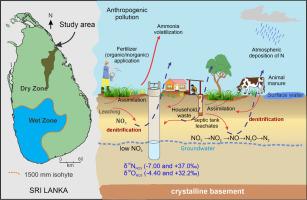
基于双同位素方法的斯里兰卡热带结晶地形地下水中硝酸盐的来源和动态
地下水硝酸盐污染是世界上许多地区的主要环境问题之一,主要是由于集约化农业和废物处理。因此,了解硝酸盐在含水层系统中的命运对于地下水的可持续管理非常重要。斯里兰卡是热带地区,大部分被高变质岩覆盖,农业用地的非点源污染物是地下水中硝酸盐的主要来源。研究了斯里兰卡干旱区延奥雅河流域季风前(n=60)和季风后(n=71)地下水样品的硝酸盐双同位素(δ15NNO3和δ18ONO3)特征。地下水样品的硝酸盐浓度(以NO3—N为单位)在0.10 ~ 5.60 mg/L之间变化。δ15NNO3和δ18ONO3值分别在-7.0 ~ +37.0‰和-4.4 ~ +32.2‰之间。硝酸盐浓度变异系数(CV)值较大(>100%)表明空间变异性较大,非点源污染物对地下水硝酸盐浓度的影响较大。土地利用是影响空间异质性的主要因素。同位素证据表明,地下水中的硝酸盐来源于硝化作用和混合源,如粪肥、污水、土壤氮和肥料中的铵。硝态氮转化过程中的分馏作用和源的混合作用改变了该区源的硝态氮同位素特征。反硝化、同化和氨挥发减少了土壤中可浸出的硝酸盐,导致地下水中硝酸盐浓度较低,同位素值较高。目前的研究强调了应用双同位素来确定斯里兰卡干旱地区结晶含水层中地下水硝酸盐的来源和命运的重要性。
本文章由计算机程序翻译,如有差异,请以英文原文为准。
求助全文
约1分钟内获得全文
求助全文
来源期刊
Water Research
环境科学-工程:环境
CiteScore
20.80
自引率
9.40%
发文量
1307
审稿时长
38 days
期刊介绍:
Water Research, along with its open access companion journal Water Research X, serves as a platform for publishing original research papers covering various aspects of the science and technology related to the anthropogenic water cycle, water quality, and its management worldwide. The audience targeted by the journal comprises biologists, chemical engineers, chemists, civil engineers, environmental engineers, limnologists, and microbiologists. The scope of the journal include:
•Treatment processes for water and wastewaters (municipal, agricultural, industrial, and on-site treatment), including resource recovery and residuals management;
•Urban hydrology including sewer systems, stormwater management, and green infrastructure;
•Drinking water treatment and distribution;
•Potable and non-potable water reuse;
•Sanitation, public health, and risk assessment;
•Anaerobic digestion, solid and hazardous waste management, including source characterization and the effects and control of leachates and gaseous emissions;
•Contaminants (chemical, microbial, anthropogenic particles such as nanoparticles or microplastics) and related water quality sensing, monitoring, fate, and assessment;
•Anthropogenic impacts on inland, tidal, coastal and urban waters, focusing on surface and ground waters, and point and non-point sources of pollution;
•Environmental restoration, linked to surface water, groundwater and groundwater remediation;
•Analysis of the interfaces between sediments and water, and between water and atmosphere, focusing specifically on anthropogenic impacts;
•Mathematical modelling, systems analysis, machine learning, and beneficial use of big data related to the anthropogenic water cycle;
•Socio-economic, policy, and regulations studies.
 求助内容:
求助内容: 应助结果提醒方式:

 京公网安备 11010802042870号


