Prashant Singh, Gregory Dean, Sofia Iram, Westley Peng, Samuel W Chey, Samara Rifkin, Christine Lothen-Kline, Jane Muir, Allen A Lee, Shanti Eswaran, William D Chey
{"title":"Efficacy of Mediterranean Diet vs. Low-FODMAP Diet in Patients With Nonconstipated Irritable Bowel Syndrome: A Pilot Randomized Controlled Trial.","authors":"Prashant Singh, Gregory Dean, Sofia Iram, Westley Peng, Samuel W Chey, Samara Rifkin, Christine Lothen-Kline, Jane Muir, Allen A Lee, Shanti Eswaran, William D Chey","doi":"10.1111/nmo.70060","DOIUrl":null,"url":null,"abstract":"<p><strong>Introduction: </strong>Mediterranean diet (MD) has been proposed as a dietary therapy for irritable bowel syndrome (IBS) but its efficacy remains unclear. We compared the efficacy of MD to a diet low in fermentable oligo-, di-, monosaccharides, and polyols (LFD).</p><p><strong>Methods: </strong>In this pilot-feasibility, randomized controlled trial (RCT), adult patients with diarrhea-predominant IBS (IBS-D) or mixed bowel pattern (IBS-M) were randomized to MD versus LFD for 4 weeks. Meals were provided for both groups (ModifyHealth, GA). Daily variables included abdominal pain intensity (API) and bloating, while IBS symptom severity score (IBS-SSS) and IBS adequate relief (IBS-AR) were scored weekly. The primary endpoint was the proportion of patients with ≥ 30% decrease in API for ≥ 2/4 weeks.</p><p><strong>Results: </strong>Of 26 randomized patients, 20 finished the study (10 per group). Seventy-three percent of the MD group met the primary endpoint compared to 81.8% of the LFD group (p = 1.0). Although not statistically significant, a numerically higher proportion of the LFD group reported adequate relief and met the responder endpoint for IBS-SSS (50-point reduction) compared to the MD group (54.6% vs. 27.3% for IBS-AR and 81.8% vs. 45.5% for IBS-SSS, p = 0.39 and 0.18, respectively). The LFD group also had a significantly greater reduction in IBS-SSS score over the 4-week treatment period compared to the MD group (-105.5 vs. -60, p = 0.02).</p><p><strong>Conclusion: </strong>MD provides symptom relief in IBS-D and IBS-M; however, the magnitude of relief was higher with the LFD. Larger diet comparison studies in real-world settings are needed before MD can be routinely recommended to IBS patients.</p><p><strong>Trial registration: </strong>Clinicaltrials.gov: NCT05807919.</p>","PeriodicalId":19123,"journal":{"name":"Neurogastroenterology and Motility","volume":" ","pages":"e70060"},"PeriodicalIF":2.9000,"publicationDate":"2025-10-01","publicationTypes":"Journal Article","fieldsOfStudy":null,"isOpenAccess":false,"openAccessPdf":"https://www.ncbi.nlm.nih.gov/pmc/articles/PMC12435798/pdf/","citationCount":"0","resultStr":null,"platform":"Semanticscholar","paperid":null,"PeriodicalName":"Neurogastroenterology and Motility","FirstCategoryId":"3","ListUrlMain":"https://doi.org/10.1111/nmo.70060","RegionNum":3,"RegionCategory":"医学","ArticlePicture":[],"TitleCN":null,"AbstractTextCN":null,"PMCID":null,"EPubDate":"2025/4/24 0:00:00","PubModel":"Epub","JCR":"Q1","JCRName":"CLINICAL NEUROLOGY","Score":null,"Total":0}
引用次数: 0
Abstract
Introduction: Mediterranean diet (MD) has been proposed as a dietary therapy for irritable bowel syndrome (IBS) but its efficacy remains unclear. We compared the efficacy of MD to a diet low in fermentable oligo-, di-, monosaccharides, and polyols (LFD).
Methods: In this pilot-feasibility, randomized controlled trial (RCT), adult patients with diarrhea-predominant IBS (IBS-D) or mixed bowel pattern (IBS-M) were randomized to MD versus LFD for 4 weeks. Meals were provided for both groups (ModifyHealth, GA). Daily variables included abdominal pain intensity (API) and bloating, while IBS symptom severity score (IBS-SSS) and IBS adequate relief (IBS-AR) were scored weekly. The primary endpoint was the proportion of patients with ≥ 30% decrease in API for ≥ 2/4 weeks.
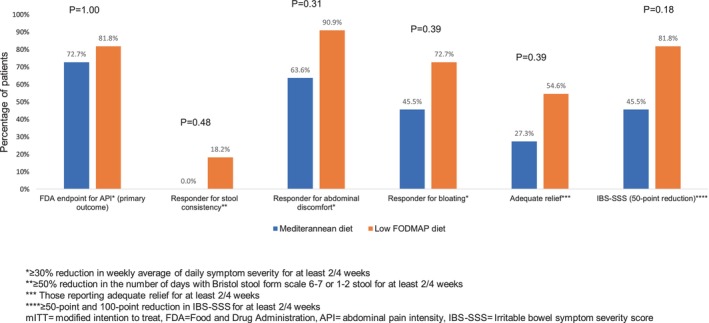
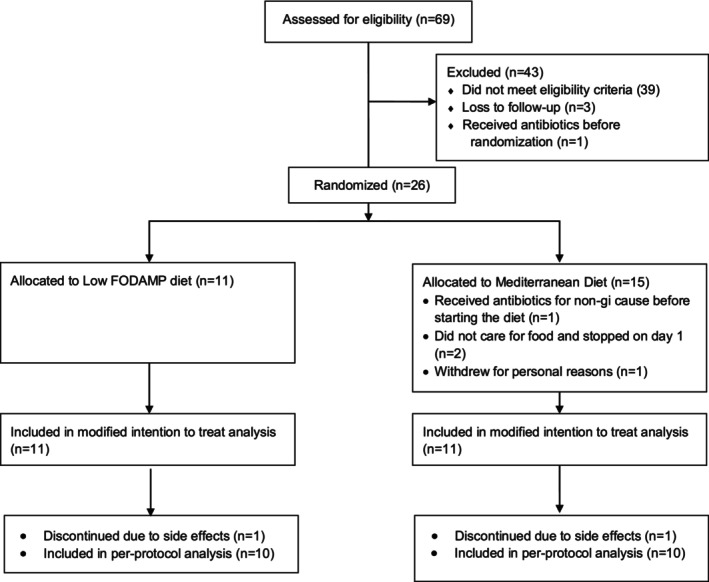
Results: Of 26 randomized patients, 20 finished the study (10 per group). Seventy-three percent of the MD group met the primary endpoint compared to 81.8% of the LFD group (p = 1.0). Although not statistically significant, a numerically higher proportion of the LFD group reported adequate relief and met the responder endpoint for IBS-SSS (50-point reduction) compared to the MD group (54.6% vs. 27.3% for IBS-AR and 81.8% vs. 45.5% for IBS-SSS, p = 0.39 and 0.18, respectively). The LFD group also had a significantly greater reduction in IBS-SSS score over the 4-week treatment period compared to the MD group (-105.5 vs. -60, p = 0.02).
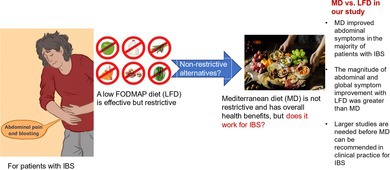
Conclusion: MD provides symptom relief in IBS-D and IBS-M; however, the magnitude of relief was higher with the LFD. Larger diet comparison studies in real-world settings are needed before MD can be routinely recommended to IBS patients.
期刊介绍:
Neurogastroenterology & Motility (NMO) is the official Journal of the European Society of Neurogastroenterology & Motility (ESNM) and the American Neurogastroenterology and Motility Society (ANMS). It is edited by James Galligan, Albert Bredenoord, and Stephen Vanner. The editorial and peer review process is independent of the societies affiliated to the journal and publisher: Neither the ANMS, the ESNM or the Publisher have editorial decision-making power. Whenever these are relevant to the content being considered or published, the editors, journal management committee and editorial board declare their interests and affiliations.

 求助内容:
求助内容: 应助结果提醒方式:

 京公网安备 11010802042870号

