
Synergistic Interaction of Sulfonyl-Containing Sulfanilamide/Sulfamide To Enhance the Dielectric and Mechanical Properties of Polyurethane Materials
IF 4.4
2区 化学
Q2 CHEMISTRY, MULTIDISCIPLINARY
引用次数: 0
Abstract
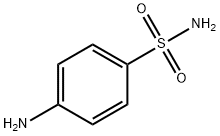
High-performance dielectric materials have gained widespread attention, due to their great potential for various applications, such as flexible electronics and capacitive sensors. In this study, sulfamide (SA) and sulfanilamide (SAN), containing sulfonyl groups, were introduced into polyurethane (PU) as chain extenders. The polyurethane with the best performance was end-capped with 3-methylsulfonyl-1-propanol (3-MSP) to investigate the effects of the SAN/SA molar ratio and the capping agent on the microstructure, dielectric properties, and mechanical performance of the PU. The experimental results indicated that, at a frequency of 102 Hz, the polyurethane material with an SAN/SA molar ratio of 2:1 (sample PU-N2S1) exhibited the highest dielectric constant (15.65), representing a 144% increase, compared to sample PU-N0S0. Meanwhile, sample PU-N2S1 showed the highest degree of microphase separation. At a frequency of 1.26 × 10⁵ Hz, its dielectric loss was 0.055. Notably, 3-MSP had a relatively large dipole moment (μ = 6.93 D). However, its incorporation into polyurethane significantly reduced the dielectric constant. The results demonstrated that the dielectric constant and dielectric loss of polyurethane were not only dependent on its dipole moment but were also closely related to its microstructure, including microphase separation and intermolecular interaction.
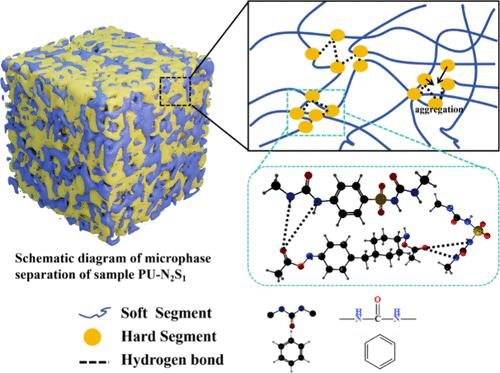
含磺酰磺胺/磺胺的协同作用提高聚氨酯材料的介电性能和力学性能
高性能介电材料因其在柔性电子、电容传感器等领域的巨大应用潜力而受到广泛关注。本研究将含有磺酰基的磺胺(SA)和磺胺(SAN)作为扩链剂引入聚氨酯(PU)中。采用3-甲基磺酰基-1-丙醇(3-MSP)封端,考察了SAN/SA摩尔比和封端剂对聚氨酯微观结构、介电性能和力学性能的影响。实验结果表明,在102 Hz频率下,SAN/SA摩尔比为2:1的聚氨酯材料(样品PU-N2S1)的介电常数最高,为15.65,比样品PU-N0S0提高了144%。样品PU-N2S1的微相分离程度最高。在1.26 × 105 Hz频率下,介质损耗为0.055。值得注意的是,3-MSP具有较大的偶极矩,μ = 6.93 D。然而,其掺入聚氨酯显著降低介电常数。结果表明,聚氨酯的介电常数和介电损耗不仅与其偶极矩有关,而且与其微相分离和分子间相互作用等微观结构密切相关。
本文章由计算机程序翻译,如有差异,请以英文原文为准。
求助全文
约1分钟内获得全文
求助全文
来源期刊
Langmuir
化学-材料科学:综合
CiteScore
6.50
自引率
10.30%
发文量
1464
审稿时长
2.1 months
期刊介绍:
Langmuir is an interdisciplinary journal publishing articles in the following subject categories:
Colloids: surfactants and self-assembly, dispersions, emulsions, foams
Interfaces: adsorption, reactions, films, forces
Biological Interfaces: biocolloids, biomolecular and biomimetic materials
Materials: nano- and mesostructured materials, polymers, gels, liquid crystals
Electrochemistry: interfacial charge transfer, charge transport, electrocatalysis, electrokinetic phenomena, bioelectrochemistry
Devices and Applications: sensors, fluidics, patterning, catalysis, photonic crystals
However, when high-impact, original work is submitted that does not fit within the above categories, decisions to accept or decline such papers will be based on one criteria: What Would Irving Do?
Langmuir ranks #2 in citations out of 136 journals in the category of Physical Chemistry with 113,157 total citations. The journal received an Impact Factor of 4.384*.
This journal is also indexed in the categories of Materials Science (ranked #1) and Multidisciplinary Chemistry (ranked #5).
文献相关原料
原料信息
原料厂家

 求助内容:
求助内容: 应助结果提醒方式:

 京公网安备 11010802042870号


