Ahmed Basuoni, Ikram Burney, Z Al-Hashami, Marwa Ahmed, Amany Hany Mohamed Kamel, Airton Leonardo de Oliveira Manoel, Yarab Al Bulushi, Waleed Dawelbeit
{"title":"When cancer reaches the heart: a case series on rare myocardial and endocardial metastases from squamous cell carcinoma.","authors":"Ahmed Basuoni, Ikram Burney, Z Al-Hashami, Marwa Ahmed, Amany Hany Mohamed Kamel, Airton Leonardo de Oliveira Manoel, Yarab Al Bulushi, Waleed Dawelbeit","doi":"10.22551/2025.46.1201.10311","DOIUrl":null,"url":null,"abstract":"<p><p>Cardiac metastases are rare but devastating complications of malignancies. Squamous cell carcinoma (SCC), particularly from non-pulmonary origins, infrequently metastasizes to the heart, making its cardiac involvement an unusual and underreported phenomenon. We present a case series of four patients diagnosed with myocardial and endocardial metastases from SCC at our center over two years. Clinical presentation, imaging modalities, suspected metastatic pathways, management strategies, and outcomes were analyzed. Patients (ages 41-74, three males, one female) had primary SCC in the vulva, tongue, buccal mucosa, and lung. Symptoms varied, including dyspnea, hypotension, chest pain, and stroke. All patients had elevated troponin levels. Echocardiography was crucial for initial detection, while PET/CT confirmed metastases, with one patient undergoing cardiac MRI. Hematogenous spread was likely metastatic pathway in most cases. Treatment was primarily palliative; only one patient received chemotherapy post-diagnosis. Survival post-cardiac metastasis diagnosis ranged from a few days to six months. Myocardial and endocardial metastases from SCC are rare and often indicate advanced disease with poor prognosis. Early recognition through multimodal imaging and biomarkers such as troponin may facilitate timely palliative interventions. Increased collaboration between oncology and cardiology may improve supportive care and symptom management in these patients.</p>","PeriodicalId":72274,"journal":{"name":"Archive of clinical cases","volume":"12 1","pages":"44-50"},"PeriodicalIF":0.7000,"publicationDate":"2025-03-19","publicationTypes":"Journal Article","fieldsOfStudy":null,"isOpenAccess":false,"openAccessPdf":"https://www.ncbi.nlm.nih.gov/pmc/articles/PMC11922157/pdf/","citationCount":"0","resultStr":null,"platform":"Semanticscholar","paperid":null,"PeriodicalName":"Archive of clinical cases","FirstCategoryId":"1085","ListUrlMain":"https://doi.org/10.22551/2025.46.1201.10311","RegionNum":0,"RegionCategory":null,"ArticlePicture":[],"TitleCN":null,"AbstractTextCN":null,"PMCID":null,"EPubDate":"2025/1/1 0:00:00","PubModel":"eCollection","JCR":"Q3","JCRName":"MEDICINE, GENERAL & INTERNAL","Score":null,"Total":0}
引用次数: 0
Abstract
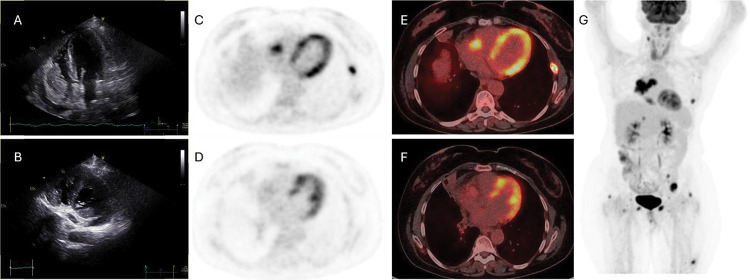
Cardiac metastases are rare but devastating complications of malignancies. Squamous cell carcinoma (SCC), particularly from non-pulmonary origins, infrequently metastasizes to the heart, making its cardiac involvement an unusual and underreported phenomenon. We present a case series of four patients diagnosed with myocardial and endocardial metastases from SCC at our center over two years. Clinical presentation, imaging modalities, suspected metastatic pathways, management strategies, and outcomes were analyzed. Patients (ages 41-74, three males, one female) had primary SCC in the vulva, tongue, buccal mucosa, and lung. Symptoms varied, including dyspnea, hypotension, chest pain, and stroke. All patients had elevated troponin levels. Echocardiography was crucial for initial detection, while PET/CT confirmed metastases, with one patient undergoing cardiac MRI. Hematogenous spread was likely metastatic pathway in most cases. Treatment was primarily palliative; only one patient received chemotherapy post-diagnosis. Survival post-cardiac metastasis diagnosis ranged from a few days to six months. Myocardial and endocardial metastases from SCC are rare and often indicate advanced disease with poor prognosis. Early recognition through multimodal imaging and biomarkers such as troponin may facilitate timely palliative interventions. Increased collaboration between oncology and cardiology may improve supportive care and symptom management in these patients.



 求助内容:
求助内容: 应助结果提醒方式:

 京公网安备 11010802042870号


