
One-step preparation of N, S-doped graphene quantum dots for white light-emitting diodes
IF 6.7
2区 材料科学
Q2 CHEMISTRY, PHYSICAL
Journal of Alloys and Compounds
Pub Date : 2025-04-10
Epub Date: 2025-03-19
DOI:10.1016/j.jallcom.2025.179827
引用次数: 0
Abstract
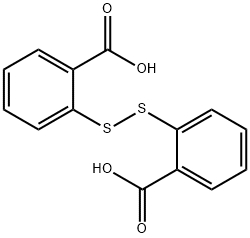
Two-dimensional (2D) materials consist of either a single layer or just a few layers of atoms or molecular layers, and their exceptional optoelectronic properties including high carrier mobility, wide spectral absorption range, and optical response from the number of layers. Graphene quantum dots (GQDs) as a small-sized 2D material exhibited unique physical and chemical properties at the quantum scale. In this study, the N, S-doped GQDs (named as Y-GQDs) were synthesized through straightforward solvothermal process using 2, 2-dithiobenzoic acid and o-phenylenediamine as the precursors. The distribution of the prepared GQDs sample was uniform, with height varying between 0.6 and 0.8 nm. The excellent optical properties of Y-GQDs were attributed to the high crystalline graphene structure and rich functional groups including -C-SO3-C-, -C-SO4-C-, C-N, etc. The optimal excitation and emission wavelengths of Y-GQDs were 380 nm and 535 nm, respectively. Additionally, the multi-color and tunable luminescence characteristics could be achieved by excitation wavelength, solvent, and concentration. Gratifyingly, the N, S-doped GQDs were successfully used to build white light emitting devices via a sol-gel process. The color rendering index reached 83.7 with color temperature of 5306 K, and the GQDs exhibited good optical stability under different driving currents and UV light. This study underscored the significant potential of GQDs in creating promising phosphors for superior lighting applications.
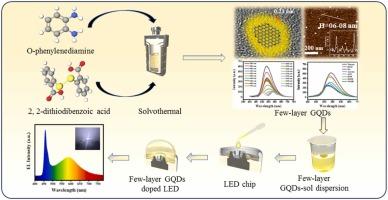
白光二极管用N, s掺杂石墨烯量子点的一步制备
二维(2D)材料由单层或仅几层原子或分子层组成,其独特的光电特性包括高载流子迁移率,宽光谱吸收范围和层数的光学响应。石墨烯量子点作为一种小尺寸的二维材料,在量子尺度上表现出独特的物理和化学性质。本研究以2,2'-二硫代苯甲酸和邻苯二胺为前驱体,通过溶剂热法合成了N, s掺杂的GQDs(称为Y-GQDs)。制备的GQDs样品分布均匀,高度在0.6 ~ 0.8 nm之间。Y-GQDs具有优异的光学性能,主要归功于其高结晶石墨烯结构和丰富的官能团,包括- c - so3 - c -、- c - so4 - c -、C-N等。Y-GQDs的最佳激发波长为380 nm,最佳发射波长为535 nm。此外,通过激发波长、溶剂和浓度可以实现多色和可调的发光特性。令人欣慰的是,N, s掺杂的GQDs通过溶胶-凝胶工艺成功地用于构建白光发射器件。显色指数达到83.7,色温为5306 K,在不同驱动电流和紫外光下均表现出良好的光学稳定性。这项研究强调了GQDs在创造有前途的荧光粉方面的巨大潜力,用于优越的照明应用。
本文章由计算机程序翻译,如有差异,请以英文原文为准。
求助全文
约1分钟内获得全文
求助全文
来源期刊
Journal of Alloys and Compounds
工程技术-材料科学:综合
CiteScore
11.10
自引率
14.50%
发文量
5146
审稿时长
67 days
期刊介绍:
The Journal of Alloys and Compounds is intended to serve as an international medium for the publication of work on solid materials comprising compounds as well as alloys. Its great strength lies in the diversity of discipline which it encompasses, drawing together results from materials science, solid-state chemistry and physics.
文献相关原料
原料信息
原料厂家
 求助内容:
求助内容: 应助结果提醒方式:

 京公网安备 11010802042870号


