Haowen He, FengXue Tan, YingJiao Zhai, FuJun Liu, DengKui Wang, Xuan Fang, Jinhua Li, Sophie Laurent
{"title":"Atomic Basal Defect-Rich MoS2 by One-Step Synthesis and Mechanism Exploration","authors":"Haowen He, FengXue Tan, YingJiao Zhai, FuJun Liu, DengKui Wang, Xuan Fang, Jinhua Li, Sophie Laurent","doi":"10.1002/smll.202404684","DOIUrl":null,"url":null,"abstract":"<p>Two-dimensional molybdenum disulfide (2D MoS<sub>2</sub>) shows great promise as a surface-enhanced Raman scattering (SERS) substrate due to its strong exciton resonance. However, the inert basal plane limits the performance of SERS. In this work, a strategy is proposed for the one-step synthesis of atomically basal defect-rich MoS<sub>2</sub>. The study first reveals that NaCl plays a two-stage role in the growth process, where NaCl initially promotes the rapid growth of large MoS<sub>2</sub> as previously reported, and then promotes the formation of atomic basal defects dominated by single sulfur vacancies. Additionally, spectral changes induced by modulation of experimental parameters and density function theory calculation show that defect generation occurs during cooling. Meanwhile, the ratio of <span></span><math>\n <semantics>\n <msubsup>\n <mi>E</mi>\n <mrow>\n <mn>2</mn>\n <mi>g</mi>\n </mrow>\n <mn>1</mn>\n </msubsup>\n <annotation>${\\mathrm{E}}_{{\\mathrm{2g}}}^{\\mathrm{1}}$</annotation>\n </semantics></math> to A<sub>1g</sub> in defect-rich MoS<sub>2</sub> exhibits different variation trends compared with pristine MoS<sub>2</sub> in power-dependent Raman, and the ratio increases with increasing basal defects. In SERS tests, the limit of detection for rhodamine 6G reached 10<sup>−9 </sup><span>m</span>, which is comparable to the performance of conventional noble metal SERS substrate. The activation strategy of the inert basal plane is applicable to other 2D transition metal dichalcogenides, and further has the potential to enhance performance in other domains, such as SERS and hydrogen evolution reactions.</p>","PeriodicalId":228,"journal":{"name":"Small","volume":"21 4","pages":""},"PeriodicalIF":11.8000,"publicationDate":"2024-09-17","publicationTypes":"Journal Article","fieldsOfStudy":null,"isOpenAccess":false,"openAccessPdf":"","citationCount":"0","resultStr":null,"platform":"Semanticscholar","paperid":null,"PeriodicalName":"Small","FirstCategoryId":"88","ListUrlMain":"https://onlinelibrary.wiley.com/doi/10.1002/smll.202404684","RegionNum":2,"RegionCategory":"材料科学","ArticlePicture":[],"TitleCN":null,"AbstractTextCN":null,"PMCID":null,"EPubDate":"","PubModel":"","JCR":"Q1","JCRName":"CHEMISTRY, MULTIDISCIPLINARY","Score":null,"Total":0}
引用次数: 0
Abstract
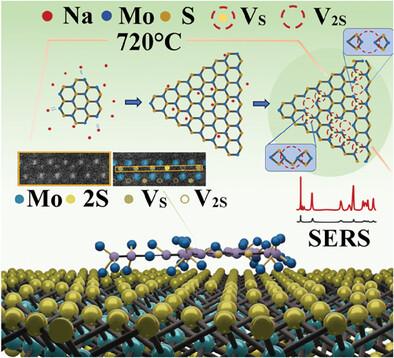
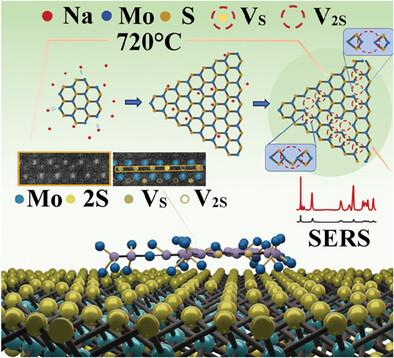
Two-dimensional molybdenum disulfide (2D MoS2) shows great promise as a surface-enhanced Raman scattering (SERS) substrate due to its strong exciton resonance. However, the inert basal plane limits the performance of SERS. In this work, a strategy is proposed for the one-step synthesis of atomically basal defect-rich MoS2. The study first reveals that NaCl plays a two-stage role in the growth process, where NaCl initially promotes the rapid growth of large MoS2 as previously reported, and then promotes the formation of atomic basal defects dominated by single sulfur vacancies. Additionally, spectral changes induced by modulation of experimental parameters and density function theory calculation show that defect generation occurs during cooling. Meanwhile, the ratio of to A1g in defect-rich MoS2 exhibits different variation trends compared with pristine MoS2 in power-dependent Raman, and the ratio increases with increasing basal defects. In SERS tests, the limit of detection for rhodamine 6G reached 10−9 m, which is comparable to the performance of conventional noble metal SERS substrate. The activation strategy of the inert basal plane is applicable to other 2D transition metal dichalcogenides, and further has the potential to enhance performance in other domains, such as SERS and hydrogen evolution reactions.
期刊介绍:
Small serves as an exceptional platform for both experimental and theoretical studies in fundamental and applied interdisciplinary research at the nano- and microscale. The journal offers a compelling mix of peer-reviewed Research Articles, Reviews, Perspectives, and Comments.
With a remarkable 2022 Journal Impact Factor of 13.3 (Journal Citation Reports from Clarivate Analytics, 2023), Small remains among the top multidisciplinary journals, covering a wide range of topics at the interface of materials science, chemistry, physics, engineering, medicine, and biology.
Small's readership includes biochemists, biologists, biomedical scientists, chemists, engineers, information technologists, materials scientists, physicists, and theoreticians alike.

 求助内容:
求助内容: 应助结果提醒方式:

 京公网安备 11010802042870号


