Li Ding , Yangzheng Huang , Le Shi , Youcai Chen , Dandan Cheng , Haoyu Zhan , Shao-Lu Li , Chunrui Wu
{"title":"Tris-phenol phosphine oxide-based polyester loose nanofiltration membranes with a three-dimensional structure for efficient dye/salt separation","authors":"Li Ding , Yangzheng Huang , Le Shi , Youcai Chen , Dandan Cheng , Haoyu Zhan , Shao-Lu Li , Chunrui Wu","doi":"10.1016/j.seppur.2024.128962","DOIUrl":null,"url":null,"abstract":"<div><p>Loose nanofiltration (LNF) membranes prepared by hydroxyl monomers with good dye rejection and inorganic salt permeation properties have attracted significant attention for treating salt-containing textile wastewater. This study adopted interfacial polymerization (IP) method to fabricate a novel polyester LNF membrane, in which tris (4-hydroxyphenyl) phosphine oxide (THPPO) with a steric structure was employed as the solely aqueous monomer. To enhance the solubility and esterification reaction activity of THPPO, sodium hydroxide (NaOH) was specially adopted in aqueous phase, helping the development of the polyester selective layer. The findings demonstrated that the prepared ultrathin (30–38 nm) polyester selective layer exhibited a smooth surface with a negative charge. The optimal membrane LNF-0.05 exhibited a good water permeance of 20.8 L m<sup>−2</sup> h<sup>−1</sup> bar<sup>−1</sup>, excellent rejection of anionic dyes (99.6 % for EBT, 99.3 % for CR, 98.8 % for DR 23, and 98.1 % for MB), and low rejection of monovalent salts (8.2 % for NaCl, 5.0 % for MgCl<sub>2</sub>), showing excellent EBT/NaCl mixture selectivity as high as 221. The performance stability of the membranes was partially testified by continuous filtration process. These results confirm the significant application potential of tris-phenol phosphine oxide-based polyester LNF membrane for treating saline textile wastewater.</p></div>","PeriodicalId":427,"journal":{"name":"Separation and Purification Technology","volume":"354 ","pages":"Article 128962"},"PeriodicalIF":9.1000,"publicationDate":"2025-02-19","publicationTypes":"Journal Article","fieldsOfStudy":null,"isOpenAccess":false,"openAccessPdf":"","citationCount":"0","resultStr":null,"platform":"Semanticscholar","paperid":null,"PeriodicalName":"Separation and Purification Technology","FirstCategoryId":"5","ListUrlMain":"https://www.sciencedirect.com/science/article/pii/S1383586624027011","RegionNum":1,"RegionCategory":"工程技术","ArticlePicture":[],"TitleCN":null,"AbstractTextCN":null,"PMCID":null,"EPubDate":"2024/7/27 0:00:00","PubModel":"Epub","JCR":"Q1","JCRName":"ENGINEERING, CHEMICAL","Score":null,"Total":0}
引用次数: 0
Abstract
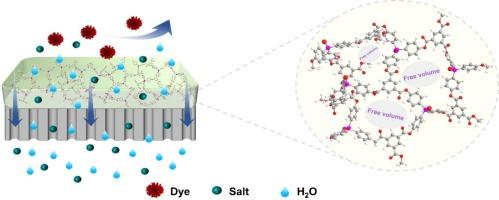
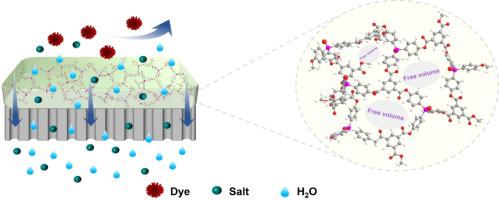
Loose nanofiltration (LNF) membranes prepared by hydroxyl monomers with good dye rejection and inorganic salt permeation properties have attracted significant attention for treating salt-containing textile wastewater. This study adopted interfacial polymerization (IP) method to fabricate a novel polyester LNF membrane, in which tris (4-hydroxyphenyl) phosphine oxide (THPPO) with a steric structure was employed as the solely aqueous monomer. To enhance the solubility and esterification reaction activity of THPPO, sodium hydroxide (NaOH) was specially adopted in aqueous phase, helping the development of the polyester selective layer. The findings demonstrated that the prepared ultrathin (30–38 nm) polyester selective layer exhibited a smooth surface with a negative charge. The optimal membrane LNF-0.05 exhibited a good water permeance of 20.8 L m−2 h−1 bar−1, excellent rejection of anionic dyes (99.6 % for EBT, 99.3 % for CR, 98.8 % for DR 23, and 98.1 % for MB), and low rejection of monovalent salts (8.2 % for NaCl, 5.0 % for MgCl2), showing excellent EBT/NaCl mixture selectivity as high as 221. The performance stability of the membranes was partially testified by continuous filtration process. These results confirm the significant application potential of tris-phenol phosphine oxide-based polyester LNF membrane for treating saline textile wastewater.
期刊介绍:
Separation and Purification Technology is a premier journal committed to sharing innovative methods for separation and purification in chemical and environmental engineering, encompassing both homogeneous solutions and heterogeneous mixtures. Our scope includes the separation and/or purification of liquids, vapors, and gases, as well as carbon capture and separation techniques. However, it's important to note that methods solely intended for analytical purposes are not within the scope of the journal. Additionally, disciplines such as soil science, polymer science, and metallurgy fall outside the purview of Separation and Purification Technology. Join us in advancing the field of separation and purification methods for sustainable solutions in chemical and environmental engineering.

 求助内容:
求助内容: 应助结果提醒方式:

 京公网安备 11010802042870号


