Xunsi Qin, Mingjun Cao, Tianliu Peng, Hongying Shan, Weisi Lian, Yang Yu, Guanghou Shui and Rong Li*,
{"title":"Features, Potential Invasion Pathways, and Reproductive Health Risks of Microplastics Detected in Human Uterus","authors":"Xunsi Qin, Mingjun Cao, Tianliu Peng, Hongying Shan, Weisi Lian, Yang Yu, Guanghou Shui and Rong Li*, ","doi":"10.1021/acs.est.4c01541","DOIUrl":null,"url":null,"abstract":"<p >Microplastics (MPs) are ubiquitous in global ecosystems and may pose a potential risk to human health. However, critical information on MP exposure and risk to female reproductive health is still lacking. In this study, we characterized MPs in human endometrium and investigated their size-dependent entry mode as well as potential reproductive toxicity. Endometrial tissues of 22 female patients were examined, revealing that human endometrium was contaminated with MPs, mainly polyamide (PA), polyurethane (PU), polyethylene terephthalate (PET), polypropylene (PP), polystyrene (PS), and polyethylene (PE), ranging from 2–200 μm in size. Experiments conducted in mice demonstrated that the invasion of the uterus by MPs was modulated either through diet–blood circulation (micrometer-sized particles) or via the vagina–uterine lacuna mode (larger particles reaching a size of 100 μm. Intravenous exposure to MPs resulted in reduced fertility and abnormal sex ratio in mouse offspring (<i>P</i> < 0.05). After 3.5 months of intragastric exposure, there was a significant inflammatory response in the endometrium (<i>P</i> < 0.05), confirmed by embryo transfer as a uterine factor leading to decreased fertility. Furthermore, human endometrial organoids cultured with MPs <i>in vitro</i> exhibited significantly apoptotic responses and disrupted growth patterns (<i>P</i> < 0.01). These findings raise significant concerns regarding MP contamination in the human uterus and its potential effects on reproductive health.</p>","PeriodicalId":36,"journal":{"name":"环境科学与技术","volume":"58 24","pages":"10482–10493"},"PeriodicalIF":12.2000,"publicationDate":"2024-06-03","publicationTypes":"Journal Article","fieldsOfStudy":null,"isOpenAccess":false,"openAccessPdf":"","citationCount":"0","resultStr":null,"platform":"Semanticscholar","paperid":null,"PeriodicalName":"环境科学与技术","FirstCategoryId":"1","ListUrlMain":"https://pubs.acs.org/doi/10.1021/acs.est.4c01541","RegionNum":1,"RegionCategory":"环境科学与生态学","ArticlePicture":[],"TitleCN":null,"AbstractTextCN":null,"PMCID":null,"EPubDate":"","PubModel":"","JCR":"Q1","JCRName":"ENGINEERING, ENVIRONMENTAL","Score":null,"Total":0}
引用次数: 0
Abstract
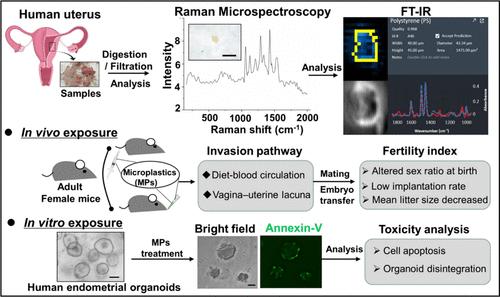
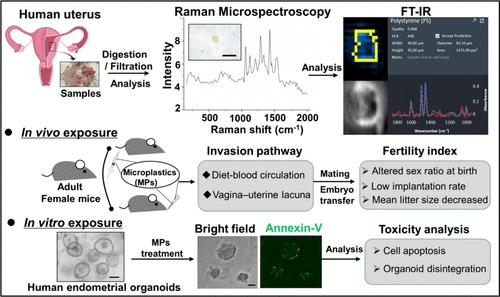
Microplastics (MPs) are ubiquitous in global ecosystems and may pose a potential risk to human health. However, critical information on MP exposure and risk to female reproductive health is still lacking. In this study, we characterized MPs in human endometrium and investigated their size-dependent entry mode as well as potential reproductive toxicity. Endometrial tissues of 22 female patients were examined, revealing that human endometrium was contaminated with MPs, mainly polyamide (PA), polyurethane (PU), polyethylene terephthalate (PET), polypropylene (PP), polystyrene (PS), and polyethylene (PE), ranging from 2–200 μm in size. Experiments conducted in mice demonstrated that the invasion of the uterus by MPs was modulated either through diet–blood circulation (micrometer-sized particles) or via the vagina–uterine lacuna mode (larger particles reaching a size of 100 μm. Intravenous exposure to MPs resulted in reduced fertility and abnormal sex ratio in mouse offspring (P < 0.05). After 3.5 months of intragastric exposure, there was a significant inflammatory response in the endometrium (P < 0.05), confirmed by embryo transfer as a uterine factor leading to decreased fertility. Furthermore, human endometrial organoids cultured with MPs in vitro exhibited significantly apoptotic responses and disrupted growth patterns (P < 0.01). These findings raise significant concerns regarding MP contamination in the human uterus and its potential effects on reproductive health.
期刊介绍:
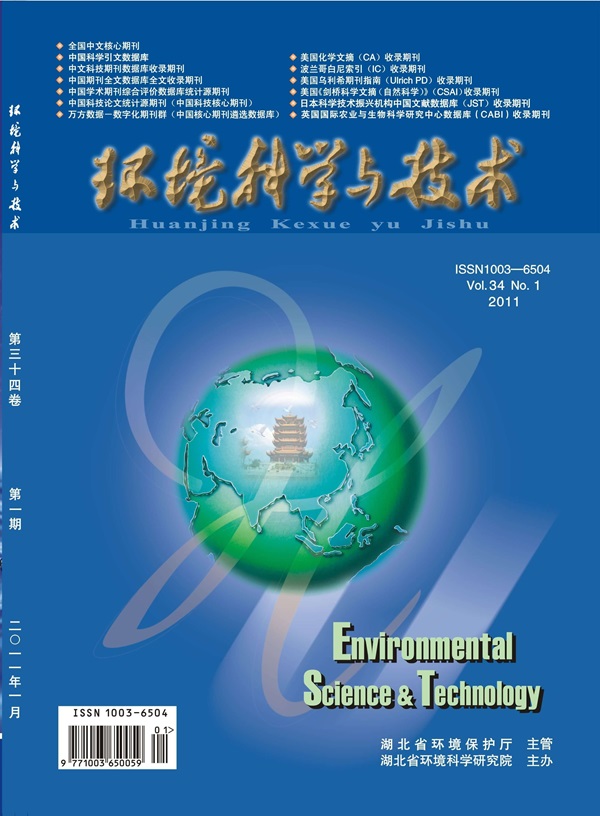
Environmental Science & Technology (ES&T) is a co-sponsored academic and technical magazine by the Hubei Provincial Environmental Protection Bureau and the Hubei Provincial Academy of Environmental Sciences.
Environmental Science & Technology (ES&T) holds the status of Chinese core journals, scientific papers source journals of China, Chinese Science Citation Database source journals, and Chinese Academic Journal Comprehensive Evaluation Database source journals. This publication focuses on the academic field of environmental protection, featuring articles related to environmental protection and technical advancements.

 求助内容:
求助内容: 应助结果提醒方式:

 京公网安备 11010802042870号


