Geunsu Bae, Han Chang Kwon*, Man Ho Han, Hyung-Suk Oh, Frédéric Jaouen* and Chang Hyuck Choi*,
{"title":"Single-Site-Level Deciphering of the Complexity of Electrochemical Oxygen Reduction on Fe–N–C Catalysts","authors":"Geunsu Bae, Han Chang Kwon*, Man Ho Han, Hyung-Suk Oh, Frédéric Jaouen* and Chang Hyuck Choi*, ","doi":"10.1021/acscatal.4c01640","DOIUrl":null,"url":null,"abstract":"<p >Fe–N–C catalysts are emerging as potential alternatives to platinum in the oxygen reduction reaction (ORR) for fuel cell cathodes. The challenge in optimizing these catalysts lies in their structural complexity and the multiplicity of reaction pathways. Here, we employ a series of model catalysts with varying amounts of Fe–N<sub><i>x</i></sub> and Fe nanoparticles (NPs) and estimate their turnover frequency (TOF) for apparent H<sub>2</sub>O and H<sub>2</sub>O<sub>2</sub> production at different catalyst loadings. This approach highlights the importance of the surface site density (SD) of Fe–N<sub><i>x</i></sub> moieties in determining the overall ORR activity, selectivity, and even stability. We uncover that increasing the SD of Fe–N<sub><i>x</i></sub> moieties fosters the indirect 4e<sup>–</sup> ORR pathway and consequently promotes their TOF toward preferential H<sub>2</sub>O production. In contrast, Fe NPs, often formed at high Fe contents, behave as anticatalysts (or spectators) in this context. Indeed, an online inductively coupled plasma-mass spectrometry (ICP-MS) study reveals that a higher SD can lead to the faster leaching of Fe–N<sub><i>x</i></sub> moieties during operation, resulting in accelerated activity decline. Taken together, the comprehensive understanding of the intricate dependence of catalytic activity and stability on the nature and amount of Fe species provides a basis for design principles of next-generation Fe–N–C catalysts.</p>","PeriodicalId":9,"journal":{"name":"ACS Catalysis ","volume":"14 11","pages":"8184–8192"},"PeriodicalIF":13.1000,"publicationDate":"2024-05-10","publicationTypes":"Journal Article","fieldsOfStudy":null,"isOpenAccess":false,"openAccessPdf":"","citationCount":"0","resultStr":null,"platform":"Semanticscholar","paperid":null,"PeriodicalName":"ACS Catalysis ","FirstCategoryId":"92","ListUrlMain":"https://pubs.acs.org/doi/10.1021/acscatal.4c01640","RegionNum":1,"RegionCategory":"化学","ArticlePicture":[],"TitleCN":null,"AbstractTextCN":null,"PMCID":null,"EPubDate":"","PubModel":"","JCR":"Q1","JCRName":"CHEMISTRY, PHYSICAL","Score":null,"Total":0}
引用次数: 0
Abstract
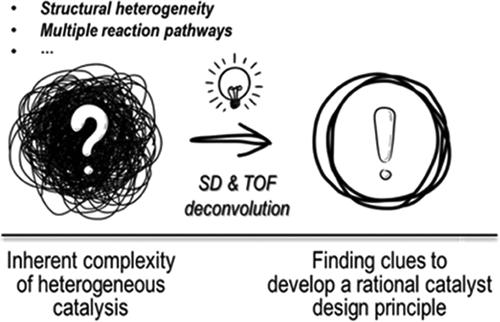
Fe–N–C catalysts are emerging as potential alternatives to platinum in the oxygen reduction reaction (ORR) for fuel cell cathodes. The challenge in optimizing these catalysts lies in their structural complexity and the multiplicity of reaction pathways. Here, we employ a series of model catalysts with varying amounts of Fe–Nx and Fe nanoparticles (NPs) and estimate their turnover frequency (TOF) for apparent H2O and H2O2 production at different catalyst loadings. This approach highlights the importance of the surface site density (SD) of Fe–Nx moieties in determining the overall ORR activity, selectivity, and even stability. We uncover that increasing the SD of Fe–Nx moieties fosters the indirect 4e– ORR pathway and consequently promotes their TOF toward preferential H2O production. In contrast, Fe NPs, often formed at high Fe contents, behave as anticatalysts (or spectators) in this context. Indeed, an online inductively coupled plasma-mass spectrometry (ICP-MS) study reveals that a higher SD can lead to the faster leaching of Fe–Nx moieties during operation, resulting in accelerated activity decline. Taken together, the comprehensive understanding of the intricate dependence of catalytic activity and stability on the nature and amount of Fe species provides a basis for design principles of next-generation Fe–N–C catalysts.
期刊介绍:
ACS Catalysis is an esteemed journal that publishes original research in the fields of heterogeneous catalysis, molecular catalysis, and biocatalysis. It offers broad coverage across diverse areas such as life sciences, organometallics and synthesis, photochemistry and electrochemistry, drug discovery and synthesis, materials science, environmental protection, polymer discovery and synthesis, and energy and fuels.
The scope of the journal is to showcase innovative work in various aspects of catalysis. This includes new reactions and novel synthetic approaches utilizing known catalysts, the discovery or modification of new catalysts, elucidation of catalytic mechanisms through cutting-edge investigations, practical enhancements of existing processes, as well as conceptual advances in the field. Contributions to ACS Catalysis can encompass both experimental and theoretical research focused on catalytic molecules, macromolecules, and materials that exhibit catalytic turnover.


 求助内容:
求助内容: 应助结果提醒方式:

 京公网安备 11010802042870号


