Jinsong Liu, Changyin Zhu*, Fengxiao Zhu, Haitao Sun, Jin Wang, Guodong Fang and Dongmei Zhou*,
{"title":"Strong Substance Exchange at Paddy Soil-Water Interface Promotes Nonphotochemical Formation of Reactive Oxygen Species in Overlying Water","authors":"Jinsong Liu, Changyin Zhu*, Fengxiao Zhu, Haitao Sun, Jin Wang, Guodong Fang and Dongmei Zhou*, ","doi":"10.1021/acs.est.3c10866","DOIUrl":null,"url":null,"abstract":"<p >Photochemically generated reactive oxygen species (ROS) are widespread on the earth’s surface under sunlight irradiation. However, the nonphotochemical ROS generation in surface water (e.g., paddy overlying water) has been largely neglected. This work elucidated the drivers of nonphotochemical ROS generation and its spatial distribution in undisturbed paddy overlying water, by combining ROS imaging technology with <i>in situ</i> ROS monitoring. It was found that H<sub>2</sub>O<sub>2</sub> concentrations formed in three paddy overlying waters could reach 0.03–16.9 μM, and the ROS profiles exhibited spatial heterogeneity. The O<sub>2</sub> planar-optode indicated that redox interfaces were not always generated at the soil–water interface but also possibly in the water layer, depending on the soil properties. The formed redox interface facilitated a rapid turnover of reducing and oxidizing substances, creating an ideal environment for the generation of ROS. Additionally, the electron-donating capacities of water at soil–water interfaces increased by 4.5–8.4 times compared to that of the top water layers. Importantly, field investigation results confirmed that sustainable •OH generation through nonphotochemical pathways constituted of a significant proportion of total daily production (>50%), suggesting a comparable or even greater role than photochemical ROS generation. In summary, the nonphotochemical ROS generation process reported in this study greatly enhances the understanding of natural ROS production processes in paddy soils.</p>","PeriodicalId":36,"journal":{"name":"环境科学与技术","volume":"58 17","pages":"7403–7414"},"PeriodicalIF":12.2000,"publicationDate":"2024-04-16","publicationTypes":"Journal Article","fieldsOfStudy":null,"isOpenAccess":false,"openAccessPdf":"","citationCount":"0","resultStr":null,"platform":"Semanticscholar","paperid":null,"PeriodicalName":"环境科学与技术","FirstCategoryId":"1","ListUrlMain":"https://pubs.acs.org/doi/10.1021/acs.est.3c10866","RegionNum":1,"RegionCategory":"环境科学与生态学","ArticlePicture":[],"TitleCN":null,"AbstractTextCN":null,"PMCID":null,"EPubDate":"","PubModel":"","JCR":"Q1","JCRName":"ENGINEERING, ENVIRONMENTAL","Score":null,"Total":0}
引用次数: 0
Abstract
Photochemically generated reactive oxygen species (ROS) are widespread on the earth’s surface under sunlight irradiation. However, the nonphotochemical ROS generation in surface water (e.g., paddy overlying water) has been largely neglected. This work elucidated the drivers of nonphotochemical ROS generation and its spatial distribution in undisturbed paddy overlying water, by combining ROS imaging technology with in situ ROS monitoring. It was found that H2O2 concentrations formed in three paddy overlying waters could reach 0.03–16.9 μM, and the ROS profiles exhibited spatial heterogeneity. The O2 planar-optode indicated that redox interfaces were not always generated at the soil–water interface but also possibly in the water layer, depending on the soil properties. The formed redox interface facilitated a rapid turnover of reducing and oxidizing substances, creating an ideal environment for the generation of ROS. Additionally, the electron-donating capacities of water at soil–water interfaces increased by 4.5–8.4 times compared to that of the top water layers. Importantly, field investigation results confirmed that sustainable •OH generation through nonphotochemical pathways constituted of a significant proportion of total daily production (>50%), suggesting a comparable or even greater role than photochemical ROS generation. In summary, the nonphotochemical ROS generation process reported in this study greatly enhances the understanding of natural ROS production processes in paddy soils.
期刊介绍:
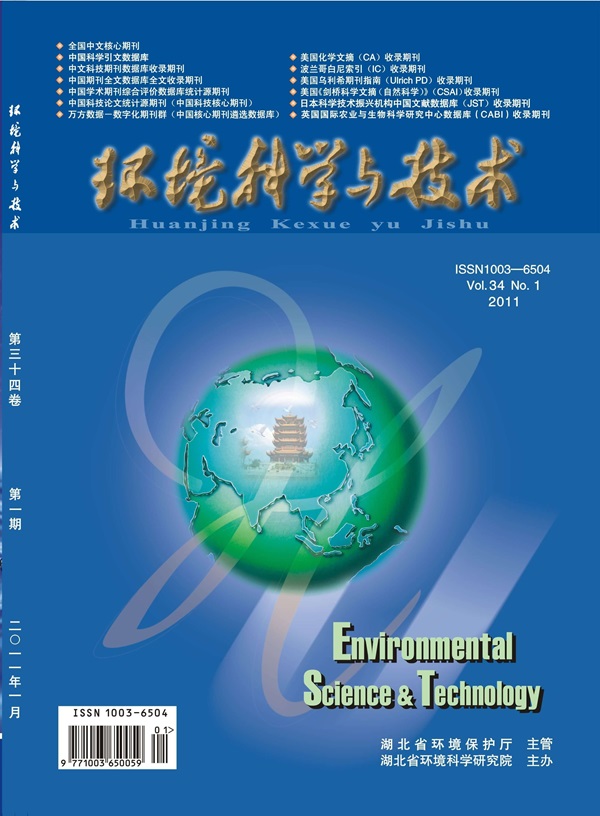
Environmental Science & Technology (ES&T) is a co-sponsored academic and technical magazine by the Hubei Provincial Environmental Protection Bureau and the Hubei Provincial Academy of Environmental Sciences.
Environmental Science & Technology (ES&T) holds the status of Chinese core journals, scientific papers source journals of China, Chinese Science Citation Database source journals, and Chinese Academic Journal Comprehensive Evaluation Database source journals. This publication focuses on the academic field of environmental protection, featuring articles related to environmental protection and technical advancements.



 求助内容:
 应助结果提醒方式:


 京公网安备 11010802042870号


