{"title":"Biomimetic Guttation Feature in 2D Hydrotalcite Membranes for Self-Sustaining Water Purification","authors":"Zhi-Wei Fan, Jie Zhang, Bo-Yu Zuo, Xiao-Bao Tian, Zhifeng Wang, Xiao-Jie Ju, Rui Xie, Wei Wang, Da-Wei Pan, Zhuang Liu, Liang-Yin Chu","doi":"10.1002/adfm.202316247","DOIUrl":null,"url":null,"abstract":"<p>Significant achievements have been made in membrane-based nanofiltration to combat global micropollutant contamination in aquatic environments, but the current water purification membranes have been constrained by the inherent limitations of substantial operating pressure gradients. Here, a novel solution inspired by natural guttation process observed in plants is presented. This biomimetic guttation feature is realized in the 2D hydrotalcite membranes composed of layered double hydroxides (LDHs), which spontaneously exhibit water seepage, akin to the expulsion of excess liquid from plant leaves in nature. This self-sustaining water permeation is attributed to the surface force-pore flow mechanism. Unlike conventional membranes requiring external operating pressure, the guttation flux positively correlates with LDH membrane thickness up to a threshold point. Further demonstration shows the potential of the membrane by achieving over 99% rejection of small molecular weight organic dyes, for addressing micropollutant challenges. Leveraging the guttation feature, steric effects related to the <i>d</i>-spacing, and the chemical safety of LDH, the finding opens multiple opportunities for self-sustaining nanofiltration and forward osmosis applications, such as pharmaceuticals (e.g., protein purification) and food processing (e.g., fruit juice or milk concentration) standing to benefit significantly from this innovative technology.</p>","PeriodicalId":112,"journal":{"name":"Advanced Functional Materials","volume":"34 26","pages":""},"PeriodicalIF":19.9000,"publicationDate":"2024-02-25","publicationTypes":"Journal Article","fieldsOfStudy":null,"isOpenAccess":false,"openAccessPdf":"","citationCount":"0","resultStr":null,"platform":"Semanticscholar","paperid":null,"PeriodicalName":"Advanced Functional Materials","FirstCategoryId":"88","ListUrlMain":"https://advanced.onlinelibrary.wiley.com/doi/10.1002/adfm.202316247","RegionNum":1,"RegionCategory":"材料科学","ArticlePicture":[],"TitleCN":null,"AbstractTextCN":null,"PMCID":null,"EPubDate":"","PubModel":"","JCR":"Q1","JCRName":"CHEMISTRY, MULTIDISCIPLINARY","Score":null,"Total":0}
引用次数: 0
Abstract
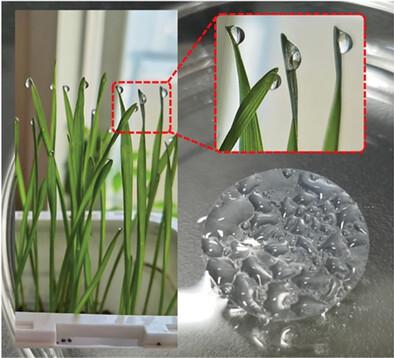
Significant achievements have been made in membrane-based nanofiltration to combat global micropollutant contamination in aquatic environments, but the current water purification membranes have been constrained by the inherent limitations of substantial operating pressure gradients. Here, a novel solution inspired by natural guttation process observed in plants is presented. This biomimetic guttation feature is realized in the 2D hydrotalcite membranes composed of layered double hydroxides (LDHs), which spontaneously exhibit water seepage, akin to the expulsion of excess liquid from plant leaves in nature. This self-sustaining water permeation is attributed to the surface force-pore flow mechanism. Unlike conventional membranes requiring external operating pressure, the guttation flux positively correlates with LDH membrane thickness up to a threshold point. Further demonstration shows the potential of the membrane by achieving over 99% rejection of small molecular weight organic dyes, for addressing micropollutant challenges. Leveraging the guttation feature, steric effects related to the d-spacing, and the chemical safety of LDH, the finding opens multiple opportunities for self-sustaining nanofiltration and forward osmosis applications, such as pharmaceuticals (e.g., protein purification) and food processing (e.g., fruit juice or milk concentration) standing to benefit significantly from this innovative technology.
期刊介绍:
Firmly established as a top-tier materials science journal, Advanced Functional Materials reports breakthrough research in all aspects of materials science, including nanotechnology, chemistry, physics, and biology every week.
Advanced Functional Materials is known for its rapid and fair peer review, quality content, and high impact, making it the first choice of the international materials science community.


 求助内容:
求助内容: 应助结果提醒方式:

 京公网安备 11010802042870号


