Zhihui Liu, Hai Liu, Minglu Li, Yichen Meng, Xiao Wang, Tianxiang Yan, Qun Fan, Shi Nee Lou, Wenquan Cui, Prof. Dr. Sheng Zhang
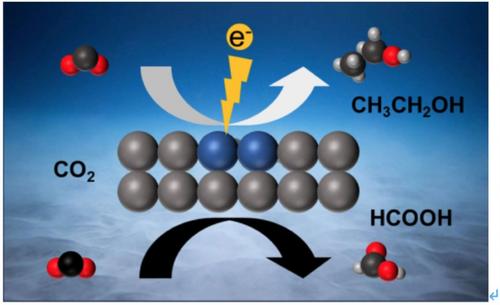
{"title":"Pd-Doped In2O3 for CO2 Electroreduction to Ethanol through CO Binding Regulation","authors":"Zhihui Liu, Hai Liu, Minglu Li, Yichen Meng, Xiao Wang, Tianxiang Yan, Qun Fan, Shi Nee Lou, Wenquan Cui, Prof. Dr. Sheng Zhang","doi":"10.1002/cctc.202301700","DOIUrl":null,"url":null,"abstract":"<p>Renewable energy driven electrochemical carbon dioxide reduction (CO<sub>2</sub>RR) to alcohols provides an effective pathway for achieving carbon neutrality and sustainable development. However, it is challenging to convert CO<sub>2</sub> into ethanol due to the sluggish C−C coupling and complex 12 electron/proton transferred process, which has been achieved mainly on Cu catalysts but with poor selectivity. Herein, In<sub>2</sub>O<sub>3</sub> catalysts were doped with small amount of Pd and exhibited high activity for CO<sub>2</sub>RR to ethanol with a high Faradaic efficiency (50.7 %) at low overpotential. The introduction of Pd promotes the transformation of reaction products from formic acid to ethanol by modulating the binding strength of *CO intermediates. The <i>in-situ</i> ATR-SEIRAS and DFT calculations proved that the formation of Pd−O−In could modulate the binding strength of *CO and enhanced its coverage, thus facilitating C−C coupling step towards ethanol. This study may provide a new strategy to the generation of high value-added products from CO<sub>2</sub> over Non-Cu-based catalysts.</p>","PeriodicalId":141,"journal":{"name":"ChemCatChem","volume":"16 10","pages":""},"PeriodicalIF":4.1000,"publicationDate":"2024-02-06","publicationTypes":"Journal Article","fieldsOfStudy":null,"isOpenAccess":false,"openAccessPdf":"","citationCount":"0","resultStr":null,"platform":"Semanticscholar","paperid":null,"PeriodicalName":"ChemCatChem","FirstCategoryId":"92","ListUrlMain":"https://chemistry-europe.onlinelibrary.wiley.com/doi/10.1002/cctc.202301700","RegionNum":3,"RegionCategory":"化学","ArticlePicture":[],"TitleCN":null,"AbstractTextCN":null,"PMCID":null,"EPubDate":"","PubModel":"","JCR":"Q2","JCRName":"CHEMISTRY, PHYSICAL","Score":null,"Total":0}
引用次数: 0
Abstract
Renewable energy driven electrochemical carbon dioxide reduction (CO2RR) to alcohols provides an effective pathway for achieving carbon neutrality and sustainable development. However, it is challenging to convert CO2 into ethanol due to the sluggish C−C coupling and complex 12 electron/proton transferred process, which has been achieved mainly on Cu catalysts but with poor selectivity. Herein, In2O3 catalysts were doped with small amount of Pd and exhibited high activity for CO2RR to ethanol with a high Faradaic efficiency (50.7 %) at low overpotential. The introduction of Pd promotes the transformation of reaction products from formic acid to ethanol by modulating the binding strength of *CO intermediates. The in-situ ATR-SEIRAS and DFT calculations proved that the formation of Pd−O−In could modulate the binding strength of *CO and enhanced its coverage, thus facilitating C−C coupling step towards ethanol. This study may provide a new strategy to the generation of high value-added products from CO2 over Non-Cu-based catalysts.
期刊介绍:
With an impact factor of 4.495 (2018), ChemCatChem is one of the premier journals in the field of catalysis. The journal provides primary research papers and critical secondary information on heterogeneous, homogeneous and bio- and nanocatalysis. The journal is well placed to strengthen cross-communication within between these communities. Its authors and readers come from academia, the chemical industry, and government laboratories across the world. It is published on behalf of Chemistry Europe, an association of 16 European chemical societies, and is supported by the German Catalysis Society.


 求助内容:
求助内容: 应助结果提醒方式:

 京公网安备 11010802042870号


