{"title":"Self-assembled dendrimer polyamide nanofilms with enhanced effective pore area for ion separation","authors":"Bingbing Yuan, Yuhang Zhang, Pengfei Qi, Dongxiao Yang, Ping Hu, Siheng Zhao, Kaili Zhang, Xiaozhuan Zhang, Meng You, Jiabao Cui, Juhui Jiang, Xiangdong Lou, Q. Jason Niu","doi":"10.1038/s41467-023-44530-2","DOIUrl":null,"url":null,"abstract":"<p>Membrane technology using well-defined pore structure can achieve high ion purity and recovery. However, fine-tuning the inner pore structure of the separation nanofilm to be uniform and enhance the effective pore area is still challenging. Here, we report dendrimers with different peripheral groups that preferentially self-assemble in aqueous-phase amine solution to facilitate the formation of polyamide nanofilms with a well-defined effective pore range and uniform pore structure. The high permeabilities are maintained by forming asymmetric hollow nanostripe nanofilms, and their well-designed ion effective separation pore ranges show an enhancement, rationalized by molecular simulation. The self-assembled dendrimer polyamide membrane provides Cl<sup>–</sup>/SO<sub>4</sub><sup>2–</sup> selectivity more than 17 times that of its pristine polyamide counterparts, increasing from 167.9 to 2883.0. Furthermore, the designed membranes achieve higher Li purity and Li recovery compared to current state-of-the-art membranes. Such an approach provides a scalable strategy to fine-tune subnanometre structures in ion separation nanofilms.</p>","PeriodicalId":19066,"journal":{"name":"Nature Communications","volume":"118 1","pages":""},"PeriodicalIF":18.1000,"publicationDate":"2024-01-11","publicationTypes":"Journal Article","fieldsOfStudy":null,"isOpenAccess":false,"openAccessPdf":"","citationCount":"0","resultStr":null,"platform":"Semanticscholar","paperid":null,"PeriodicalName":"Nature Communications","FirstCategoryId":"103","ListUrlMain":"https://doi.org/10.1038/s41467-023-44530-2","RegionNum":1,"RegionCategory":"综合性期刊","ArticlePicture":[],"TitleCN":null,"AbstractTextCN":null,"PMCID":null,"EPubDate":"","PubModel":"","JCR":"Q1","JCRName":"MULTIDISCIPLINARY SCIENCES","Score":null,"Total":0}
引用次数: 0
Abstract
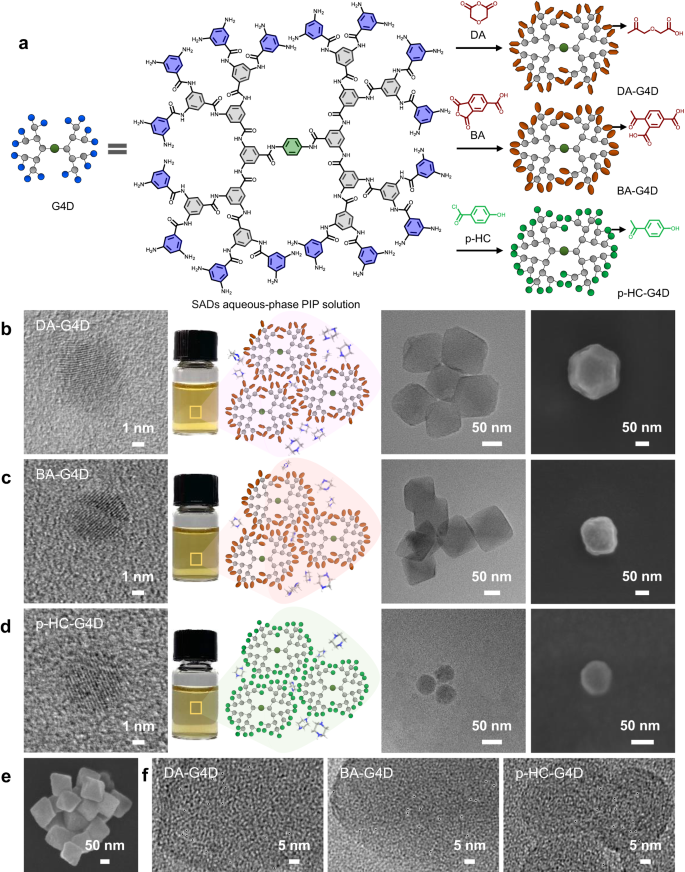
Membrane technology using well-defined pore structure can achieve high ion purity and recovery. However, fine-tuning the inner pore structure of the separation nanofilm to be uniform and enhance the effective pore area is still challenging. Here, we report dendrimers with different peripheral groups that preferentially self-assemble in aqueous-phase amine solution to facilitate the formation of polyamide nanofilms with a well-defined effective pore range and uniform pore structure. The high permeabilities are maintained by forming asymmetric hollow nanostripe nanofilms, and their well-designed ion effective separation pore ranges show an enhancement, rationalized by molecular simulation. The self-assembled dendrimer polyamide membrane provides Cl–/SO42– selectivity more than 17 times that of its pristine polyamide counterparts, increasing from 167.9 to 2883.0. Furthermore, the designed membranes achieve higher Li purity and Li recovery compared to current state-of-the-art membranes. Such an approach provides a scalable strategy to fine-tune subnanometre structures in ion separation nanofilms.
期刊介绍:
Nature Communications, an open-access journal, publishes high-quality research spanning all areas of the natural sciences. Papers featured in the journal showcase significant advances relevant to specialists in each respective field. With a 2-year impact factor of 16.6 (2022) and a median time of 8 days from submission to the first editorial decision, Nature Communications is committed to rapid dissemination of research findings. As a multidisciplinary journal, it welcomes contributions from biological, health, physical, chemical, Earth, social, mathematical, applied, and engineering sciences, aiming to highlight important breakthroughs within each domain.

 求助内容:
求助内容: 应助结果提醒方式:

 京公网安备 11010802042870号


