Yi-Chu Chen , Peter Malfertheiner , Hao-Ting Yu , Chih-Lin Kuo , Yung-Yueh Chang , Fan-Tsui Meng , Yu-Xuan Wu , Juo-Lun Hsiao , Mei-Jyh Chen , Kun-Pei Lin , Chun-Ying Wu , Jaw-Town Lin , Colm O’Morain , Francis Megraud , Wen-Chung Lee , Emad M. El-Omar , Ming-Shiang Wu , Jyh-Ming Liou
{"title":"Global Prevalence of Helicobacter pylori Infection and Incidence of Gastric Cancer Between 1980 and 2022","authors":"Yi-Chu Chen , Peter Malfertheiner , Hao-Ting Yu , Chih-Lin Kuo , Yung-Yueh Chang , Fan-Tsui Meng , Yu-Xuan Wu , Juo-Lun Hsiao , Mei-Jyh Chen , Kun-Pei Lin , Chun-Ying Wu , Jaw-Town Lin , Colm O’Morain , Francis Megraud , Wen-Chung Lee , Emad M. El-Omar , Ming-Shiang Wu , Jyh-Ming Liou","doi":"10.1053/j.gastro.2023.12.022","DOIUrl":null,"url":null,"abstract":"<div><h3>Background & Aims</h3><p>We aimed to assess the secular trend of the global prevalence of <em>Helicobacter pylori (H pylori)</em> infection in adults and children/adolescents and to show its relation to that of gastric cancer incidence.</p></div><div><h3>Methods</h3><p>We performed a systematic review and meta-analysis to calculate overall prevalence, adjusted by multivariate meta-regression analysis. The incidence rates of gastric cancer were derived from the Global Burden of Disease Study and Cancer Incidence in Five Continents.</p></div><div><h3>Results</h3><p>Of the 16,976 articles screened, 1748 articles from 111 countries were eligible for analysis. The crude global prevalence of <em>H pylori</em> has reduced from 52.6% (95% confidence interval [CI], 49.6%–55.6%) before 1990 to 43.9% (95% CI, 42.3%–45.5%) in adults during 2015 through 2022, but was as still as high as 35.1% (95% CI, 30.5%–40.1%) in children and adolescents during 2015 through 2022. Secular trend and multivariate regression analyses showed that the global prevalence of <em>H pylori</em> has declined by 15.9% (95% CI, −20.5% to −11.3%) over the last 3 decades in adults, but not in children and adolescents. Significant reduction of <em>H pylori</em> prevalence was observed in adults in the Western Pacific, Southeast Asian, and African regions. However, <em>H pylori</em> prevalence was not significantly reduced in children and adolescents in any World Health Organization regions. The incidence of gastric cancer has decreased globally and in various countries where the prevalence of <em>H pylori</em> infection has declined.</p></div><div><h3>Conclusions</h3><p>The global prevalence of <em>H pylori</em> infection has declined during the last 3 decades in adults, but not in children and adolescents. The results raised the hypothesis that the public health drive to reduce the prevalence of <em>H pylori</em> as a strategy to reduce the incidence of gastric cancer in the population should be confirmed in large-scale clinical trials.</p></div>","PeriodicalId":12590,"journal":{"name":"Gastroenterology","volume":"166 4","pages":"Pages 605-619"},"PeriodicalIF":29.7000,"publicationDate":"2024-04-01","publicationTypes":"Journal Article","fieldsOfStudy":null,"isOpenAccess":false,"openAccessPdf":"","citationCount":"0","resultStr":null,"platform":"Semanticscholar","paperid":null,"PeriodicalName":"Gastroenterology","FirstCategoryId":"3","ListUrlMain":"https://www.sciencedirect.com/science/article/pii/S0016508523056871","RegionNum":1,"RegionCategory":"医学","ArticlePicture":[],"TitleCN":null,"AbstractTextCN":null,"PMCID":null,"EPubDate":"2024/1/2 0:00:00","PubModel":"Epub","JCR":"Q1","JCRName":"GASTROENTEROLOGY & HEPATOLOGY","Score":null,"Total":0}
引用次数: 0
Abstract
Background & Aims
We aimed to assess the secular trend of the global prevalence of Helicobacter pylori (H pylori) infection in adults and children/adolescents and to show its relation to that of gastric cancer incidence.
Methods
We performed a systematic review and meta-analysis to calculate overall prevalence, adjusted by multivariate meta-regression analysis. The incidence rates of gastric cancer were derived from the Global Burden of Disease Study and Cancer Incidence in Five Continents.
Results
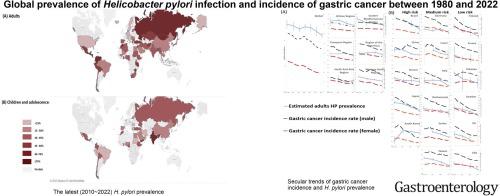
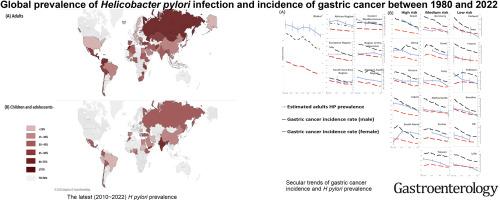
Of the 16,976 articles screened, 1748 articles from 111 countries were eligible for analysis. The crude global prevalence of H pylori has reduced from 52.6% (95% confidence interval [CI], 49.6%–55.6%) before 1990 to 43.9% (95% CI, 42.3%–45.5%) in adults during 2015 through 2022, but was as still as high as 35.1% (95% CI, 30.5%–40.1%) in children and adolescents during 2015 through 2022. Secular trend and multivariate regression analyses showed that the global prevalence of H pylori has declined by 15.9% (95% CI, −20.5% to −11.3%) over the last 3 decades in adults, but not in children and adolescents. Significant reduction of H pylori prevalence was observed in adults in the Western Pacific, Southeast Asian, and African regions. However, H pylori prevalence was not significantly reduced in children and adolescents in any World Health Organization regions. The incidence of gastric cancer has decreased globally and in various countries where the prevalence of H pylori infection has declined.
Conclusions
The global prevalence of H pylori infection has declined during the last 3 decades in adults, but not in children and adolescents. The results raised the hypothesis that the public health drive to reduce the prevalence of H pylori as a strategy to reduce the incidence of gastric cancer in the population should be confirmed in large-scale clinical trials.
期刊介绍:
Gastroenterology is the most prominent journal in the field of gastrointestinal disease. It is the flagship journal of the American Gastroenterological Association and delivers authoritative coverage of clinical, translational, and basic studies of all aspects of the digestive system, including the liver and pancreas, as well as nutrition.
Some regular features of Gastroenterology include original research studies by leading authorities, comprehensive reviews and perspectives on important topics in adult and pediatric gastroenterology and hepatology. The journal also includes features such as editorials, correspondence, and commentaries, as well as special sections like "Mentoring, Education and Training Corner," "Diversity, Equity and Inclusion in GI," "Gastro Digest," "Gastro Curbside Consult," and "Gastro Grand Rounds."
Gastroenterology also provides digital media materials such as videos and "GI Rapid Reel" animations. It is abstracted and indexed in various databases including Scopus, Biological Abstracts, Current Contents, Embase, Nutrition Abstracts, Chemical Abstracts, Current Awareness in Biological Sciences, PubMed/Medline, and the Science Citation Index.

 求助内容:
求助内容: 应助结果提醒方式:

 京公网安备 11010802042870号


