Life-cycle energy demand comparison of medium voltage Silicon IGBT and Silicon Carbide MOSFET power semiconductor modules in railway traction applications
{"title":"Life-cycle energy demand comparison of medium voltage Silicon IGBT and Silicon Carbide MOSFET power semiconductor modules in railway traction applications","authors":"Lucas Barroso Spejo , Innocent Akor , Munaf Rahimo , Renato Amaral Minamisawa","doi":"10.1016/j.pedc.2023.100050","DOIUrl":null,"url":null,"abstract":"<div><p>Power semiconductors process roughly 70 % of global energy, with a higher percentage expected as worldwide transport electrification, renewables and wide-band-gap (WBG) semiconductors are implemented, significantly affecting global energy savings. This manuscript evaluates the cumulative energy demand (CED) encompassing the manufacture and use-phase in a railway traction application of silicon (Si) and silicon carbide (SiC) power semiconductor modules. Realistic manufacturing data from a power semiconductor fab has been considered for 3.3 kV/450 A state-of-the-art Si and SiC LinPak modules. SiC devices presented around 2.6 – 3.8× higher CED per area than Si devices in the manufacturing phase. However, due to the considerably smaller SiC chip area per ampere required, a 1.1 – 1.6× lower grey energy than Si technology is estimated. For the first time, such analysis is based on specialized power semiconductor fab data for both technologies and provides a baseline for the life cycle energy assessment of power electronics systems. Besides, the use-phase energy losses were evaluated for a realistic railway application, considering an operational lifetime of 30 years. The module manufacturing energy is negligible compared to the use-phase stage. Furthermore, the SiC technology presented an estimated energy-saving potential of 24 MWh/lifetime per module compared to the Si device.</p></div>","PeriodicalId":74483,"journal":{"name":"Power electronic devices and components","volume":"6 ","pages":"Article 100050"},"PeriodicalIF":0.0000,"publicationDate":"2023-10-01","publicationTypes":"Journal Article","fieldsOfStudy":null,"isOpenAccess":false,"openAccessPdf":"https://www.sciencedirect.com/science/article/pii/S2772370423000184/pdfft?md5=c9eabbadc44e9325c045e520ae757d21&pid=1-s2.0-S2772370423000184-main.pdf","citationCount":"0","resultStr":null,"platform":"Semanticscholar","paperid":null,"PeriodicalName":"Power electronic devices and components","FirstCategoryId":"1085","ListUrlMain":"https://www.sciencedirect.com/science/article/pii/S2772370423000184","RegionNum":0,"RegionCategory":null,"ArticlePicture":[],"TitleCN":null,"AbstractTextCN":null,"PMCID":null,"EPubDate":"2023/11/7 0:00:00","PubModel":"Epub","JCR":"","JCRName":"","Score":null,"Total":0}
引用次数: 0
Abstract
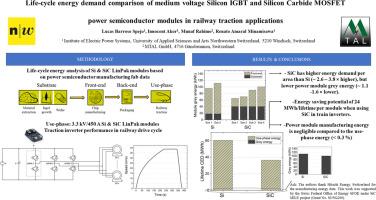
Power semiconductors process roughly 70 % of global energy, with a higher percentage expected as worldwide transport electrification, renewables and wide-band-gap (WBG) semiconductors are implemented, significantly affecting global energy savings. This manuscript evaluates the cumulative energy demand (CED) encompassing the manufacture and use-phase in a railway traction application of silicon (Si) and silicon carbide (SiC) power semiconductor modules. Realistic manufacturing data from a power semiconductor fab has been considered for 3.3 kV/450 A state-of-the-art Si and SiC LinPak modules. SiC devices presented around 2.6 – 3.8× higher CED per area than Si devices in the manufacturing phase. However, due to the considerably smaller SiC chip area per ampere required, a 1.1 – 1.6× lower grey energy than Si technology is estimated. For the first time, such analysis is based on specialized power semiconductor fab data for both technologies and provides a baseline for the life cycle energy assessment of power electronics systems. Besides, the use-phase energy losses were evaluated for a realistic railway application, considering an operational lifetime of 30 years. The module manufacturing energy is negligible compared to the use-phase stage. Furthermore, the SiC technology presented an estimated energy-saving potential of 24 MWh/lifetime per module compared to the Si device.
Power electronic devices and componentsHardware and Architecture, Electrical and Electronic Engineering, Atomic and Molecular Physics, and Optics, Safety, Risk, Reliability and Quality


 求助内容:
求助内容: 应助结果提醒方式:

 京公网安备 11010802042870号


