Wenshu Zhang, Siyang Liu, Jian Chen, Fangyuan Hu*, Xudong Wang, Hao Huang, Man Yao*
{"title":"Exploring the Potentials of Ti3CiN2–iTx (i = 0, 1, 2)-MXene for Anode Materials of High-Performance Sodium-Ion Batteries","authors":"Wenshu Zhang, Siyang Liu, Jian Chen, Fangyuan Hu*, Xudong Wang, Hao Huang, Man Yao*","doi":"10.1021/acsami.1c02470","DOIUrl":null,"url":null,"abstract":"<p >Two-dimensional (2D) MXenes, including carbides, nitrides, and carbonitrides MXene, have been proved to be a possible candidate as anode materials of sodium-ion batteries. This paper focuses on the electronic properties and the electrochemical performance of nitrides MXene. First, density functional theory simulations were utilized to disclose the geometric structure and electronic properties, Na diffusion path, and storage behaviors of titanium carbonitrides Ti<sub>3</sub>CNT<i><sub>x</sub></i>, nitrides MXene Ti<sub>3</sub>N<sub>2</sub>T<i><sub>x</sub></i>, and carbides MXene Ti<sub>3</sub>C<sub>2</sub>T<i><sub>x</sub></i> with oxygen terminations, predicting the more excellent performance of Ti<sub>3</sub>N<sub>2</sub>O<sub>2</sub> than Ti<sub>3</sub>C<sub>2</sub>O<sub>2</sub>. Also, then the structure characterization and electrochemical performance experiments of Ti<sub>3</sub>C<sub>2</sub>T<i><sub>x</sub></i> and Ti<sub>3</sub>CNT<i><sub>x</sub></i> were conducted to verify the theoretical predictions and test the cycling performances. The superior performance of Ti<sub>3</sub>N<sub>2</sub>O<sub>2</sub> originates from the stronger connection of O–Ti–N than that of O–Ti–C, resulting in the stackings of Ti<sub>3</sub>N<sub>2</sub>O<sub>2</sub> being tighter and the interlayer spacings being larger than that of Ti<sub>3</sub>C<sub>2</sub>O<sub>2</sub>, which is advantageous to sodiation and desodiation. The capacity of Ti<sub>3</sub>CNT<i><sub>x</sub></i> increased again to 145 mAh/g after 35 cycles at a current density of 20 mA/g, which demonstrated a better rate performance than Ti<sub>3</sub>C<sub>2</sub>T<i><sub>x</sub></i> corroborated by the diffusion barriers of the theoretical calculation results. Ti<sub>3</sub>CNT<i><sub>x</sub></i> exhibits a good cycling performance of 110 mAh/g (≈60% of the initial value) after 200 cycles, which is better than that of 87 mAh/g (≈51% of the initial value) of Ti<sub>3</sub>C<sub>2</sub>T<i><sub>x</sub></i>. It is worth noting that all these performances ensure that nitride MXene is more suitable as the anode material of Na-ion batteries than carbide MXene. These findings are conducive to expanding the MXene family and promoting their application in energy storage applications.</p>","PeriodicalId":5,"journal":{"name":"ACS Applied Materials & Interfaces","volume":"13 19","pages":"22341–22350"},"PeriodicalIF":7.8000,"publicationDate":"2021-05-07","publicationTypes":"Journal Article","fieldsOfStudy":null,"isOpenAccess":false,"openAccessPdf":"https://sci-hub-pdf.com/10.1021/acsami.1c02470","citationCount":"15","resultStr":null,"platform":"Semanticscholar","paperid":null,"PeriodicalName":"ACS Applied Materials & Interfaces","FirstCategoryId":"88","ListUrlMain":"https://pubs.acs.org/doi/10.1021/acsami.1c02470","RegionNum":2,"RegionCategory":"材料科学","ArticlePicture":[],"TitleCN":null,"AbstractTextCN":null,"PMCID":null,"EPubDate":"","PubModel":"","JCR":"Q1","JCRName":"MATERIALS SCIENCE, MULTIDISCIPLINARY","Score":null,"Total":0}
引用次数: 15
Abstract
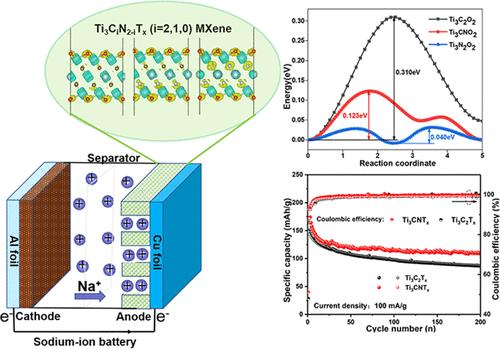
Two-dimensional (2D) MXenes, including carbides, nitrides, and carbonitrides MXene, have been proved to be a possible candidate as anode materials of sodium-ion batteries. This paper focuses on the electronic properties and the electrochemical performance of nitrides MXene. First, density functional theory simulations were utilized to disclose the geometric structure and electronic properties, Na diffusion path, and storage behaviors of titanium carbonitrides Ti3CNTx, nitrides MXene Ti3N2Tx, and carbides MXene Ti3C2Tx with oxygen terminations, predicting the more excellent performance of Ti3N2O2 than Ti3C2O2. Also, then the structure characterization and electrochemical performance experiments of Ti3C2Tx and Ti3CNTx were conducted to verify the theoretical predictions and test the cycling performances. The superior performance of Ti3N2O2 originates from the stronger connection of O–Ti–N than that of O–Ti–C, resulting in the stackings of Ti3N2O2 being tighter and the interlayer spacings being larger than that of Ti3C2O2, which is advantageous to sodiation and desodiation. The capacity of Ti3CNTx increased again to 145 mAh/g after 35 cycles at a current density of 20 mA/g, which demonstrated a better rate performance than Ti3C2Tx corroborated by the diffusion barriers of the theoretical calculation results. Ti3CNTx exhibits a good cycling performance of 110 mAh/g (≈60% of the initial value) after 200 cycles, which is better than that of 87 mAh/g (≈51% of the initial value) of Ti3C2Tx. It is worth noting that all these performances ensure that nitride MXene is more suitable as the anode material of Na-ion batteries than carbide MXene. These findings are conducive to expanding the MXene family and promoting their application in energy storage applications.
期刊介绍:
ACS Applied Materials & Interfaces is a leading interdisciplinary journal that brings together chemists, engineers, physicists, and biologists to explore the development and utilization of newly-discovered materials and interfacial processes for specific applications. Our journal has experienced remarkable growth since its establishment in 2009, both in terms of the number of articles published and the impact of the research showcased. We are proud to foster a truly global community, with the majority of published articles originating from outside the United States, reflecting the rapid growth of applied research worldwide.

 求助内容:
求助内容: 应助结果提醒方式:

 京公网安备 11010802042870号


