Marc Peraire, Ezequiel-Jesús Pérez-Sánchez, Jesús Pérez-Pazos, Juan Manuel de Gomar-Malia, Vicenç Tort-Herrando
{"title":"Relevance of psychogeriatrics in the prison setting: a systematic review.","authors":"Marc Peraire, Ezequiel-Jesús Pérez-Sánchez, Jesús Pérez-Pazos, Juan Manuel de Gomar-Malia, Vicenç Tort-Herrando","doi":"10.18176/resp.00058","DOIUrl":null,"url":null,"abstract":"<p><strong>Introduction: </strong>The aging of the world population is reflected in the penitentiary setting, with a progressive increase of elderly inmates. These prisoners present complex clinical processes with multiple comorbidities, and require a specialized approach. However, resources have not yet been adapted to the unique characteristics of this vulnerable subpopulation. The aim of this review is to highlight the relevance of psychogeriatrics in prison, detecting the most prevalent diseases and outlining the needs of elderly inmates.</p><p><strong>Material and method: </strong>Narrative review through databases of those studies that analyze psychopathologies among inmates over 50.</p><p><strong>Results: </strong>Elderly inmates present a high prevalence of substance use (especially alcohol), affective symptoms (depression) and cognitive deterioration. A significant presence of personality disorders, anxiety, post-traumatic disorders, psychotic disorders, and physical comorbidities is also observed, with rates higher than among young convicts and the general geriatric population. There is a higher prevalence for any diagnosis amongst women, mainly for affective disorders.</p><p><strong>Discussion: </strong>Prisoners over 50 have a different profile from other prison population. They suffer from more physical and mental illnesses, and so require specific health and social approaches. It would be advisable to adapt clinical care by optimizing resources, developing prison psychogeriatrics and establishing specific assessment and treatment methods.</p>","PeriodicalId":30044,"journal":{"name":"Revista Espanola de Sanidad Penitenciaria","volume":"24 3","pages":"101-109"},"PeriodicalIF":0.0000,"publicationDate":"2022-09-01","publicationTypes":"Journal Article","fieldsOfStudy":null,"isOpenAccess":false,"openAccessPdf":"https://ftp.ncbi.nlm.nih.gov/pub/pmc/oa_pdf/0c/38/2013-6463-sanipe-24-03-101.PMC9768562.pdf","citationCount":"0","resultStr":null,"platform":"Semanticscholar","paperid":null,"PeriodicalName":"Revista Espanola de Sanidad Penitenciaria","FirstCategoryId":"1085","ListUrlMain":"https://doi.org/10.18176/resp.00058","RegionNum":0,"RegionCategory":null,"ArticlePicture":[],"TitleCN":null,"AbstractTextCN":null,"PMCID":null,"EPubDate":"","PubModel":"","JCR":"Q3","JCRName":"Medicine","Score":null,"Total":0}
引用次数: 0
Abstract
Introduction: The aging of the world population is reflected in the penitentiary setting, with a progressive increase of elderly inmates. These prisoners present complex clinical processes with multiple comorbidities, and require a specialized approach. However, resources have not yet been adapted to the unique characteristics of this vulnerable subpopulation. The aim of this review is to highlight the relevance of psychogeriatrics in prison, detecting the most prevalent diseases and outlining the needs of elderly inmates.
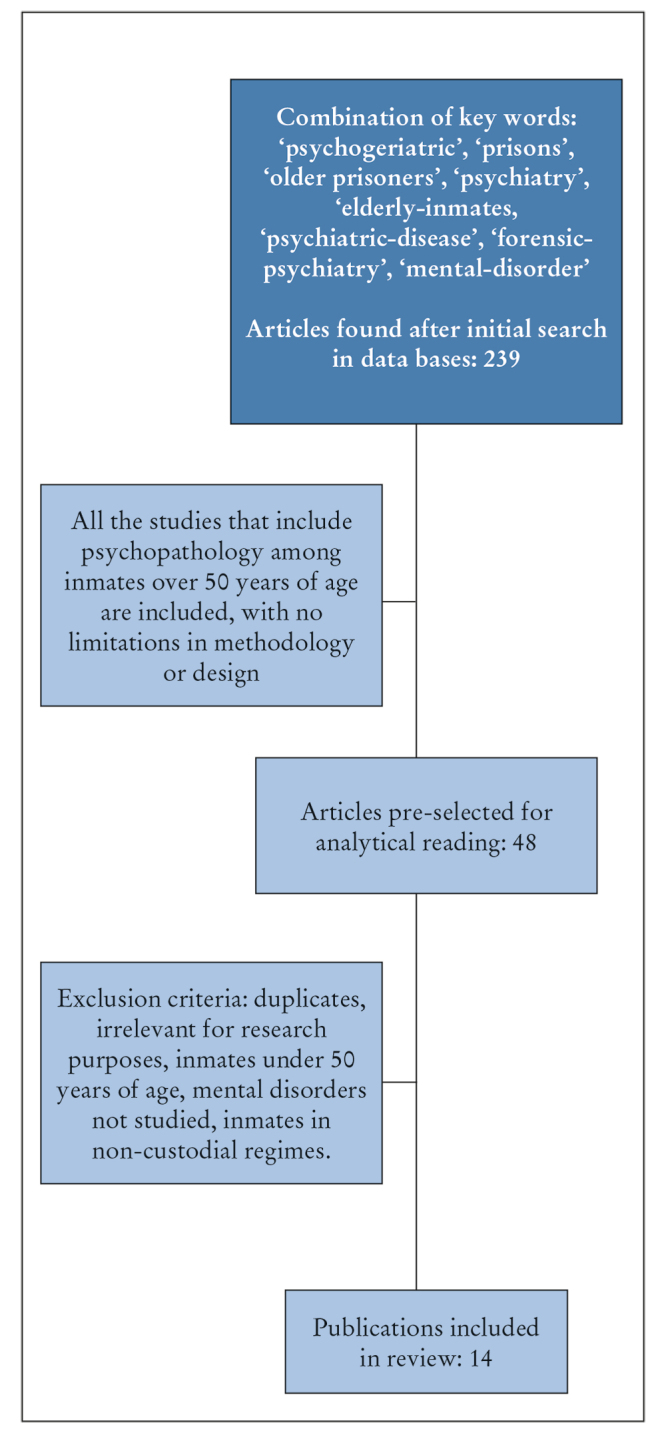
Material and method: Narrative review through databases of those studies that analyze psychopathologies among inmates over 50.
Results: Elderly inmates present a high prevalence of substance use (especially alcohol), affective symptoms (depression) and cognitive deterioration. A significant presence of personality disorders, anxiety, post-traumatic disorders, psychotic disorders, and physical comorbidities is also observed, with rates higher than among young convicts and the general geriatric population. There is a higher prevalence for any diagnosis amongst women, mainly for affective disorders.
Discussion: Prisoners over 50 have a different profile from other prison population. They suffer from more physical and mental illnesses, and so require specific health and social approaches. It would be advisable to adapt clinical care by optimizing resources, developing prison psychogeriatrics and establishing specific assessment and treatment methods.


 求助内容:
 应助结果提醒方式:


 京公网安备 11010802042870号


