{"title":"Effect of dyslipidemia, obesity, and atopic status on exhaled and alveolar nitric oxide in asthmatic children.","authors":"Pakvirin Nanakorn Chanachon, Adithep Sawatchai, Wanlapa Jotikasthira, Potjanee Kiewngam, Watcharoot Kanchongkittiphon, Wiparat Manuyakorn","doi":"10.12932/AP-230123-1534","DOIUrl":null,"url":null,"abstract":"<p><strong>Background: </strong>Dyslipidemia and obesity contribute to a pro-inflammatory state. Eosinophilic airway inflammation can be indirectly measured by fractional exhaled nitric oxide (FeNO) produced in the airways of asthmatic subjects.</p><p><strong>Objective: </strong>To compare exhaled nitric oxide (NO) and alveolar NO in asthmatic children with and without dyslipidemia.</p><p><strong>Methods: </strong>Asthmatic children (5-18 years old) had fasting serum low-density lipoprotein cholesterol, triglyceride, and high-density lipoprotein cholesterol (HDL-C) concentrations, and C-reactive protein (CRP) concentrations measured. FeNO was measured at constant flow rates of 20, 50, 100, and 300 ml/s by the chemiluminescence method. NO concentrations in tissue of the upper airways (CawNO) and the total flux of NO in the conducting airways (JawNO) were determined through FeNO at 20, 100, and 300 ml/s using a mathematical model. The atopic status was assessed using the skin prick test for aero-allergens.</p><p><strong>Results: </strong>One hundred forty-one asthmatic children were enrolled with a mean (standard deviation) age of 11.82 (3.38) years. Sixty-four (45.4%) children had dyslipidemia and 20 (14.2%) were obese. Children with low HDL-C concentrations had significantly higher CawNO and JawNO than those with normal HDL-C concentrations (both p = 0.03). Asthmatic children with obesity had higher CRP concentrations than those with a normal weight (p < 0.001). Atopic children had a significantly higher FeNO, CawNO, and JawNO than non-atopic children (all p < 0.05).</p><p><strong>Conclusions: </strong>This study suggests an effect of HDL-C on CawNO and JawNO in asthmatic children. An intervention that normalizes HDL-C concentrations may be beneficial for airway inflammation in asthmatic children.</p>","PeriodicalId":8552,"journal":{"name":"Asian Pacific journal of allergy and immunology","volume":" ","pages":"122-130"},"PeriodicalIF":2.1000,"publicationDate":"2026-03-01","publicationTypes":"Journal Article","fieldsOfStudy":null,"isOpenAccess":false,"openAccessPdf":"","citationCount":"0","resultStr":null,"platform":"Semanticscholar","paperid":null,"PeriodicalName":"Asian Pacific journal of allergy and immunology","FirstCategoryId":"3","ListUrlMain":"https://doi.org/10.12932/AP-230123-1534","RegionNum":4,"RegionCategory":"医学","ArticlePicture":[],"TitleCN":null,"AbstractTextCN":null,"PMCID":null,"EPubDate":"","PubModel":"","JCR":"Q3","JCRName":"ALLERGY","Score":null,"Total":0}
引用次数: 0
Abstract
Background: Dyslipidemia and obesity contribute to a pro-inflammatory state. Eosinophilic airway inflammation can be indirectly measured by fractional exhaled nitric oxide (FeNO) produced in the airways of asthmatic subjects.
Objective: To compare exhaled nitric oxide (NO) and alveolar NO in asthmatic children with and without dyslipidemia.
Methods: Asthmatic children (5-18 years old) had fasting serum low-density lipoprotein cholesterol, triglyceride, and high-density lipoprotein cholesterol (HDL-C) concentrations, and C-reactive protein (CRP) concentrations measured. FeNO was measured at constant flow rates of 20, 50, 100, and 300 ml/s by the chemiluminescence method. NO concentrations in tissue of the upper airways (CawNO) and the total flux of NO in the conducting airways (JawNO) were determined through FeNO at 20, 100, and 300 ml/s using a mathematical model. The atopic status was assessed using the skin prick test for aero-allergens.
Results: One hundred forty-one asthmatic children were enrolled with a mean (standard deviation) age of 11.82 (3.38) years. Sixty-four (45.4%) children had dyslipidemia and 20 (14.2%) were obese. Children with low HDL-C concentrations had significantly higher CawNO and JawNO than those with normal HDL-C concentrations (both p = 0.03). Asthmatic children with obesity had higher CRP concentrations than those with a normal weight (p < 0.001). Atopic children had a significantly higher FeNO, CawNO, and JawNO than non-atopic children (all p < 0.05).
Conclusions: This study suggests an effect of HDL-C on CawNO and JawNO in asthmatic children. An intervention that normalizes HDL-C concentrations may be beneficial for airway inflammation in asthmatic children.
期刊介绍:
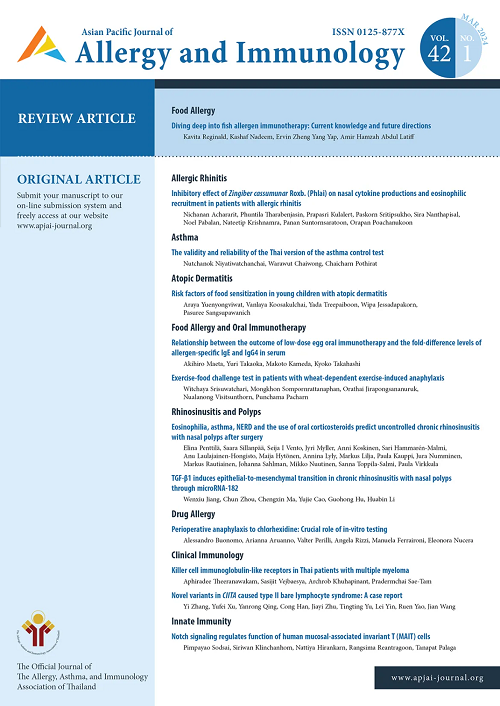
The Asian Pacific Journal of Allergy and Immunology (APJAI) is an online open access journal with the recent impact factor (2018) 1.747
APJAI published 4 times per annum (March, June, September, December). Four issues constitute one volume.
APJAI publishes original research articles of basic science, clinical science and reviews on various aspects of allergy and immunology. This journal is an official journal of and published by the Allergy, Asthma and Immunology Association, Thailand.
The scopes include mechanism, pathogenesis, host-pathogen interaction, host-environment interaction, allergic diseases, immune-mediated diseases, epidemiology, diagnosis, treatment and prevention, immunotherapy, and vaccine. All papers are published in English and are refereed to international standards.

 求助内容:
 应助结果提醒方式:


 京公网安备 11010802042870号


