Shiho Amagasa, Masamitsu Kamada, Adrian E Bauman, Motohiko Miyachi, Shigeru Inoue
{"title":"2020年东京奥运会对日本人口水平体育活动的赛前影响评估:时间序列分析。","authors":"Shiho Amagasa, Masamitsu Kamada, Adrian E Bauman, Motohiko Miyachi, Shigeru Inoue","doi":"10.1186/s12966-022-01332-x","DOIUrl":null,"url":null,"abstract":"<p><strong>Background: </strong>The Olympic Games represent an opportunity to create a 'physical activity legacy' that promotes physical activity at the population level in the host nations and cities. However, previous studies showed little increase in population-level physical activity following the Olympics. The upsurge of public interest in sports and physical activity participation before the Olympics may diminish rapidly following the Games. We examined the pre-Games effects of the Olympics on Japanese population-level physical activity after the announcement of Tokyo's successful bid for the 2020 Olympic and Paralympic Games in September 2013.</p><p><strong>Methods: </strong>We used publicly available data from serial cross-sectional surveys conducted with nationally or regionally representative samples in Japan seven years before and after the announcement (from 2006-2020). The outcomes were 1) daily step counts and 2) exercise habit prevalence (≥ 30 min/day, ≥ 2 days/week, and over a year) from the National Health and Nutrition Surveys Japan (NHNS-J; 14 time points; aggregated data); and 3) sports participation (at least once a week) from the National Sports-Life Survey conducted every two years (NSLS; eight time points; individual-level data of 18,867 adults) and from the Public Opinion Survey on Sports Participation of Tokyo Residents (POSSP; eight time points; aggregated data). Age- and gender-adjusted regression models were used to estimate changes in the outcomes before and after the announcement.</p><p><strong>Results: </strong>There were no significant pre-Games effects of the Olympics on national-level physical activity participation among Japanese adults. Sports participation (56.4% and 57.5%, respectively; P = 0.518), daily steps (6,535 and 6,686 steps/day; P = 0.353), and exercise habit (30.7% and 29.1%, P = 0.309) did not change significantly before and after the announcement. Although an increase in sports participation among Tokyo residents was not found in the NSLS (61.5% and 59.3%, P = 0.227), it was observed in the POSSP (49.1% and 57.7%, P = 0.019). Nonetheless, this increase might not be related to the pre-Games effects since the trend diminished following the announcement.</p><p><strong>Conclusions: </strong>Population-level physical activity did not show significant changes until 2020. Realising the physical activity legacy of an Olympics may require strategic promotion and cross-agency partnership implementation in the pre- and post-event period.</p>","PeriodicalId":520799,"journal":{"name":"The international journal of behavioral nutrition and physical activity","volume":" ","pages":"96"},"PeriodicalIF":5.5000,"publicationDate":"2022-08-06","publicationTypes":"Journal Article","fieldsOfStudy":null,"isOpenAccess":false,"openAccessPdf":"https://www.ncbi.nlm.nih.gov/pmc/articles/PMC9356482/pdf/","citationCount":"0","resultStr":"{\"title\":\"Evaluation of pre-Games effects of the Tokyo 2020 Olympic Games on Japanese population-level physical activity: a time-series analysis.\",\"authors\":\"Shiho Amagasa, Masamitsu Kamada, Adrian E Bauman, Motohiko Miyachi, Shigeru Inoue\",\"doi\":\"10.1186/s12966-022-01332-x\",\"DOIUrl\":null,\"url\":null,\"abstract\":\"<p><strong>Background: </strong>The Olympic Games represent an opportunity to create a 'physical activity legacy' that promotes physical activity at the population level in the host nations and cities. However, previous studies showed little increase in population-level physical activity following the Olympics. The upsurge of public interest in sports and physical activity participation before the Olympics may diminish rapidly following the Games. We examined the pre-Games effects of the Olympics on Japanese population-level physical activity after the announcement of Tokyo's successful bid for the 2020 Olympic and Paralympic Games in September 2013.</p><p><strong>Methods: </strong>We used publicly available data from serial cross-sectional surveys conducted with nationally or regionally representative samples in Japan seven years before and after the announcement (from 2006-2020). The outcomes were 1) daily step counts and 2) exercise habit prevalence (≥ 30 min/day, ≥ 2 days/week, and over a year) from the National Health and Nutrition Surveys Japan (NHNS-J; 14 time points; aggregated data); and 3) sports participation (at least once a week) from the National Sports-Life Survey conducted every two years (NSLS; eight time points; individual-level data of 18,867 adults) and from the Public Opinion Survey on Sports Participation of Tokyo Residents (POSSP; eight time points; aggregated data). Age- and gender-adjusted regression models were used to estimate changes in the outcomes before and after the announcement.</p><p><strong>Results: </strong>There were no significant pre-Games effects of the Olympics on national-level physical activity participation among Japanese adults. Sports participation (56.4% and 57.5%, respectively; P = 0.518), daily steps (6,535 and 6,686 steps/day; P = 0.353), and exercise habit (30.7% and 29.1%, P = 0.309) did not change significantly before and after the announcement. Although an increase in sports participation among Tokyo residents was not found in the NSLS (61.5% and 59.3%, P = 0.227), it was observed in the POSSP (49.1% and 57.7%, P = 0.019). Nonetheless, this increase might not be related to the pre-Games effects since the trend diminished following the announcement.</p><p><strong>Conclusions: </strong>Population-level physical activity did not show significant changes until 2020. Realising the physical activity legacy of an Olympics may require strategic promotion and cross-agency partnership implementation in the pre- and post-event period.</p>\",\"PeriodicalId\":520799,\"journal\":{\"name\":\"The international journal of behavioral nutrition and physical activity\",\"volume\":\" \",\"pages\":\"96\"},\"PeriodicalIF\":5.5000,\"publicationDate\":\"2022-08-06\",\"publicationTypes\":\"Journal Article\",\"fieldsOfStudy\":null,\"isOpenAccess\":false,\"openAccessPdf\":\"https://www.ncbi.nlm.nih.gov/pmc/articles/PMC9356482/pdf/\",\"citationCount\":\"0\",\"resultStr\":null,\"platform\":\"Semanticscholar\",\"paperid\":null,\"PeriodicalName\":\"The international journal of behavioral nutrition and physical activity\",\"FirstCategoryId\":\"3\",\"ListUrlMain\":\"https://doi.org/10.1186/s12966-022-01332-x\",\"RegionNum\":0,\"RegionCategory\":null,\"ArticlePicture\":[],\"TitleCN\":null,\"AbstractTextCN\":null,\"PMCID\":null,\"EPubDate\":\"\",\"PubModel\":\"\",\"JCR\":\"\",\"JCRName\":\"\",\"Score\":null,\"Total\":0}","platform":"Semanticscholar","paperid":null,"PeriodicalName":"The international journal of behavioral nutrition and physical activity","FirstCategoryId":"3","ListUrlMain":"https://doi.org/10.1186/s12966-022-01332-x","RegionNum":0,"RegionCategory":null,"ArticlePicture":[],"TitleCN":null,"AbstractTextCN":null,"PMCID":null,"EPubDate":"","PubModel":"","JCR":"","JCRName":"","Score":null,"Total":0}
Evaluation of pre-Games effects of the Tokyo 2020 Olympic Games on Japanese population-level physical activity: a time-series analysis.
Background: The Olympic Games represent an opportunity to create a 'physical activity legacy' that promotes physical activity at the population level in the host nations and cities. However, previous studies showed little increase in population-level physical activity following the Olympics. The upsurge of public interest in sports and physical activity participation before the Olympics may diminish rapidly following the Games. We examined the pre-Games effects of the Olympics on Japanese population-level physical activity after the announcement of Tokyo's successful bid for the 2020 Olympic and Paralympic Games in September 2013.
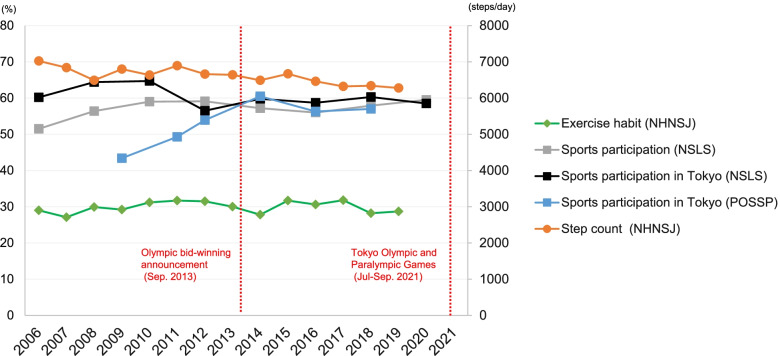
Methods: We used publicly available data from serial cross-sectional surveys conducted with nationally or regionally representative samples in Japan seven years before and after the announcement (from 2006-2020). The outcomes were 1) daily step counts and 2) exercise habit prevalence (≥ 30 min/day, ≥ 2 days/week, and over a year) from the National Health and Nutrition Surveys Japan (NHNS-J; 14 time points; aggregated data); and 3) sports participation (at least once a week) from the National Sports-Life Survey conducted every two years (NSLS; eight time points; individual-level data of 18,867 adults) and from the Public Opinion Survey on Sports Participation of Tokyo Residents (POSSP; eight time points; aggregated data). Age- and gender-adjusted regression models were used to estimate changes in the outcomes before and after the announcement.
Results: There were no significant pre-Games effects of the Olympics on national-level physical activity participation among Japanese adults. Sports participation (56.4% and 57.5%, respectively; P = 0.518), daily steps (6,535 and 6,686 steps/day; P = 0.353), and exercise habit (30.7% and 29.1%, P = 0.309) did not change significantly before and after the announcement. Although an increase in sports participation among Tokyo residents was not found in the NSLS (61.5% and 59.3%, P = 0.227), it was observed in the POSSP (49.1% and 57.7%, P = 0.019). Nonetheless, this increase might not be related to the pre-Games effects since the trend diminished following the announcement.
Conclusions: Population-level physical activity did not show significant changes until 2020. Realising the physical activity legacy of an Olympics may require strategic promotion and cross-agency partnership implementation in the pre- and post-event period.


 求助内容:
 应助结果提醒方式:


 京公网安备 11010802042870号


