Xabier Larrañaga,Brian J. Rodriguez,Jose R. Sarasua,Ester Zuza
{"title":"反对链网的节段松弛:激活玻璃态和半晶PLLA的延性机制","authors":"Xabier Larrañaga,Brian J. Rodriguez,Jose R. Sarasua,Ester Zuza","doi":"10.1021/acs.macromol.6c00777","DOIUrl":null,"url":null,"abstract":"The mechanical behavior of semicrystalline poly(l-lactide) (PLLA) is heavily influenced by its complex chain structure, which continues to be a key focus in ongoing research regarding its ability to exhibit ductile behavior. In this work, the brittle-ductile transition (BDT) of the amorphous structure of PLLA is studied in relation to its physical aging, and following the yielding of amorphous structure, the deformation of crystalline PLLA spherulites is closely examined. The significant impact of physical aging on amorphous PLLA’s mechanical properties is evident as the least aged samples show a BDT at –30 °C, aligning more closely with Vincent’s plot expectations, whereas more aged samples only exhibit ductility above 40 °C. Additionally, brittle specimen rupture is observed when the chain pullout force is reached, which increases with decreasing temperature and governs the brittle failure mechanism. The wide range of aging times and testing temperatures enables an in-depth analysis of the crazing behavior, highlighting its temperature and time dependence as an activated process. Upon yielding of the amorphous phase, various deformation modes are observed in the crystalline spherulite studies, confirming the chain network's ability to disintegrate crystalline structures and transition into a less ordered configuration as indicated by the nanoindentation and Raman spectroscopy measurements. This study conceives PLLA, not as an inherently brittle polymer, but as one whose structure needs to restore its constrained activation capacity.","PeriodicalId":51,"journal":{"name":"Macromolecules","volume":"13 1","pages":""},"PeriodicalIF":5.7000,"publicationDate":"2026-10-20","publicationTypes":"Journal Article","fieldsOfStudy":null,"isOpenAccess":false,"openAccessPdf":"","citationCount":"0","resultStr":"{\"title\":\"Against the Segmental Relaxation of the Chain Network: Activating the Ductile Mechanism of Both Glassy and Semicrystalline PLLA\",\"authors\":\"Xabier Larrañaga,Brian J. Rodriguez,Jose R. Sarasua,Ester Zuza\",\"doi\":\"10.1021/acs.macromol.6c00777\",\"DOIUrl\":null,\"url\":null,\"abstract\":\"The mechanical behavior of semicrystalline poly(l-lactide) (PLLA) is heavily influenced by its complex chain structure, which continues to be a key focus in ongoing research regarding its ability to exhibit ductile behavior. In this work, the brittle-ductile transition (BDT) of the amorphous structure of PLLA is studied in relation to its physical aging, and following the yielding of amorphous structure, the deformation of crystalline PLLA spherulites is closely examined. The significant impact of physical aging on amorphous PLLA’s mechanical properties is evident as the least aged samples show a BDT at –30 °C, aligning more closely with Vincent’s plot expectations, whereas more aged samples only exhibit ductility above 40 °C. Additionally, brittle specimen rupture is observed when the chain pullout force is reached, which increases with decreasing temperature and governs the brittle failure mechanism. The wide range of aging times and testing temperatures enables an in-depth analysis of the crazing behavior, highlighting its temperature and time dependence as an activated process. Upon yielding of the amorphous phase, various deformation modes are observed in the crystalline spherulite studies, confirming the chain network's ability to disintegrate crystalline structures and transition into a less ordered configuration as indicated by the nanoindentation and Raman spectroscopy measurements. This study conceives PLLA, not as an inherently brittle polymer, but as one whose structure needs to restore its constrained activation capacity.\",\"PeriodicalId\":51,\"journal\":{\"name\":\"Macromolecules\",\"volume\":\"13 1\",\"pages\":\"\"},\"PeriodicalIF\":5.7000,\"publicationDate\":\"2026-10-20\",\"publicationTypes\":\"Journal Article\",\"fieldsOfStudy\":null,\"isOpenAccess\":false,\"openAccessPdf\":\"\",\"citationCount\":\"0\",\"resultStr\":null,\"platform\":\"Semanticscholar\",\"paperid\":null,\"PeriodicalName\":\"Macromolecules\",\"FirstCategoryId\":\"92\",\"ListUrlMain\":\"https://doi.org/10.1021/acs.macromol.6c00777\",\"RegionNum\":1,\"RegionCategory\":\"化学\",\"ArticlePicture\":[],\"TitleCN\":null,\"AbstractTextCN\":null,\"PMCID\":null,\"EPubDate\":\"\",\"PubModel\":\"\",\"JCR\":\"Q1\",\"JCRName\":\"POLYMER SCIENCE\",\"Score\":null,\"Total\":0}","platform":"Semanticscholar","paperid":null,"PeriodicalName":"Macromolecules","FirstCategoryId":"92","ListUrlMain":"https://doi.org/10.1021/acs.macromol.6c00777","RegionNum":1,"RegionCategory":"化学","ArticlePicture":[],"TitleCN":null,"AbstractTextCN":null,"PMCID":null,"EPubDate":"","PubModel":"","JCR":"Q1","JCRName":"POLYMER SCIENCE","Score":null,"Total":0}
Against the Segmental Relaxation of the Chain Network: Activating the Ductile Mechanism of Both Glassy and Semicrystalline PLLA
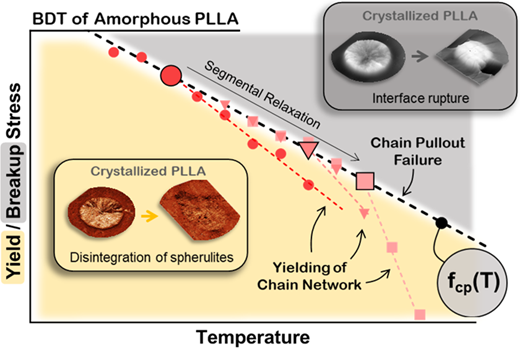
The mechanical behavior of semicrystalline poly(l-lactide) (PLLA) is heavily influenced by its complex chain structure, which continues to be a key focus in ongoing research regarding its ability to exhibit ductile behavior. In this work, the brittle-ductile transition (BDT) of the amorphous structure of PLLA is studied in relation to its physical aging, and following the yielding of amorphous structure, the deformation of crystalline PLLA spherulites is closely examined. The significant impact of physical aging on amorphous PLLA’s mechanical properties is evident as the least aged samples show a BDT at –30 °C, aligning more closely with Vincent’s plot expectations, whereas more aged samples only exhibit ductility above 40 °C. Additionally, brittle specimen rupture is observed when the chain pullout force is reached, which increases with decreasing temperature and governs the brittle failure mechanism. The wide range of aging times and testing temperatures enables an in-depth analysis of the crazing behavior, highlighting its temperature and time dependence as an activated process. Upon yielding of the amorphous phase, various deformation modes are observed in the crystalline spherulite studies, confirming the chain network's ability to disintegrate crystalline structures and transition into a less ordered configuration as indicated by the nanoindentation and Raman spectroscopy measurements. This study conceives PLLA, not as an inherently brittle polymer, but as one whose structure needs to restore its constrained activation capacity.
期刊介绍:
Macromolecules publishes original, fundamental, and impactful research on all aspects of polymer science. Topics of interest include synthesis (e.g., controlled polymerizations, polymerization catalysis, post polymerization modification, new monomer structures and polymer architectures, and polymerization mechanisms/kinetics analysis); phase behavior, thermodynamics, dynamic, and ordering/disordering phenomena (e.g., self-assembly, gelation, crystallization, solution/melt/solid-state characteristics); structure and properties (e.g., mechanical and rheological properties, surface/interfacial characteristics, electronic and transport properties); new state of the art characterization (e.g., spectroscopy, scattering, microscopy, rheology), simulation (e.g., Monte Carlo, molecular dynamics, multi-scale/coarse-grained modeling), and theoretical methods. Renewable/sustainable polymers, polymer networks, responsive polymers, electro-, magneto- and opto-active macromolecules, inorganic polymers, charge-transporting polymers (ion-containing, semiconducting, and conducting), nanostructured polymers, and polymer composites are also of interest. Typical papers published in Macromolecules showcase important and innovative concepts, experimental methods/observations, and theoretical/computational approaches that demonstrate a fundamental advance in the understanding of polymers.