{"title":"具有不同间隔长度的楔形侧链液晶聚合物的层次动力学和相变","authors":"Minghe Sun,Yining Fan,Pingchuan Sun,Shuang Yang,Er-Qiang Chen","doi":"10.1021/acs.macromol.6c01947","DOIUrl":null,"url":null,"abstract":"As an important class of graft polymers, side-chain liquid crystalline polymers (SCLCPs) containing anisotropic mesogenic groups exhibit complex molecular dynamics that are closely coupled with hierarchical structural evolution. In this study, using various characterization techniques, we investigate the phase structures and viscoelastic behavior of a series of wedge-shaped SCLCPs, denoted as CxBP (x = 1, 3, 7), where x is the number of methylene units in the spacer linking the wedge-shaped mesogenic side group to the polynorbornene backbone. CxBPs form a hexagonal columnar phase (ColH), with multichain supramolecular columns serving as the basic building block arising from microphase separation of the main and side chains. Upon cooling from the isotropic state, CxBPs show unique multistep increases in modulus through four distinct stages (I–IV) with shear moduli of 104, 105, 107, and 108 Pa, respectively, separated by three relaxation/transition processes (α, β, γ). When approaching to –100 °C, a δ-relaxation further raises the modulus to ∼109 Pa. The α- and γ-processes correspond to first-order transitions: the isotropic-to-ColH transition at ∼90 °C and partial ordering of the side-chain alkyl tails at ∼0 °C, respectively. Notably, the β-process is a predominantly noncooperative relaxation following Arrhenius behavior with an activation energy of ∼300 kJ/mol, attributed to the motion of mesogens on the side chains. Freezing of this motion transforms the ColH from a “mobile” to a “mesogen-arrested” state, increasing the shear modulus by 2 orders of magnitude from stage II to stage III. We find that a longer spacer lowers the β-relaxation temperature. With a single methylene unit as the spacer, C1BP shows β-relaxation partially overlapping with the α-process. Extending the spacer length to three or more methylene units (C3BP, C7BP) enables sufficient dynamic decoupling of the main and side chains, yielding a wider stage II with a shear modulus of 105 Pa.","PeriodicalId":51,"journal":{"name":"Macromolecules","volume":"1 1","pages":""},"PeriodicalIF":5.7000,"publicationDate":"2026-10-20","publicationTypes":"Journal Article","fieldsOfStudy":null,"isOpenAccess":false,"openAccessPdf":"","citationCount":"0","resultStr":"{\"title\":\"Hierarchical Dynamics and Phase Transitions in Wedge-Shaped Side-Chain Liquid Crystalline Polymers with Varying Spacer Lengths\",\"authors\":\"Minghe Sun,Yining Fan,Pingchuan Sun,Shuang Yang,Er-Qiang Chen\",\"doi\":\"10.1021/acs.macromol.6c01947\",\"DOIUrl\":null,\"url\":null,\"abstract\":\"As an important class of graft polymers, side-chain liquid crystalline polymers (SCLCPs) containing anisotropic mesogenic groups exhibit complex molecular dynamics that are closely coupled with hierarchical structural evolution. In this study, using various characterization techniques, we investigate the phase structures and viscoelastic behavior of a series of wedge-shaped SCLCPs, denoted as CxBP (x = 1, 3, 7), where x is the number of methylene units in the spacer linking the wedge-shaped mesogenic side group to the polynorbornene backbone. CxBPs form a hexagonal columnar phase (ColH), with multichain supramolecular columns serving as the basic building block arising from microphase separation of the main and side chains. Upon cooling from the isotropic state, CxBPs show unique multistep increases in modulus through four distinct stages (I–IV) with shear moduli of 104, 105, 107, and 108 Pa, respectively, separated by three relaxation/transition processes (α, β, γ). When approaching to –100 °C, a δ-relaxation further raises the modulus to ∼109 Pa. The α- and γ-processes correspond to first-order transitions: the isotropic-to-ColH transition at ∼90 °C and partial ordering of the side-chain alkyl tails at ∼0 °C, respectively. Notably, the β-process is a predominantly noncooperative relaxation following Arrhenius behavior with an activation energy of ∼300 kJ/mol, attributed to the motion of mesogens on the side chains. Freezing of this motion transforms the ColH from a “mobile” to a “mesogen-arrested” state, increasing the shear modulus by 2 orders of magnitude from stage II to stage III. We find that a longer spacer lowers the β-relaxation temperature. With a single methylene unit as the spacer, C1BP shows β-relaxation partially overlapping with the α-process. Extending the spacer length to three or more methylene units (C3BP, C7BP) enables sufficient dynamic decoupling of the main and side chains, yielding a wider stage II with a shear modulus of 105 Pa.\",\"PeriodicalId\":51,\"journal\":{\"name\":\"Macromolecules\",\"volume\":\"1 1\",\"pages\":\"\"},\"PeriodicalIF\":5.7000,\"publicationDate\":\"2026-10-20\",\"publicationTypes\":\"Journal Article\",\"fieldsOfStudy\":null,\"isOpenAccess\":false,\"openAccessPdf\":\"\",\"citationCount\":\"0\",\"resultStr\":null,\"platform\":\"Semanticscholar\",\"paperid\":null,\"PeriodicalName\":\"Macromolecules\",\"FirstCategoryId\":\"92\",\"ListUrlMain\":\"https://doi.org/10.1021/acs.macromol.6c01947\",\"RegionNum\":1,\"RegionCategory\":\"化学\",\"ArticlePicture\":[],\"TitleCN\":null,\"AbstractTextCN\":null,\"PMCID\":null,\"EPubDate\":\"\",\"PubModel\":\"\",\"JCR\":\"Q1\",\"JCRName\":\"POLYMER SCIENCE\",\"Score\":null,\"Total\":0}","platform":"Semanticscholar","paperid":null,"PeriodicalName":"Macromolecules","FirstCategoryId":"92","ListUrlMain":"https://doi.org/10.1021/acs.macromol.6c01947","RegionNum":1,"RegionCategory":"化学","ArticlePicture":[],"TitleCN":null,"AbstractTextCN":null,"PMCID":null,"EPubDate":"","PubModel":"","JCR":"Q1","JCRName":"POLYMER SCIENCE","Score":null,"Total":0}
Hierarchical Dynamics and Phase Transitions in Wedge-Shaped Side-Chain Liquid Crystalline Polymers with Varying Spacer Lengths
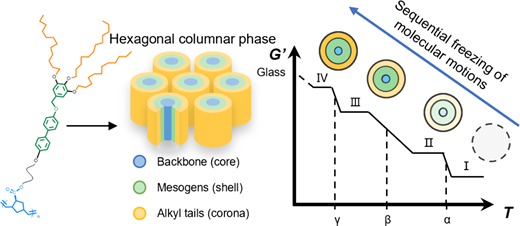
As an important class of graft polymers, side-chain liquid crystalline polymers (SCLCPs) containing anisotropic mesogenic groups exhibit complex molecular dynamics that are closely coupled with hierarchical structural evolution. In this study, using various characterization techniques, we investigate the phase structures and viscoelastic behavior of a series of wedge-shaped SCLCPs, denoted as CxBP (x = 1, 3, 7), where x is the number of methylene units in the spacer linking the wedge-shaped mesogenic side group to the polynorbornene backbone. CxBPs form a hexagonal columnar phase (ColH), with multichain supramolecular columns serving as the basic building block arising from microphase separation of the main and side chains. Upon cooling from the isotropic state, CxBPs show unique multistep increases in modulus through four distinct stages (I–IV) with shear moduli of 104, 105, 107, and 108 Pa, respectively, separated by three relaxation/transition processes (α, β, γ). When approaching to –100 °C, a δ-relaxation further raises the modulus to ∼109 Pa. The α- and γ-processes correspond to first-order transitions: the isotropic-to-ColH transition at ∼90 °C and partial ordering of the side-chain alkyl tails at ∼0 °C, respectively. Notably, the β-process is a predominantly noncooperative relaxation following Arrhenius behavior with an activation energy of ∼300 kJ/mol, attributed to the motion of mesogens on the side chains. Freezing of this motion transforms the ColH from a “mobile” to a “mesogen-arrested” state, increasing the shear modulus by 2 orders of magnitude from stage II to stage III. We find that a longer spacer lowers the β-relaxation temperature. With a single methylene unit as the spacer, C1BP shows β-relaxation partially overlapping with the α-process. Extending the spacer length to three or more methylene units (C3BP, C7BP) enables sufficient dynamic decoupling of the main and side chains, yielding a wider stage II with a shear modulus of 105 Pa.
期刊介绍:
Macromolecules publishes original, fundamental, and impactful research on all aspects of polymer science. Topics of interest include synthesis (e.g., controlled polymerizations, polymerization catalysis, post polymerization modification, new monomer structures and polymer architectures, and polymerization mechanisms/kinetics analysis); phase behavior, thermodynamics, dynamic, and ordering/disordering phenomena (e.g., self-assembly, gelation, crystallization, solution/melt/solid-state characteristics); structure and properties (e.g., mechanical and rheological properties, surface/interfacial characteristics, electronic and transport properties); new state of the art characterization (e.g., spectroscopy, scattering, microscopy, rheology), simulation (e.g., Monte Carlo, molecular dynamics, multi-scale/coarse-grained modeling), and theoretical methods. Renewable/sustainable polymers, polymer networks, responsive polymers, electro-, magneto- and opto-active macromolecules, inorganic polymers, charge-transporting polymers (ion-containing, semiconducting, and conducting), nanostructured polymers, and polymer composites are also of interest. Typical papers published in Macromolecules showcase important and innovative concepts, experimental methods/observations, and theoretical/computational approaches that demonstrate a fundamental advance in the understanding of polymers.