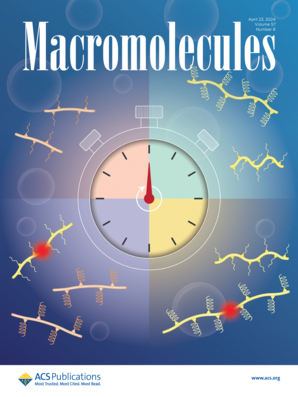
Xuefen Liu,Lefei Yu,Kerry M. Hanson,William J. Neary
{"title":"将环烯转化为精密大分子构建块","authors":"Xuefen Liu,Lefei Yu,Kerry M. Hanson,William J. Neary","doi":"10.1021/acs.macromol.6c02461","DOIUrl":null,"url":null,"abstract":"Abstract Ring-opening allene metathesis polymerization (ROAlMP) provides direct access to polyallenamers containing reactive allene functionality within the polymer backbone, yet achieving controlled polymerization has remained a major challenge. Here, we report an additive-assisted ROAlMP strategy in which triphenylphosphine (PPh3) or 3,5-dichloropyridine (3,5-Cl2Py) modulates catalyst speciation to enable controlled polymerization behavior, affording polyallenamers with predictable molecular weight (Mn up to 70 kDa) and moderate dispersities (Đ < 1.4). This enhanced control enables the synthesis of di- and triblock copolymers spanning three distinct classes of metathesis-active monomers, including cyclic alkenes, diynes, and cyclic allenes, while also providing access to self-assembled nanostructured materials containing allene-rich domains. We further demonstrate that these domains can be selectively stabilized through backbone [2 + 2] photocrosslinking, a capability inherently encoded within the polymer backbone and achieved without additional monomer functionalization. Finally, to illustrate the unique chemical opportunities afforded by backbone allenes, the resulting polyallenamers were subjected to iodonium-induced annulation, generating naphthalene-containing polymer backbones with pronounced changes in their photophysical behavior. Collectively, these results establish additive-controlled ROAlMP as a versatile platform for precision polyallenamer synthesis and highlight the unique materials opportunities enabled by allene-containing polymer backbones.","PeriodicalId":51,"journal":{"name":"Macromolecules","volume":"42 1","pages":""},"PeriodicalIF":5.7000,"publicationDate":"2026-10-19","publicationTypes":"Journal Article","fieldsOfStudy":null,"isOpenAccess":false,"openAccessPdf":"","citationCount":"0","resultStr":"{\"title\":\"Transforming Cyclic Allenes into Precision Macromolecular Building Blocks\",\"authors\":\"Xuefen Liu,Lefei Yu,Kerry M. Hanson,William J. Neary\",\"doi\":\"10.1021/acs.macromol.6c02461\",\"DOIUrl\":null,\"url\":null,\"abstract\":\"Abstract Ring-opening allene metathesis polymerization (ROAlMP) provides direct access to polyallenamers containing reactive allene functionality within the polymer backbone, yet achieving controlled polymerization has remained a major challenge. Here, we report an additive-assisted ROAlMP strategy in which triphenylphosphine (PPh3) or 3,5-dichloropyridine (3,5-Cl2Py) modulates catalyst speciation to enable controlled polymerization behavior, affording polyallenamers with predictable molecular weight (Mn up to 70 kDa) and moderate dispersities (Đ < 1.4). This enhanced control enables the synthesis of di- and triblock copolymers spanning three distinct classes of metathesis-active monomers, including cyclic alkenes, diynes, and cyclic allenes, while also providing access to self-assembled nanostructured materials containing allene-rich domains. We further demonstrate that these domains can be selectively stabilized through backbone [2 + 2] photocrosslinking, a capability inherently encoded within the polymer backbone and achieved without additional monomer functionalization. Finally, to illustrate the unique chemical opportunities afforded by backbone allenes, the resulting polyallenamers were subjected to iodonium-induced annulation, generating naphthalene-containing polymer backbones with pronounced changes in their photophysical behavior. Collectively, these results establish additive-controlled ROAlMP as a versatile platform for precision polyallenamer synthesis and highlight the unique materials opportunities enabled by allene-containing polymer backbones.\",\"PeriodicalId\":51,\"journal\":{\"name\":\"Macromolecules\",\"volume\":\"42 1\",\"pages\":\"\"},\"PeriodicalIF\":5.7000,\"publicationDate\":\"2026-10-19\",\"publicationTypes\":\"Journal Article\",\"fieldsOfStudy\":null,\"isOpenAccess\":false,\"openAccessPdf\":\"\",\"citationCount\":\"0\",\"resultStr\":null,\"platform\":\"Semanticscholar\",\"paperid\":null,\"PeriodicalName\":\"Macromolecules\",\"FirstCategoryId\":\"92\",\"ListUrlMain\":\"https://doi.org/10.1021/acs.macromol.6c02461\",\"RegionNum\":1,\"RegionCategory\":\"化学\",\"ArticlePicture\":[],\"TitleCN\":null,\"AbstractTextCN\":null,\"PMCID\":null,\"EPubDate\":\"\",\"PubModel\":\"\",\"JCR\":\"Q1\",\"JCRName\":\"POLYMER SCIENCE\",\"Score\":null,\"Total\":0}","platform":"Semanticscholar","paperid":null,"PeriodicalName":"Macromolecules","FirstCategoryId":"92","ListUrlMain":"https://doi.org/10.1021/acs.macromol.6c02461","RegionNum":1,"RegionCategory":"化学","ArticlePicture":[],"TitleCN":null,"AbstractTextCN":null,"PMCID":null,"EPubDate":"","PubModel":"","JCR":"Q1","JCRName":"POLYMER SCIENCE","Score":null,"Total":0}
Transforming Cyclic Allenes into Precision Macromolecular Building Blocks
Abstract Ring-opening allene metathesis polymerization (ROAlMP) provides direct access to polyallenamers containing reactive allene functionality within the polymer backbone, yet achieving controlled polymerization has remained a major challenge. Here, we report an additive-assisted ROAlMP strategy in which triphenylphosphine (PPh3) or 3,5-dichloropyridine (3,5-Cl2Py) modulates catalyst speciation to enable controlled polymerization behavior, affording polyallenamers with predictable molecular weight (Mn up to 70 kDa) and moderate dispersities (Đ < 1.4). This enhanced control enables the synthesis of di- and triblock copolymers spanning three distinct classes of metathesis-active monomers, including cyclic alkenes, diynes, and cyclic allenes, while also providing access to self-assembled nanostructured materials containing allene-rich domains. We further demonstrate that these domains can be selectively stabilized through backbone [2 + 2] photocrosslinking, a capability inherently encoded within the polymer backbone and achieved without additional monomer functionalization. Finally, to illustrate the unique chemical opportunities afforded by backbone allenes, the resulting polyallenamers were subjected to iodonium-induced annulation, generating naphthalene-containing polymer backbones with pronounced changes in their photophysical behavior. Collectively, these results establish additive-controlled ROAlMP as a versatile platform for precision polyallenamer synthesis and highlight the unique materials opportunities enabled by allene-containing polymer backbones.
期刊介绍:
Macromolecules publishes original, fundamental, and impactful research on all aspects of polymer science. Topics of interest include synthesis (e.g., controlled polymerizations, polymerization catalysis, post polymerization modification, new monomer structures and polymer architectures, and polymerization mechanisms/kinetics analysis); phase behavior, thermodynamics, dynamic, and ordering/disordering phenomena (e.g., self-assembly, gelation, crystallization, solution/melt/solid-state characteristics); structure and properties (e.g., mechanical and rheological properties, surface/interfacial characteristics, electronic and transport properties); new state of the art characterization (e.g., spectroscopy, scattering, microscopy, rheology), simulation (e.g., Monte Carlo, molecular dynamics, multi-scale/coarse-grained modeling), and theoretical methods. Renewable/sustainable polymers, polymer networks, responsive polymers, electro-, magneto- and opto-active macromolecules, inorganic polymers, charge-transporting polymers (ion-containing, semiconducting, and conducting), nanostructured polymers, and polymer composites are also of interest. Typical papers published in Macromolecules showcase important and innovative concepts, experimental methods/observations, and theoretical/computational approaches that demonstrate a fundamental advance in the understanding of polymers.