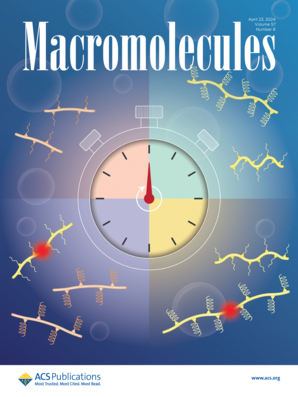
Jamison Barcelona,Yunfeng Hu,John F. Rynk,Christopher N. Bowman
{"title":"了解硫醇炔和其他竞争性连续聚合的相对反应性控制动力学和网络形成","authors":"Jamison Barcelona,Yunfeng Hu,John F. Rynk,Christopher N. Bowman","doi":"10.1021/acs.macromol.6c02262","DOIUrl":null,"url":null,"abstract":"Thiol-yne polymerizations couple two sequential additions of thiol: first, to an alkyne and subsequently, to a vinyl sulfide, making the polymerization and the resulting polymer structure dependent on the relative reactivity. Herein, kinetic, analytical, and random-graph frameworks are developed that predict the reaction kinetics and network formation of thiol-yne polymerizations. The kinetic model predicts a chemically driven form of rate acceleration that arises from the interplay between vinyl sulfide generation and consumption and results in the maximum rate being up to 33% faster than the initial rate. Time-independent solutions are found for the conversion trajectories that are then used to derive expressions for gel-point conversion, sol fraction, and elastically active network chain concentrations. The results generalize to other competitive consecutive reactions, such as epoxy-amine reactions. The propagation ratio (γ=kp,enekp,yne) and the stoichiometric ratio of thiol to yne functional groups (χ=[SH0][Y0])are found to govern the relative conversions and network formation, while chain-transfer determines the time scale. In the presence of conversion limitations, the final network develops a kinetic path dependence, transforming the propagation ratio from a transient kinetic property to a governing parameter of the final network structure.","PeriodicalId":51,"journal":{"name":"Macromolecules","volume":"15 1","pages":""},"PeriodicalIF":5.7000,"publicationDate":"2026-10-13","publicationTypes":"Journal Article","fieldsOfStudy":null,"isOpenAccess":false,"openAccessPdf":"","citationCount":"0","resultStr":"{\"title\":\"Understanding Relative Reactivity-Governed Kinetics and Network Formation in Thiol-Yne and Other Competitive Consecutive Polymerizations\",\"authors\":\"Jamison Barcelona,Yunfeng Hu,John F. Rynk,Christopher N. Bowman\",\"doi\":\"10.1021/acs.macromol.6c02262\",\"DOIUrl\":null,\"url\":null,\"abstract\":\"Thiol-yne polymerizations couple two sequential additions of thiol: first, to an alkyne and subsequently, to a vinyl sulfide, making the polymerization and the resulting polymer structure dependent on the relative reactivity. Herein, kinetic, analytical, and random-graph frameworks are developed that predict the reaction kinetics and network formation of thiol-yne polymerizations. The kinetic model predicts a chemically driven form of rate acceleration that arises from the interplay between vinyl sulfide generation and consumption and results in the maximum rate being up to 33% faster than the initial rate. Time-independent solutions are found for the conversion trajectories that are then used to derive expressions for gel-point conversion, sol fraction, and elastically active network chain concentrations. The results generalize to other competitive consecutive reactions, such as epoxy-amine reactions. The propagation ratio (γ=kp,enekp,yne) and the stoichiometric ratio of thiol to yne functional groups (χ=[SH0][Y0])are found to govern the relative conversions and network formation, while chain-transfer determines the time scale. In the presence of conversion limitations, the final network develops a kinetic path dependence, transforming the propagation ratio from a transient kinetic property to a governing parameter of the final network structure.\",\"PeriodicalId\":51,\"journal\":{\"name\":\"Macromolecules\",\"volume\":\"15 1\",\"pages\":\"\"},\"PeriodicalIF\":5.7000,\"publicationDate\":\"2026-10-13\",\"publicationTypes\":\"Journal Article\",\"fieldsOfStudy\":null,\"isOpenAccess\":false,\"openAccessPdf\":\"\",\"citationCount\":\"0\",\"resultStr\":null,\"platform\":\"Semanticscholar\",\"paperid\":null,\"PeriodicalName\":\"Macromolecules\",\"FirstCategoryId\":\"92\",\"ListUrlMain\":\"https://doi.org/10.1021/acs.macromol.6c02262\",\"RegionNum\":1,\"RegionCategory\":\"化学\",\"ArticlePicture\":[],\"TitleCN\":null,\"AbstractTextCN\":null,\"PMCID\":null,\"EPubDate\":\"\",\"PubModel\":\"\",\"JCR\":\"Q1\",\"JCRName\":\"POLYMER SCIENCE\",\"Score\":null,\"Total\":0}","platform":"Semanticscholar","paperid":null,"PeriodicalName":"Macromolecules","FirstCategoryId":"92","ListUrlMain":"https://doi.org/10.1021/acs.macromol.6c02262","RegionNum":1,"RegionCategory":"化学","ArticlePicture":[],"TitleCN":null,"AbstractTextCN":null,"PMCID":null,"EPubDate":"","PubModel":"","JCR":"Q1","JCRName":"POLYMER SCIENCE","Score":null,"Total":0}
Understanding Relative Reactivity-Governed Kinetics and Network Formation in Thiol-Yne and Other Competitive Consecutive Polymerizations
Thiol-yne polymerizations couple two sequential additions of thiol: first, to an alkyne and subsequently, to a vinyl sulfide, making the polymerization and the resulting polymer structure dependent on the relative reactivity. Herein, kinetic, analytical, and random-graph frameworks are developed that predict the reaction kinetics and network formation of thiol-yne polymerizations. The kinetic model predicts a chemically driven form of rate acceleration that arises from the interplay between vinyl sulfide generation and consumption and results in the maximum rate being up to 33% faster than the initial rate. Time-independent solutions are found for the conversion trajectories that are then used to derive expressions for gel-point conversion, sol fraction, and elastically active network chain concentrations. The results generalize to other competitive consecutive reactions, such as epoxy-amine reactions. The propagation ratio (γ=kp,enekp,yne) and the stoichiometric ratio of thiol to yne functional groups (χ=[SH0][Y0])are found to govern the relative conversions and network formation, while chain-transfer determines the time scale. In the presence of conversion limitations, the final network develops a kinetic path dependence, transforming the propagation ratio from a transient kinetic property to a governing parameter of the final network structure.
期刊介绍:
Macromolecules publishes original, fundamental, and impactful research on all aspects of polymer science. Topics of interest include synthesis (e.g., controlled polymerizations, polymerization catalysis, post polymerization modification, new monomer structures and polymer architectures, and polymerization mechanisms/kinetics analysis); phase behavior, thermodynamics, dynamic, and ordering/disordering phenomena (e.g., self-assembly, gelation, crystallization, solution/melt/solid-state characteristics); structure and properties (e.g., mechanical and rheological properties, surface/interfacial characteristics, electronic and transport properties); new state of the art characterization (e.g., spectroscopy, scattering, microscopy, rheology), simulation (e.g., Monte Carlo, molecular dynamics, multi-scale/coarse-grained modeling), and theoretical methods. Renewable/sustainable polymers, polymer networks, responsive polymers, electro-, magneto- and opto-active macromolecules, inorganic polymers, charge-transporting polymers (ion-containing, semiconducting, and conducting), nanostructured polymers, and polymer composites are also of interest. Typical papers published in Macromolecules showcase important and innovative concepts, experimental methods/observations, and theoretical/computational approaches that demonstrate a fundamental advance in the understanding of polymers.