Shan Hu, Yuhan Jiang, Tingshun Xiong, Changhong Xiao, Ruiqing Jiang, Zehua Dong, Yiyun Chen, Bin Mei, Lianlian Wu, Zhongyuan Wang
{"title":"EndoCADx:用于上消化道内镜标准化描述性诊断的偏好对齐视觉语言框架。","authors":"Shan Hu, Yuhan Jiang, Tingshun Xiong, Changhong Xiao, Ruiqing Jiang, Zehua Dong, Yiyun Chen, Bin Mei, Lianlian Wu, Zhongyuan Wang","doi":"10.1109/JBHI.2026.3741523","DOIUrl":null,"url":null,"abstract":"<p><p>The subjective nature of descriptive endoscopic diagnosis and the propensity of large vision-language models (LVLMs) to produce semantic hallucinations pose significant threats to clinical safety and standardized patient management. While computer-aided detection (CADe) systems are widely adopted for lesion localization, the transition toward standardized descriptive diagnosis (CADx) remains hindered by large model size, high inference latency, and hallucination risks. To address these barriers, we propose EndoCADx, a compact, low-latency generative framework tailored for standardized gastric descriptive diagnosis. We formalize a two-stage optimization pipeline comprising domain-specific supervised fine-tuning (SFT) and error-driven Direct Preference Optimization (DPO). By systematically mining failure-mode subsets from the initial SFT baseline, we perform targeted recalibration of the model's latent policy to improve concordance between generated descriptions and expert reference annotations. EndoCADx provides an on-demand response time of 1.46 s per physician-selected frozen keyframe, compatible with the routine \"freeze-and-inspect\" workflow. Extensive evaluation on EndoGastro-500, a multi-center independent cohort from six heterogeneous clinical centers, demonstrates robust performance: the DPO-aligned model achieves 91.6% Lesion Recognition Accuracy (ALR) and 84.7% Feature Description Accuracy (AFD), with the latter reflecting improved attribute-level consistency with expert annotations. A comprehensive Multi-Reader, Multi-Case (MRMC) study involving 12 endoscopists further reveals that EndoCADx acts as a standardizing agent; while conventional CADe alone yields only moderate inter-rater reliability (Kappa = 0.64), EndoCADx elevates diagnostic consistency to almost perfect agreement (Kappa = 0.88), particularly benefiting novice clinicians with a 17.20% accuracy gain. By balancing real-time efficiency with expert-aligned safety, this work offers a practical paradigm for the clinical translation of endoscopic VLMs as a reliable supplementary aid to professional judgment.</p>","PeriodicalId":13073,"journal":{"name":"IEEE Journal of Biomedical and Health Informatics","volume":"PP ","pages":""},"PeriodicalIF":7.7000,"publicationDate":"2026-10-09","publicationTypes":"Journal Article","fieldsOfStudy":null,"isOpenAccess":false,"openAccessPdf":"","citationCount":"0","resultStr":"{\"title\":\"EndoCADx: A Preference-Aligned Vision-Language Framework for Standardized Descriptive Diagnosis in Upper Gastrointestinal Endoscopy.\",\"authors\":\"Shan Hu, Yuhan Jiang, Tingshun Xiong, Changhong Xiao, Ruiqing Jiang, Zehua Dong, Yiyun Chen, Bin Mei, Lianlian Wu, Zhongyuan Wang\",\"doi\":\"10.1109/JBHI.2026.3741523\",\"DOIUrl\":null,\"url\":null,\"abstract\":\"<p><p>The subjective nature of descriptive endoscopic diagnosis and the propensity of large vision-language models (LVLMs) to produce semantic hallucinations pose significant threats to clinical safety and standardized patient management. While computer-aided detection (CADe) systems are widely adopted for lesion localization, the transition toward standardized descriptive diagnosis (CADx) remains hindered by large model size, high inference latency, and hallucination risks. To address these barriers, we propose EndoCADx, a compact, low-latency generative framework tailored for standardized gastric descriptive diagnosis. We formalize a two-stage optimization pipeline comprising domain-specific supervised fine-tuning (SFT) and error-driven Direct Preference Optimization (DPO). By systematically mining failure-mode subsets from the initial SFT baseline, we perform targeted recalibration of the model's latent policy to improve concordance between generated descriptions and expert reference annotations. EndoCADx provides an on-demand response time of 1.46 s per physician-selected frozen keyframe, compatible with the routine \\\"freeze-and-inspect\\\" workflow. Extensive evaluation on EndoGastro-500, a multi-center independent cohort from six heterogeneous clinical centers, demonstrates robust performance: the DPO-aligned model achieves 91.6% Lesion Recognition Accuracy (ALR) and 84.7% Feature Description Accuracy (AFD), with the latter reflecting improved attribute-level consistency with expert annotations. A comprehensive Multi-Reader, Multi-Case (MRMC) study involving 12 endoscopists further reveals that EndoCADx acts as a standardizing agent; while conventional CADe alone yields only moderate inter-rater reliability (Kappa = 0.64), EndoCADx elevates diagnostic consistency to almost perfect agreement (Kappa = 0.88), particularly benefiting novice clinicians with a 17.20% accuracy gain. By balancing real-time efficiency with expert-aligned safety, this work offers a practical paradigm for the clinical translation of endoscopic VLMs as a reliable supplementary aid to professional judgment.</p>\",\"PeriodicalId\":13073,\"journal\":{\"name\":\"IEEE Journal of Biomedical and Health Informatics\",\"volume\":\"PP \",\"pages\":\"\"},\"PeriodicalIF\":7.7000,\"publicationDate\":\"2026-10-09\",\"publicationTypes\":\"Journal Article\",\"fieldsOfStudy\":null,\"isOpenAccess\":false,\"openAccessPdf\":\"\",\"citationCount\":\"0\",\"resultStr\":null,\"platform\":\"Semanticscholar\",\"paperid\":null,\"PeriodicalName\":\"IEEE Journal of Biomedical and Health Informatics\",\"FirstCategoryId\":\"5\",\"ListUrlMain\":\"https://doi.org/10.1109/JBHI.2026.3741523\",\"RegionNum\":2,\"RegionCategory\":\"医学\",\"ArticlePicture\":[],\"TitleCN\":null,\"AbstractTextCN\":null,\"PMCID\":null,\"EPubDate\":\"\",\"PubModel\":\"\",\"JCR\":\"Q1\",\"JCRName\":\"COMPUTER SCIENCE, INFORMATION SYSTEMS\",\"Score\":null,\"Total\":0}","platform":"Semanticscholar","paperid":null,"PeriodicalName":"IEEE Journal of Biomedical and Health Informatics","FirstCategoryId":"5","ListUrlMain":"https://doi.org/10.1109/JBHI.2026.3741523","RegionNum":2,"RegionCategory":"医学","ArticlePicture":[],"TitleCN":null,"AbstractTextCN":null,"PMCID":null,"EPubDate":"","PubModel":"","JCR":"Q1","JCRName":"COMPUTER SCIENCE, INFORMATION SYSTEMS","Score":null,"Total":0}
EndoCADx: A Preference-Aligned Vision-Language Framework for Standardized Descriptive Diagnosis in Upper Gastrointestinal Endoscopy.
The subjective nature of descriptive endoscopic diagnosis and the propensity of large vision-language models (LVLMs) to produce semantic hallucinations pose significant threats to clinical safety and standardized patient management. While computer-aided detection (CADe) systems are widely adopted for lesion localization, the transition toward standardized descriptive diagnosis (CADx) remains hindered by large model size, high inference latency, and hallucination risks. To address these barriers, we propose EndoCADx, a compact, low-latency generative framework tailored for standardized gastric descriptive diagnosis. We formalize a two-stage optimization pipeline comprising domain-specific supervised fine-tuning (SFT) and error-driven Direct Preference Optimization (DPO). By systematically mining failure-mode subsets from the initial SFT baseline, we perform targeted recalibration of the model's latent policy to improve concordance between generated descriptions and expert reference annotations. EndoCADx provides an on-demand response time of 1.46 s per physician-selected frozen keyframe, compatible with the routine "freeze-and-inspect" workflow. Extensive evaluation on EndoGastro-500, a multi-center independent cohort from six heterogeneous clinical centers, demonstrates robust performance: the DPO-aligned model achieves 91.6% Lesion Recognition Accuracy (ALR) and 84.7% Feature Description Accuracy (AFD), with the latter reflecting improved attribute-level consistency with expert annotations. A comprehensive Multi-Reader, Multi-Case (MRMC) study involving 12 endoscopists further reveals that EndoCADx acts as a standardizing agent; while conventional CADe alone yields only moderate inter-rater reliability (Kappa = 0.64), EndoCADx elevates diagnostic consistency to almost perfect agreement (Kappa = 0.88), particularly benefiting novice clinicians with a 17.20% accuracy gain. By balancing real-time efficiency with expert-aligned safety, this work offers a practical paradigm for the clinical translation of endoscopic VLMs as a reliable supplementary aid to professional judgment.
期刊介绍:
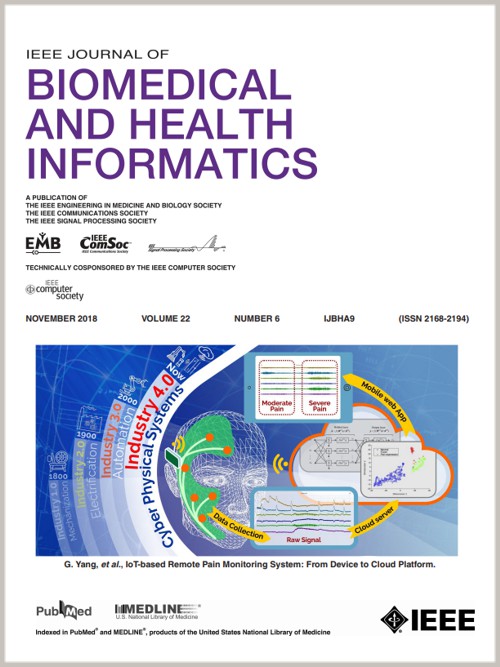
IEEE Journal of Biomedical and Health Informatics publishes original papers presenting recent advances where information and communication technologies intersect with health, healthcare, life sciences, and biomedicine. Topics include acquisition, transmission, storage, retrieval, management, and analysis of biomedical and health information. The journal covers applications of information technologies in healthcare, patient monitoring, preventive care, early disease diagnosis, therapy discovery, and personalized treatment protocols. It explores electronic medical and health records, clinical information systems, decision support systems, medical and biological imaging informatics, wearable systems, body area/sensor networks, and more. Integration-related topics like interoperability, evidence-based medicine, and secure patient data are also addressed.

 求助内容:
 应助结果提醒方式:


 京公网安备 11010802042870号


