Peter L Elkin, Aaron N Elkin, Guresh Mehta, Frank LeHouillier, Jonathan R Nebeker, Nazmus Saquib, Steven H Brown
{"title":"语义临床知识增强改进了跨商业和开放大型语言模型的医学问题回答。","authors":"Peter L Elkin, Aaron N Elkin, Guresh Mehta, Frank LeHouillier, Jonathan R Nebeker, Nazmus Saquib, Steven H Brown","doi":"10.1109/JBHI.2026.3742187","DOIUrl":null,"url":null,"abstract":"<p><strong>Objective: </strong>To evaluate whether semantic clinical knowledge augmentation through Semantic Clinical Artificial Intelligence (SCAI) improves medical question answering across commercial and open large language models, and to examine how a reasoning distilled model performs on the same benchmark.</p><p><strong>Materials and methods: </strong>We evaluated Google Gemini, Microsoft Copilot, Meta Llama 3 70B, and DeepSeek-R1-Distill-Llama-70B on official text only United States Medical Licensing Exam (USMLE) sample questions from Step 1 (n = 87), Step 2 CK (n = 103), and Step 3 (n = 123), with and without SCAI. SCAI comprised HD-NLP parsing, graph and knowledge graph embeddings, a trained SCAI LLM semantic knowledge reasoner, and a semantic knowledge base; the current implementation contained 33,023,902 triples across 246 relation labels. Responses were scored against the answer key with secondary human verification. All models produced a response to every text only item, so incorrect responses were counted as confabulations.</p><p><strong>Results: </strong>Across 313 items, accuracy increased from 90.7% to 97.1% for Gemini, 82.4% to 92.0% for Llama 3 70B, and 55.3% to 81.8% for DeepSeek-R1-Distill; Copilot changed from 93.6% to 94.2%. Within model gains were statistically significant for Gemini, Llama 3 70B, and DeepSeek-R1-Distill on all three steps, but not for Copilot. The best single model result was Llama 3 70B plus SCAI on Step 3 (121/123, 98.4%). Gemini plus SCAI was the numerically strongest commercial system.</p><p><strong>Conclusions: </strong>SCAI was associated with materially better accuracy and lower confabulation (False Positive Results) across several heterogeneous LLMs, supporting a semantically grounded pipeline in which a dedicated SCAI LLM generates clinical context for a host LLM while suggesting that strong general reasoning performance does not automatically translate into healthcare readiness.</p>","PeriodicalId":13073,"journal":{"name":"IEEE Journal of Biomedical and Health Informatics","volume":"PP ","pages":""},"PeriodicalIF":7.7000,"publicationDate":"2026-10-09","publicationTypes":"Journal Article","fieldsOfStudy":null,"isOpenAccess":false,"openAccessPdf":"","citationCount":"0","resultStr":"{\"title\":\"Semantic Clinical Knowledge Augmentation Improves Medical Question Answering Across Commercial and Open Large Language Models.\",\"authors\":\"Peter L Elkin, Aaron N Elkin, Guresh Mehta, Frank LeHouillier, Jonathan R Nebeker, Nazmus Saquib, Steven H Brown\",\"doi\":\"10.1109/JBHI.2026.3742187\",\"DOIUrl\":null,\"url\":null,\"abstract\":\"<p><strong>Objective: </strong>To evaluate whether semantic clinical knowledge augmentation through Semantic Clinical Artificial Intelligence (SCAI) improves medical question answering across commercial and open large language models, and to examine how a reasoning distilled model performs on the same benchmark.</p><p><strong>Materials and methods: </strong>We evaluated Google Gemini, Microsoft Copilot, Meta Llama 3 70B, and DeepSeek-R1-Distill-Llama-70B on official text only United States Medical Licensing Exam (USMLE) sample questions from Step 1 (n = 87), Step 2 CK (n = 103), and Step 3 (n = 123), with and without SCAI. SCAI comprised HD-NLP parsing, graph and knowledge graph embeddings, a trained SCAI LLM semantic knowledge reasoner, and a semantic knowledge base; the current implementation contained 33,023,902 triples across 246 relation labels. Responses were scored against the answer key with secondary human verification. All models produced a response to every text only item, so incorrect responses were counted as confabulations.</p><p><strong>Results: </strong>Across 313 items, accuracy increased from 90.7% to 97.1% for Gemini, 82.4% to 92.0% for Llama 3 70B, and 55.3% to 81.8% for DeepSeek-R1-Distill; Copilot changed from 93.6% to 94.2%. Within model gains were statistically significant for Gemini, Llama 3 70B, and DeepSeek-R1-Distill on all three steps, but not for Copilot. The best single model result was Llama 3 70B plus SCAI on Step 3 (121/123, 98.4%). Gemini plus SCAI was the numerically strongest commercial system.</p><p><strong>Conclusions: </strong>SCAI was associated with materially better accuracy and lower confabulation (False Positive Results) across several heterogeneous LLMs, supporting a semantically grounded pipeline in which a dedicated SCAI LLM generates clinical context for a host LLM while suggesting that strong general reasoning performance does not automatically translate into healthcare readiness.</p>\",\"PeriodicalId\":13073,\"journal\":{\"name\":\"IEEE Journal of Biomedical and Health Informatics\",\"volume\":\"PP \",\"pages\":\"\"},\"PeriodicalIF\":7.7000,\"publicationDate\":\"2026-10-09\",\"publicationTypes\":\"Journal Article\",\"fieldsOfStudy\":null,\"isOpenAccess\":false,\"openAccessPdf\":\"\",\"citationCount\":\"0\",\"resultStr\":null,\"platform\":\"Semanticscholar\",\"paperid\":null,\"PeriodicalName\":\"IEEE Journal of Biomedical and Health Informatics\",\"FirstCategoryId\":\"5\",\"ListUrlMain\":\"https://doi.org/10.1109/JBHI.2026.3742187\",\"RegionNum\":2,\"RegionCategory\":\"医学\",\"ArticlePicture\":[],\"TitleCN\":null,\"AbstractTextCN\":null,\"PMCID\":null,\"EPubDate\":\"\",\"PubModel\":\"\",\"JCR\":\"Q1\",\"JCRName\":\"COMPUTER SCIENCE, INFORMATION SYSTEMS\",\"Score\":null,\"Total\":0}","platform":"Semanticscholar","paperid":null,"PeriodicalName":"IEEE Journal of Biomedical and Health Informatics","FirstCategoryId":"5","ListUrlMain":"https://doi.org/10.1109/JBHI.2026.3742187","RegionNum":2,"RegionCategory":"医学","ArticlePicture":[],"TitleCN":null,"AbstractTextCN":null,"PMCID":null,"EPubDate":"","PubModel":"","JCR":"Q1","JCRName":"COMPUTER SCIENCE, INFORMATION SYSTEMS","Score":null,"Total":0}
Semantic Clinical Knowledge Augmentation Improves Medical Question Answering Across Commercial and Open Large Language Models.
Objective: To evaluate whether semantic clinical knowledge augmentation through Semantic Clinical Artificial Intelligence (SCAI) improves medical question answering across commercial and open large language models, and to examine how a reasoning distilled model performs on the same benchmark.
Materials and methods: We evaluated Google Gemini, Microsoft Copilot, Meta Llama 3 70B, and DeepSeek-R1-Distill-Llama-70B on official text only United States Medical Licensing Exam (USMLE) sample questions from Step 1 (n = 87), Step 2 CK (n = 103), and Step 3 (n = 123), with and without SCAI. SCAI comprised HD-NLP parsing, graph and knowledge graph embeddings, a trained SCAI LLM semantic knowledge reasoner, and a semantic knowledge base; the current implementation contained 33,023,902 triples across 246 relation labels. Responses were scored against the answer key with secondary human verification. All models produced a response to every text only item, so incorrect responses were counted as confabulations.
Results: Across 313 items, accuracy increased from 90.7% to 97.1% for Gemini, 82.4% to 92.0% for Llama 3 70B, and 55.3% to 81.8% for DeepSeek-R1-Distill; Copilot changed from 93.6% to 94.2%. Within model gains were statistically significant for Gemini, Llama 3 70B, and DeepSeek-R1-Distill on all three steps, but not for Copilot. The best single model result was Llama 3 70B plus SCAI on Step 3 (121/123, 98.4%). Gemini plus SCAI was the numerically strongest commercial system.
Conclusions: SCAI was associated with materially better accuracy and lower confabulation (False Positive Results) across several heterogeneous LLMs, supporting a semantically grounded pipeline in which a dedicated SCAI LLM generates clinical context for a host LLM while suggesting that strong general reasoning performance does not automatically translate into healthcare readiness.
期刊介绍:
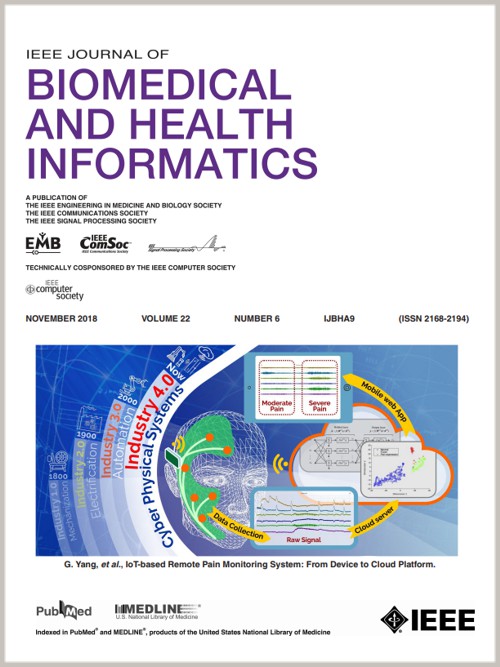
IEEE Journal of Biomedical and Health Informatics publishes original papers presenting recent advances where information and communication technologies intersect with health, healthcare, life sciences, and biomedicine. Topics include acquisition, transmission, storage, retrieval, management, and analysis of biomedical and health information. The journal covers applications of information technologies in healthcare, patient monitoring, preventive care, early disease diagnosis, therapy discovery, and personalized treatment protocols. It explores electronic medical and health records, clinical information systems, decision support systems, medical and biological imaging informatics, wearable systems, body area/sensor networks, and more. Integration-related topics like interoperability, evidence-based medicine, and secure patient data are also addressed.

 求助内容:
 应助结果提醒方式:


 京公网安备 11010802042870号


