Lifeng Xiao, Kushagra Agrawal, Rongsheng Cai, Ruiyang Qu, Sofia Mediavilla Madrigal, Matthew Conway, David J Morgan, Stuart H Taylor, Andrew M Beale, Sarah J Haigh, Andrew J Logsdail, Meenakshisundaram Sankar
{"title":"通过载体诱导效应控制非均相Pt催化剂的化学选择性。","authors":"Lifeng Xiao, Kushagra Agrawal, Rongsheng Cai, Ruiyang Qu, Sofia Mediavilla Madrigal, Matthew Conway, David J Morgan, Stuart H Taylor, Andrew M Beale, Sarah J Haigh, Andrew J Logsdail, Meenakshisundaram Sankar","doi":"10.1039/d6cy00493h","DOIUrl":null,"url":null,"abstract":"<p><p>Tuning the chemoselectivity of a supported metal heterogeneous catalyst during hydrogenation reactions is extremely important and challenging, often achieved by changing the metal or adding homogeneous additives to the reaction. Tuning of the chemoselectivity for a given reaction over a supported metal catalyst, with a better understanding of the nature of the active site, is highly valuable to both academia and industry. Here, we report a support induced chemoselectivity (SIC) switch between Pt/TiO<sub>2</sub> and Pt/Nb<sub>2</sub>O<sub>5</sub> during the hydrogenation of 3-nitrostyrene with high chemoselectivity. Specifically, 0.2%Pt/TiO<sub>2</sub> selectively reduces the -NO<sub>2</sub> group to form 3-vinyl aniline, whereas 0.2%Pt/Nb<sub>2</sub>O<sub>5</sub> selectively reduces the C[double bond, length as m-dash]C bond to form 3-ethylnitrobenzene. Advanced characterisation and <i>ab initio</i> calculations indicate that the observed differences in selectivity could be because of support-dependent interactions at Pt-support interfacial sites, which modify the local electronic environment and adsorption behaviour of the substrate. These results suggest that the support-metal interfacial sites could potentially play a key role in controlling and switching chemoselectivity during 3-nitrostyrene hydrogenation. These results demonstrate that, in addition to modifying the metallic sites, the chemoselectivity of supported Pt nanoparticles can also be tuned by changing the support, offering an additional approach for designing new chemoselective supported metal catalysts for 3-nitrostyrene hydrogenation.</p>","PeriodicalId":66,"journal":{"name":"Catalysis Science & Technology","volume":" ","pages":""},"PeriodicalIF":4.0000,"publicationDate":"2026-09-29","publicationTypes":"Journal Article","fieldsOfStudy":null,"isOpenAccess":false,"openAccessPdf":"https://www.ncbi.nlm.nih.gov/pmc/articles/PMC13647151/pdf/","citationCount":"0","resultStr":"{\"title\":\"Controlling chemoselectivity of heterogeneous Pt catalysts <i>via</i> a support induced effect.\",\"authors\":\"Lifeng Xiao, Kushagra Agrawal, Rongsheng Cai, Ruiyang Qu, Sofia Mediavilla Madrigal, Matthew Conway, David J Morgan, Stuart H Taylor, Andrew M Beale, Sarah J Haigh, Andrew J Logsdail, Meenakshisundaram Sankar\",\"doi\":\"10.1039/d6cy00493h\",\"DOIUrl\":null,\"url\":null,\"abstract\":\"<p><p>Tuning the chemoselectivity of a supported metal heterogeneous catalyst during hydrogenation reactions is extremely important and challenging, often achieved by changing the metal or adding homogeneous additives to the reaction. Tuning of the chemoselectivity for a given reaction over a supported metal catalyst, with a better understanding of the nature of the active site, is highly valuable to both academia and industry. Here, we report a support induced chemoselectivity (SIC) switch between Pt/TiO<sub>2</sub> and Pt/Nb<sub>2</sub>O<sub>5</sub> during the hydrogenation of 3-nitrostyrene with high chemoselectivity. Specifically, 0.2%Pt/TiO<sub>2</sub> selectively reduces the -NO<sub>2</sub> group to form 3-vinyl aniline, whereas 0.2%Pt/Nb<sub>2</sub>O<sub>5</sub> selectively reduces the C[double bond, length as m-dash]C bond to form 3-ethylnitrobenzene. Advanced characterisation and <i>ab initio</i> calculations indicate that the observed differences in selectivity could be because of support-dependent interactions at Pt-support interfacial sites, which modify the local electronic environment and adsorption behaviour of the substrate. These results suggest that the support-metal interfacial sites could potentially play a key role in controlling and switching chemoselectivity during 3-nitrostyrene hydrogenation. These results demonstrate that, in addition to modifying the metallic sites, the chemoselectivity of supported Pt nanoparticles can also be tuned by changing the support, offering an additional approach for designing new chemoselective supported metal catalysts for 3-nitrostyrene hydrogenation.</p>\",\"PeriodicalId\":66,\"journal\":{\"name\":\"Catalysis Science & Technology\",\"volume\":\" \",\"pages\":\"\"},\"PeriodicalIF\":4.0000,\"publicationDate\":\"2026-09-29\",\"publicationTypes\":\"Journal Article\",\"fieldsOfStudy\":null,\"isOpenAccess\":false,\"openAccessPdf\":\"https://www.ncbi.nlm.nih.gov/pmc/articles/PMC13647151/pdf/\",\"citationCount\":\"0\",\"resultStr\":null,\"platform\":\"Semanticscholar\",\"paperid\":null,\"PeriodicalName\":\"Catalysis Science & Technology\",\"FirstCategoryId\":\"92\",\"ListUrlMain\":\"https://doi.org/10.1039/d6cy00493h\",\"RegionNum\":3,\"RegionCategory\":\"化学\",\"ArticlePicture\":[],\"TitleCN\":null,\"AbstractTextCN\":null,\"PMCID\":null,\"EPubDate\":\"\",\"PubModel\":\"\",\"JCR\":\"Q2\",\"JCRName\":\"CHEMISTRY, PHYSICAL\",\"Score\":null,\"Total\":0}","platform":"Semanticscholar","paperid":null,"PeriodicalName":"Catalysis Science & Technology","FirstCategoryId":"92","ListUrlMain":"https://doi.org/10.1039/d6cy00493h","RegionNum":3,"RegionCategory":"化学","ArticlePicture":[],"TitleCN":null,"AbstractTextCN":null,"PMCID":null,"EPubDate":"","PubModel":"","JCR":"Q2","JCRName":"CHEMISTRY, PHYSICAL","Score":null,"Total":0}
Controlling chemoselectivity of heterogeneous Pt catalysts via a support induced effect.
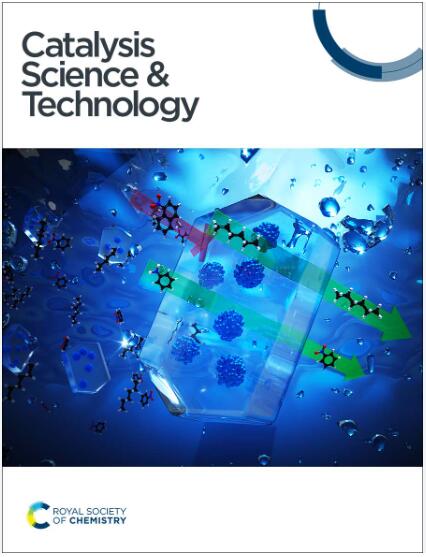
Tuning the chemoselectivity of a supported metal heterogeneous catalyst during hydrogenation reactions is extremely important and challenging, often achieved by changing the metal or adding homogeneous additives to the reaction. Tuning of the chemoselectivity for a given reaction over a supported metal catalyst, with a better understanding of the nature of the active site, is highly valuable to both academia and industry. Here, we report a support induced chemoselectivity (SIC) switch between Pt/TiO2 and Pt/Nb2O5 during the hydrogenation of 3-nitrostyrene with high chemoselectivity. Specifically, 0.2%Pt/TiO2 selectively reduces the -NO2 group to form 3-vinyl aniline, whereas 0.2%Pt/Nb2O5 selectively reduces the C[double bond, length as m-dash]C bond to form 3-ethylnitrobenzene. Advanced characterisation and ab initio calculations indicate that the observed differences in selectivity could be because of support-dependent interactions at Pt-support interfacial sites, which modify the local electronic environment and adsorption behaviour of the substrate. These results suggest that the support-metal interfacial sites could potentially play a key role in controlling and switching chemoselectivity during 3-nitrostyrene hydrogenation. These results demonstrate that, in addition to modifying the metallic sites, the chemoselectivity of supported Pt nanoparticles can also be tuned by changing the support, offering an additional approach for designing new chemoselective supported metal catalysts for 3-nitrostyrene hydrogenation.
期刊介绍:
A multidisciplinary journal focusing on cutting edge research across all fundamental science and technological aspects of catalysis.
Editor-in-chief: Bert Weckhuysen
Impact factor: 5.0
Time to first decision (peer reviewed only): 31 days

 求助内容:
 应助结果提醒方式:


 京公网安备 11010802042870号


