Bowen Guo, Jie Xu, Chen Ma, Zeju Li, Yuanyuan Wang, Yi Guo
{"title":"DermL2V:通过llm驱动编码统一异质皮肤病学文本。","authors":"Bowen Guo, Jie Xu, Chen Ma, Zeju Li, Yuanyuan Wang, Yi Guo","doi":"10.1109/JBHI.2026.3740718","DOIUrl":null,"url":null,"abstract":"<p><p>Dermatology diagnosis requires text encoding models that map unstructured descriptions to clinical semantic representations. Using public dermatology corpora to train such models remains highly challenging due to the lack of a specialized dataset offering unified semantic triplets as well as the difficulty of adaptively weighting clinically informative tokens and enhancing discrimination between clinically different but lexically similar descriptions. In this paper, we first construct DermSCL, a dermatology-specific dataset that organizes heterogeneous dermatology texts into 140,278 structured anchor-positive-negative semantic triplets and provides a unified supervision signal for text representation learning. Pretrained on DermSCL, we propose DermL2V, an LLM-based dermatology text encoder that improves representations by adaptively aggregating clinically relevant token information within a text and distinguishing semantic differences across different texts. First, we introduce a novel Clinical-Aware Relevance Aggregation module, where multiple relevance heads learn complementary token-level relevance patterns under dermatology-specific contrastive supervision to strengthen the representation. Second, we design a Boundary-Aware Semantic Mixup Strategy, which constructs intra- and inter-triplet near-boundary supervisory signals to enhance discrimination between clinically distinct yet lexically similar descriptions. Together, these two components synergistically improve the semantic robustness and discriminative capacity of the learned representations for dermatology. Furthermore, we evaluate DermL2V on important clinical tasks, including dermatology knowledge retrieval, embedding space analysis, concept classification and cross-modal retrieval. Across four out-of-domain dermatology retrieval datasets, DermL2V achieves the best average NDCG@10 and Recall@10 scores while delivering the best performance on the other downstream tasks. These results show DermL2V's potential as a dermatology-specific semantic encoder, providing reliable representations for retrieval-centered clinical applications. The project source code is publicly available here.</p>","PeriodicalId":13073,"journal":{"name":"IEEE Journal of Biomedical and Health Informatics","volume":"PP ","pages":""},"PeriodicalIF":7.7000,"publicationDate":"2026-10-07","publicationTypes":"Journal Article","fieldsOfStudy":null,"isOpenAccess":false,"openAccessPdf":"","citationCount":"0","resultStr":"{\"title\":\"DermL2V: Unifying Heterogeneous Dermatology Texts Via LLM-Driven Encoding.\",\"authors\":\"Bowen Guo, Jie Xu, Chen Ma, Zeju Li, Yuanyuan Wang, Yi Guo\",\"doi\":\"10.1109/JBHI.2026.3740718\",\"DOIUrl\":null,\"url\":null,\"abstract\":\"<p><p>Dermatology diagnosis requires text encoding models that map unstructured descriptions to clinical semantic representations. Using public dermatology corpora to train such models remains highly challenging due to the lack of a specialized dataset offering unified semantic triplets as well as the difficulty of adaptively weighting clinically informative tokens and enhancing discrimination between clinically different but lexically similar descriptions. In this paper, we first construct DermSCL, a dermatology-specific dataset that organizes heterogeneous dermatology texts into 140,278 structured anchor-positive-negative semantic triplets and provides a unified supervision signal for text representation learning. Pretrained on DermSCL, we propose DermL2V, an LLM-based dermatology text encoder that improves representations by adaptively aggregating clinically relevant token information within a text and distinguishing semantic differences across different texts. First, we introduce a novel Clinical-Aware Relevance Aggregation module, where multiple relevance heads learn complementary token-level relevance patterns under dermatology-specific contrastive supervision to strengthen the representation. Second, we design a Boundary-Aware Semantic Mixup Strategy, which constructs intra- and inter-triplet near-boundary supervisory signals to enhance discrimination between clinically distinct yet lexically similar descriptions. Together, these two components synergistically improve the semantic robustness and discriminative capacity of the learned representations for dermatology. Furthermore, we evaluate DermL2V on important clinical tasks, including dermatology knowledge retrieval, embedding space analysis, concept classification and cross-modal retrieval. Across four out-of-domain dermatology retrieval datasets, DermL2V achieves the best average NDCG@10 and Recall@10 scores while delivering the best performance on the other downstream tasks. These results show DermL2V's potential as a dermatology-specific semantic encoder, providing reliable representations for retrieval-centered clinical applications. The project source code is publicly available here.</p>\",\"PeriodicalId\":13073,\"journal\":{\"name\":\"IEEE Journal of Biomedical and Health Informatics\",\"volume\":\"PP \",\"pages\":\"\"},\"PeriodicalIF\":7.7000,\"publicationDate\":\"2026-10-07\",\"publicationTypes\":\"Journal Article\",\"fieldsOfStudy\":null,\"isOpenAccess\":false,\"openAccessPdf\":\"\",\"citationCount\":\"0\",\"resultStr\":null,\"platform\":\"Semanticscholar\",\"paperid\":null,\"PeriodicalName\":\"IEEE Journal of Biomedical and Health Informatics\",\"FirstCategoryId\":\"5\",\"ListUrlMain\":\"https://doi.org/10.1109/JBHI.2026.3740718\",\"RegionNum\":2,\"RegionCategory\":\"医学\",\"ArticlePicture\":[],\"TitleCN\":null,\"AbstractTextCN\":null,\"PMCID\":null,\"EPubDate\":\"\",\"PubModel\":\"\",\"JCR\":\"Q1\",\"JCRName\":\"COMPUTER SCIENCE, INFORMATION SYSTEMS\",\"Score\":null,\"Total\":0}","platform":"Semanticscholar","paperid":null,"PeriodicalName":"IEEE Journal of Biomedical and Health Informatics","FirstCategoryId":"5","ListUrlMain":"https://doi.org/10.1109/JBHI.2026.3740718","RegionNum":2,"RegionCategory":"医学","ArticlePicture":[],"TitleCN":null,"AbstractTextCN":null,"PMCID":null,"EPubDate":"","PubModel":"","JCR":"Q1","JCRName":"COMPUTER SCIENCE, INFORMATION SYSTEMS","Score":null,"Total":0}
DermL2V: Unifying Heterogeneous Dermatology Texts Via LLM-Driven Encoding.
Dermatology diagnosis requires text encoding models that map unstructured descriptions to clinical semantic representations. Using public dermatology corpora to train such models remains highly challenging due to the lack of a specialized dataset offering unified semantic triplets as well as the difficulty of adaptively weighting clinically informative tokens and enhancing discrimination between clinically different but lexically similar descriptions. In this paper, we first construct DermSCL, a dermatology-specific dataset that organizes heterogeneous dermatology texts into 140,278 structured anchor-positive-negative semantic triplets and provides a unified supervision signal for text representation learning. Pretrained on DermSCL, we propose DermL2V, an LLM-based dermatology text encoder that improves representations by adaptively aggregating clinically relevant token information within a text and distinguishing semantic differences across different texts. First, we introduce a novel Clinical-Aware Relevance Aggregation module, where multiple relevance heads learn complementary token-level relevance patterns under dermatology-specific contrastive supervision to strengthen the representation. Second, we design a Boundary-Aware Semantic Mixup Strategy, which constructs intra- and inter-triplet near-boundary supervisory signals to enhance discrimination between clinically distinct yet lexically similar descriptions. Together, these two components synergistically improve the semantic robustness and discriminative capacity of the learned representations for dermatology. Furthermore, we evaluate DermL2V on important clinical tasks, including dermatology knowledge retrieval, embedding space analysis, concept classification and cross-modal retrieval. Across four out-of-domain dermatology retrieval datasets, DermL2V achieves the best average NDCG@10 and Recall@10 scores while delivering the best performance on the other downstream tasks. These results show DermL2V's potential as a dermatology-specific semantic encoder, providing reliable representations for retrieval-centered clinical applications. The project source code is publicly available here.
期刊介绍:
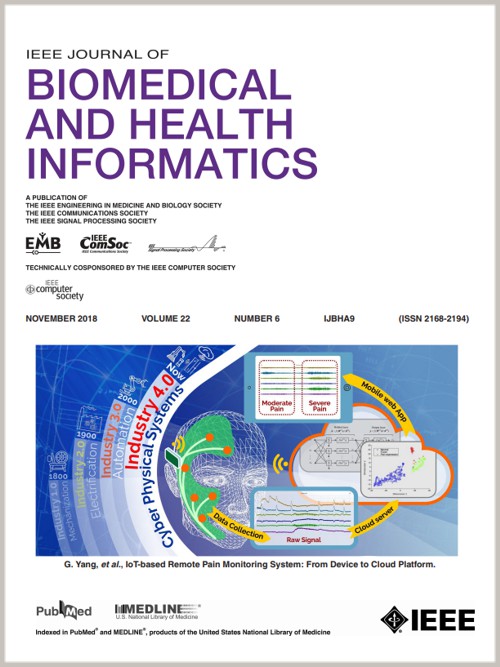
IEEE Journal of Biomedical and Health Informatics publishes original papers presenting recent advances where information and communication technologies intersect with health, healthcare, life sciences, and biomedicine. Topics include acquisition, transmission, storage, retrieval, management, and analysis of biomedical and health information. The journal covers applications of information technologies in healthcare, patient monitoring, preventive care, early disease diagnosis, therapy discovery, and personalized treatment protocols. It explores electronic medical and health records, clinical information systems, decision support systems, medical and biological imaging informatics, wearable systems, body area/sensor networks, and more. Integration-related topics like interoperability, evidence-based medicine, and secure patient data are also addressed.

 求助内容:
 应助结果提醒方式:


 京公网安备 11010802042870号


