Joseph Azria, Arnaud Beddok, Esteban Brenet, Delphine Antoni, Laurence Auzeau, Nathaniel Assouly, Marine Fontaine, Sofiane Guendouzen, Jean-Claude Merol, Yacine Merrouche, Philippe Guilbert, Antonio Da Silva Ribeiro Mota
{"title":"舌底体积和剂量作为口腔鳞状细胞癌最终或辅助放疗后晚期吞咽困难的预测因素","authors":"Joseph Azria, Arnaud Beddok, Esteban Brenet, Delphine Antoni, Laurence Auzeau, Nathaniel Assouly, Marine Fontaine, Sofiane Guendouzen, Jean-Claude Merol, Yacine Merrouche, Philippe Guilbert, Antonio Da Silva Ribeiro Mota","doi":"10.1016/j.phro.2026.101038","DOIUrl":null,"url":null,"abstract":"<div><h3>Background and purpose</h3><div>Radiation-induced dysphagia is a major determinant of quality of life in patients treated for oral cavity squamous cell carcinoma (OCSCC). While dose to the pharyngeal constrictor muscles has been extensively investigated, the base of tongue (BOT) remains poorly studied. This study aimed to evaluate the association between BOT volume and dose–volume parameters and late dysphagia.</div></div><div><h3>Material and methods</h3><div>Fifty-two patients with OCSCC treated with volumetric modulated arc therapy (VMAT) between 2019 and 2023 were retrospectively analyzed. All patients had a prophylactic feeding tube (FT) placed before VMAT. The base of tongue was delineated using an artificial intelligence-based segmentation algorithm and reviewed by a senior radiation oncologist. Late dysphagia was defined as prolonged FT dependency using the cohort-specific 75th percentile (> 442.5 days). Volumetric and dose/volume parameters of the BOT (D<sub>0%–</sub>D<sub>100%</sub>) were analyzed using logistic regression, receiver operating characteristic (ROC) curve analysis, and Kaplan–Meier methods.</div></div><div><h3>Results</h3><div>The median BOT volume for the entire cohort was 18.4 cm<sup>3</sup> (interquartile range [IQR]: 15.7–21.3 cm<sup>3</sup>). Patients with late dysphagia had smaller BOT volumes than those without (15.9 vs. 19.5 cm<sup>3</sup>, <em>p</em> = 0.02). A BOT volume < 19.12 cm<sup>3</sup> was associated with increased dysphagia risk. No dose/volume parameter reached statistical significance, although a trend suggested lower risk for a BOT D<sub>50%</sub> < 52.2 Gy (<em>p</em> = 0.21). A combined model integrating BOT volume and D<sub>50%</sub> achieved an area under the curve (AUC) of 0.74 (95% CI: 0.61–0.87).</div></div><div><h3>Conclusions</h3><div>Smaller BOT volume was associated with increased risk of prolonged FT dependency after radiotherapy for OCSCC. BOT dose metrics were not significant but showed hypothesis-generating trends that warrant validation in larger cohorts and dose-optimization studies.</div></div>","PeriodicalId":36850,"journal":{"name":"Physics and Imaging in Radiation Oncology","volume":"40 ","pages":"Article 101038"},"PeriodicalIF":3.2000,"publicationDate":"2026-07-01","publicationTypes":"Journal Article","fieldsOfStudy":null,"isOpenAccess":false,"openAccessPdf":"","citationCount":"0","resultStr":"{\"title\":\"Base of tongue volume and dose as predictors of late dysphagia after definitive or adjuvant radiotherapy for oral cavity squamous cell carcinoma\",\"authors\":\"Joseph Azria, Arnaud Beddok, Esteban Brenet, Delphine Antoni, Laurence Auzeau, Nathaniel Assouly, Marine Fontaine, Sofiane Guendouzen, Jean-Claude Merol, Yacine Merrouche, Philippe Guilbert, Antonio Da Silva Ribeiro Mota\",\"doi\":\"10.1016/j.phro.2026.101038\",\"DOIUrl\":null,\"url\":null,\"abstract\":\"<div><h3>Background and purpose</h3><div>Radiation-induced dysphagia is a major determinant of quality of life in patients treated for oral cavity squamous cell carcinoma (OCSCC). While dose to the pharyngeal constrictor muscles has been extensively investigated, the base of tongue (BOT) remains poorly studied. This study aimed to evaluate the association between BOT volume and dose–volume parameters and late dysphagia.</div></div><div><h3>Material and methods</h3><div>Fifty-two patients with OCSCC treated with volumetric modulated arc therapy (VMAT) between 2019 and 2023 were retrospectively analyzed. All patients had a prophylactic feeding tube (FT) placed before VMAT. The base of tongue was delineated using an artificial intelligence-based segmentation algorithm and reviewed by a senior radiation oncologist. Late dysphagia was defined as prolonged FT dependency using the cohort-specific 75th percentile (> 442.5 days). Volumetric and dose/volume parameters of the BOT (D<sub>0%–</sub>D<sub>100%</sub>) were analyzed using logistic regression, receiver operating characteristic (ROC) curve analysis, and Kaplan–Meier methods.</div></div><div><h3>Results</h3><div>The median BOT volume for the entire cohort was 18.4 cm<sup>3</sup> (interquartile range [IQR]: 15.7–21.3 cm<sup>3</sup>). Patients with late dysphagia had smaller BOT volumes than those without (15.9 vs. 19.5 cm<sup>3</sup>, <em>p</em> = 0.02). A BOT volume < 19.12 cm<sup>3</sup> was associated with increased dysphagia risk. No dose/volume parameter reached statistical significance, although a trend suggested lower risk for a BOT D<sub>50%</sub> < 52.2 Gy (<em>p</em> = 0.21). A combined model integrating BOT volume and D<sub>50%</sub> achieved an area under the curve (AUC) of 0.74 (95% CI: 0.61–0.87).</div></div><div><h3>Conclusions</h3><div>Smaller BOT volume was associated with increased risk of prolonged FT dependency after radiotherapy for OCSCC. BOT dose metrics were not significant but showed hypothesis-generating trends that warrant validation in larger cohorts and dose-optimization studies.</div></div>\",\"PeriodicalId\":36850,\"journal\":{\"name\":\"Physics and Imaging in Radiation Oncology\",\"volume\":\"40 \",\"pages\":\"Article 101038\"},\"PeriodicalIF\":3.2000,\"publicationDate\":\"2026-07-01\",\"publicationTypes\":\"Journal Article\",\"fieldsOfStudy\":null,\"isOpenAccess\":false,\"openAccessPdf\":\"\",\"citationCount\":\"0\",\"resultStr\":null,\"platform\":\"Semanticscholar\",\"paperid\":null,\"PeriodicalName\":\"Physics and Imaging in Radiation Oncology\",\"FirstCategoryId\":\"1085\",\"ListUrlMain\":\"https://www.sciencedirect.com/science/article/pii/S2405631626001387\",\"RegionNum\":0,\"RegionCategory\":null,\"ArticlePicture\":[],\"TitleCN\":null,\"AbstractTextCN\":null,\"PMCID\":null,\"EPubDate\":\"2026/7/12 0:00:00\",\"PubModel\":\"Epub\",\"JCR\":\"Q2\",\"JCRName\":\"ONCOLOGY\",\"Score\":null,\"Total\":0}","platform":"Semanticscholar","paperid":null,"PeriodicalName":"Physics and Imaging in Radiation Oncology","FirstCategoryId":"1085","ListUrlMain":"https://www.sciencedirect.com/science/article/pii/S2405631626001387","RegionNum":0,"RegionCategory":null,"ArticlePicture":[],"TitleCN":null,"AbstractTextCN":null,"PMCID":null,"EPubDate":"2026/7/12 0:00:00","PubModel":"Epub","JCR":"Q2","JCRName":"ONCOLOGY","Score":null,"Total":0}
Base of tongue volume and dose as predictors of late dysphagia after definitive or adjuvant radiotherapy for oral cavity squamous cell carcinoma
Background and purpose
Radiation-induced dysphagia is a major determinant of quality of life in patients treated for oral cavity squamous cell carcinoma (OCSCC). While dose to the pharyngeal constrictor muscles has been extensively investigated, the base of tongue (BOT) remains poorly studied. This study aimed to evaluate the association between BOT volume and dose–volume parameters and late dysphagia.
Material and methods
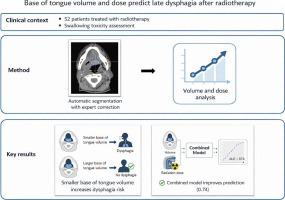
Fifty-two patients with OCSCC treated with volumetric modulated arc therapy (VMAT) between 2019 and 2023 were retrospectively analyzed. All patients had a prophylactic feeding tube (FT) placed before VMAT. The base of tongue was delineated using an artificial intelligence-based segmentation algorithm and reviewed by a senior radiation oncologist. Late dysphagia was defined as prolonged FT dependency using the cohort-specific 75th percentile (> 442.5 days). Volumetric and dose/volume parameters of the BOT (D0%–D100%) were analyzed using logistic regression, receiver operating characteristic (ROC) curve analysis, and Kaplan–Meier methods.
Results
The median BOT volume for the entire cohort was 18.4 cm3 (interquartile range [IQR]: 15.7–21.3 cm3). Patients with late dysphagia had smaller BOT volumes than those without (15.9 vs. 19.5 cm3, p = 0.02). A BOT volume < 19.12 cm3 was associated with increased dysphagia risk. No dose/volume parameter reached statistical significance, although a trend suggested lower risk for a BOT D50% < 52.2 Gy (p = 0.21). A combined model integrating BOT volume and D50% achieved an area under the curve (AUC) of 0.74 (95% CI: 0.61–0.87).
Conclusions
Smaller BOT volume was associated with increased risk of prolonged FT dependency after radiotherapy for OCSCC. BOT dose metrics were not significant but showed hypothesis-generating trends that warrant validation in larger cohorts and dose-optimization studies.