{"title":"自由曲面的应力感知面板化","authors":"Xinzhuo Hu, Roi Poranne, Julian Panetta","doi":"10.1145/3811387","DOIUrl":null,"url":null,"abstract":"Freeform surfaces are popular in architectural design for their expressive aesthetics, yet they remain challenging to fabricate. A common strategy is to approximate them with assemblies of planar polygonal panels in a process we term panelization, enabling cost-effective fabrication from sheet materials such as wood, metal, or glass. Our goal is to compute panelizations that are both geometrically faithful and structurally robust. A two-stage pipeline, <jats:italic toggle=\"yes\">i.e.</jats:italic> geometric panelization followed by structural optimization, can be effective, but joint optimization may yield better outcomes by letting mechanics influence the panelization itself. The challenges are that the panelization task is inherently combinatorial, and structural objectives depend on stresses that have a complex, global dependence on the geometry and are costly to evaluate. Moreover, improving structural performance must be balanced against preserving the input surface's design intent. To address these challenges, we formulate panelization as a continuous surface flow coupled to stress analysis, by modeling candidates as creased elastic shells. We define a global objective by integrating an arbitrary function of stress over the shell and derive efficient gradients with respect to the surface shape to enable optimization. We further introduce flow terms that better preserve the input shape and show that running BFGS in a Sobolev space substantially outperforms standard BFGS and Sobolev gradient descent. We evaluate our method on architectural models, showing that incorporating stress during panelization yields substantial stress reductions and more robust designs compared to optimizing stress after fixing the panelization.","PeriodicalId":50913,"journal":{"name":"ACM Transactions on Graphics","volume":"25 1","pages":""},"PeriodicalIF":13.0000,"publicationDate":"2026-07-03","publicationTypes":"Journal Article","fieldsOfStudy":null,"isOpenAccess":false,"openAccessPdf":"","citationCount":"0","resultStr":"{\"title\":\"Stress-Aware Panelization of Freeform Surfaces\",\"authors\":\"Xinzhuo Hu, Roi Poranne, Julian Panetta\",\"doi\":\"10.1145/3811387\",\"DOIUrl\":null,\"url\":null,\"abstract\":\"Freeform surfaces are popular in architectural design for their expressive aesthetics, yet they remain challenging to fabricate. A common strategy is to approximate them with assemblies of planar polygonal panels in a process we term panelization, enabling cost-effective fabrication from sheet materials such as wood, metal, or glass. Our goal is to compute panelizations that are both geometrically faithful and structurally robust. A two-stage pipeline, <jats:italic toggle=\\\"yes\\\">i.e.</jats:italic> geometric panelization followed by structural optimization, can be effective, but joint optimization may yield better outcomes by letting mechanics influence the panelization itself. The challenges are that the panelization task is inherently combinatorial, and structural objectives depend on stresses that have a complex, global dependence on the geometry and are costly to evaluate. Moreover, improving structural performance must be balanced against preserving the input surface's design intent. To address these challenges, we formulate panelization as a continuous surface flow coupled to stress analysis, by modeling candidates as creased elastic shells. We define a global objective by integrating an arbitrary function of stress over the shell and derive efficient gradients with respect to the surface shape to enable optimization. We further introduce flow terms that better preserve the input shape and show that running BFGS in a Sobolev space substantially outperforms standard BFGS and Sobolev gradient descent. We evaluate our method on architectural models, showing that incorporating stress during panelization yields substantial stress reductions and more robust designs compared to optimizing stress after fixing the panelization.\",\"PeriodicalId\":50913,\"journal\":{\"name\":\"ACM Transactions on Graphics\",\"volume\":\"25 1\",\"pages\":\"\"},\"PeriodicalIF\":13.0000,\"publicationDate\":\"2026-07-03\",\"publicationTypes\":\"Journal Article\",\"fieldsOfStudy\":null,\"isOpenAccess\":false,\"openAccessPdf\":\"\",\"citationCount\":\"0\",\"resultStr\":null,\"platform\":\"Semanticscholar\",\"paperid\":null,\"PeriodicalName\":\"ACM Transactions on Graphics\",\"FirstCategoryId\":\"94\",\"ListUrlMain\":\"https://doi.org/10.1145/3811387\",\"RegionNum\":1,\"RegionCategory\":\"计算机科学\",\"ArticlePicture\":[],\"TitleCN\":null,\"AbstractTextCN\":null,\"PMCID\":null,\"EPubDate\":\"\",\"PubModel\":\"\",\"JCR\":\"Q1\",\"JCRName\":\"COMPUTER SCIENCE, SOFTWARE ENGINEERING\",\"Score\":null,\"Total\":0}","platform":"Semanticscholar","paperid":null,"PeriodicalName":"ACM Transactions on Graphics","FirstCategoryId":"94","ListUrlMain":"https://doi.org/10.1145/3811387","RegionNum":1,"RegionCategory":"计算机科学","ArticlePicture":[],"TitleCN":null,"AbstractTextCN":null,"PMCID":null,"EPubDate":"","PubModel":"","JCR":"Q1","JCRName":"COMPUTER SCIENCE, SOFTWARE ENGINEERING","Score":null,"Total":0}
Freeform surfaces are popular in architectural design for their expressive aesthetics, yet they remain challenging to fabricate. A common strategy is to approximate them with assemblies of planar polygonal panels in a process we term panelization, enabling cost-effective fabrication from sheet materials such as wood, metal, or glass. Our goal is to compute panelizations that are both geometrically faithful and structurally robust. A two-stage pipeline, i.e. geometric panelization followed by structural optimization, can be effective, but joint optimization may yield better outcomes by letting mechanics influence the panelization itself. The challenges are that the panelization task is inherently combinatorial, and structural objectives depend on stresses that have a complex, global dependence on the geometry and are costly to evaluate. Moreover, improving structural performance must be balanced against preserving the input surface's design intent. To address these challenges, we formulate panelization as a continuous surface flow coupled to stress analysis, by modeling candidates as creased elastic shells. We define a global objective by integrating an arbitrary function of stress over the shell and derive efficient gradients with respect to the surface shape to enable optimization. We further introduce flow terms that better preserve the input shape and show that running BFGS in a Sobolev space substantially outperforms standard BFGS and Sobolev gradient descent. We evaluate our method on architectural models, showing that incorporating stress during panelization yields substantial stress reductions and more robust designs compared to optimizing stress after fixing the panelization.
期刊介绍:
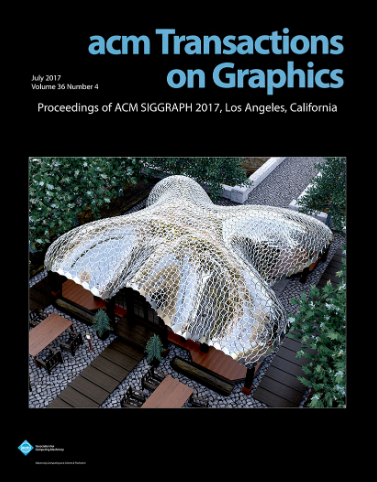
ACM Transactions on Graphics (TOG) is a peer-reviewed scientific journal that aims to disseminate the latest findings of note in the field of computer graphics. It has been published since 1982 by the Association for Computing Machinery. Starting in 2003, all papers accepted for presentation at the annual SIGGRAPH conference are printed in a special summer issue of the journal.