Yizhou Li, Sarah M. Narehood, Brian D. Cook, Kelly L. McGuire, Mark A. Herzik Jr.* and F. Akif Tezcan*,
{"title":"异源氮酶配合物的结构和功能表征。","authors":"Yizhou Li, Sarah M. Narehood, Brian D. Cook, Kelly L. McGuire, Mark A. Herzik Jr.* and F. Akif Tezcan*, ","doi":"10.1021/acs.biochem.6c00360","DOIUrl":null,"url":null,"abstract":"<p >Nitrogenase is the only known enzyme that catalyzes the reduction of dinitrogen to ammonia. The most prevalent isozyme, molybdenum nitrogenase, comprises the catalytic molybdenum–iron protein (MoFeP) and the ATP-dependent reductase iron protein (FeP). Although Mo-nitrogenases are widespread across bacteria and archaea and appear to share conserved mechanistic and structural features, FeP and MoFeP show considerable sequence variability across diazotrophs. This raises questions about the conservation of chemomechanical mechanisms coupling FeP-dependent ATP hydrolysis and electron transfer to MoFeP, and about the functional compatibility of nitrogenase components from divergent species. Previous studies showed that some heterologous FeP−MoFeP pairs can functionally complement each other, whereas other pairs lack catalytic activity, but the absence of structural information on such heterologous pairs has limited mechanistic understanding. To this end, we investigated the functional and structural compatibility of FeP and MoFeP from <i>Azotobacter vinelandii</i> (<i>Av</i>) and <i>Gluconacetobacter diazotrophicus</i> (<i>Gd</i>), two phylogenetically and ecologically distinct species. Building on our prior work with <i>Gd</i>-nitrogenase and recently developed cryogenic electron microscopy (cryoEM) protocols, we determined the ADP·BeF<sub><i>x</i></sub>-trapped structure of the homologous <i>Gd</i>FeP–<i>Gd</i>MoFeP complex and showed that it adopted the same geometry as its <i>Av</i> counterpart. Activity measurements showed that heterologous <i>Gd/Av</i> combinations retained 60–80% of homologous catalytic activities despite 30–50% sequence divergence in FeP and MoFeP. High-resolution cryoEM structures of <i>Gd</i>FeP–<i>Av</i>MoFeP and <i>Av</i>FeP–<i>Gd</i>MoFeP corroborated these activities and revealed that functional complementation tolerates substantial sequence variation when the core structural elements supporting ATP binding/hydrolysis, protein–protein interaction, electron transfer, and substrate reduction are conserved.</p>","PeriodicalId":28,"journal":{"name":"Biochemistry Biochemistry","volume":"65 14","pages":"2318–2329"},"PeriodicalIF":2.7000,"publicationDate":"2026-07-21","publicationTypes":"Journal Article","fieldsOfStudy":null,"isOpenAccess":false,"openAccessPdf":"","citationCount":"0","resultStr":"{\"title\":\"Structural and Functional Characterization of Heterologous Nitrogenase Complexes\",\"authors\":\"Yizhou Li, Sarah M. Narehood, Brian D. Cook, Kelly L. McGuire, Mark A. Herzik Jr.* and F. Akif Tezcan*, \",\"doi\":\"10.1021/acs.biochem.6c00360\",\"DOIUrl\":null,\"url\":null,\"abstract\":\"<p >Nitrogenase is the only known enzyme that catalyzes the reduction of dinitrogen to ammonia. The most prevalent isozyme, molybdenum nitrogenase, comprises the catalytic molybdenum–iron protein (MoFeP) and the ATP-dependent reductase iron protein (FeP). Although Mo-nitrogenases are widespread across bacteria and archaea and appear to share conserved mechanistic and structural features, FeP and MoFeP show considerable sequence variability across diazotrophs. This raises questions about the conservation of chemomechanical mechanisms coupling FeP-dependent ATP hydrolysis and electron transfer to MoFeP, and about the functional compatibility of nitrogenase components from divergent species. Previous studies showed that some heterologous FeP−MoFeP pairs can functionally complement each other, whereas other pairs lack catalytic activity, but the absence of structural information on such heterologous pairs has limited mechanistic understanding. To this end, we investigated the functional and structural compatibility of FeP and MoFeP from <i>Azotobacter vinelandii</i> (<i>Av</i>) and <i>Gluconacetobacter diazotrophicus</i> (<i>Gd</i>), two phylogenetically and ecologically distinct species. Building on our prior work with <i>Gd</i>-nitrogenase and recently developed cryogenic electron microscopy (cryoEM) protocols, we determined the ADP·BeF<sub><i>x</i></sub>-trapped structure of the homologous <i>Gd</i>FeP–<i>Gd</i>MoFeP complex and showed that it adopted the same geometry as its <i>Av</i> counterpart. Activity measurements showed that heterologous <i>Gd/Av</i> combinations retained 60–80% of homologous catalytic activities despite 30–50% sequence divergence in FeP and MoFeP. High-resolution cryoEM structures of <i>Gd</i>FeP–<i>Av</i>MoFeP and <i>Av</i>FeP–<i>Gd</i>MoFeP corroborated these activities and revealed that functional complementation tolerates substantial sequence variation when the core structural elements supporting ATP binding/hydrolysis, protein–protein interaction, electron transfer, and substrate reduction are conserved.</p>\",\"PeriodicalId\":28,\"journal\":{\"name\":\"Biochemistry Biochemistry\",\"volume\":\"65 14\",\"pages\":\"2318–2329\"},\"PeriodicalIF\":2.7000,\"publicationDate\":\"2026-07-21\",\"publicationTypes\":\"Journal Article\",\"fieldsOfStudy\":null,\"isOpenAccess\":false,\"openAccessPdf\":\"\",\"citationCount\":\"0\",\"resultStr\":null,\"platform\":\"Semanticscholar\",\"paperid\":null,\"PeriodicalName\":\"Biochemistry Biochemistry\",\"FirstCategoryId\":\"1\",\"ListUrlMain\":\"https://pubs.acs.org/doi/10.1021/acs.biochem.6c00360\",\"RegionNum\":3,\"RegionCategory\":\"生物学\",\"ArticlePicture\":[],\"TitleCN\":null,\"AbstractTextCN\":null,\"PMCID\":null,\"EPubDate\":\"2026/7/2 0:00:00\",\"PubModel\":\"Epub\",\"JCR\":\"Q3\",\"JCRName\":\"BIOCHEMISTRY & MOLECULAR BIOLOGY\",\"Score\":null,\"Total\":0}","platform":"Semanticscholar","paperid":null,"PeriodicalName":"Biochemistry Biochemistry","FirstCategoryId":"1","ListUrlMain":"https://pubs.acs.org/doi/10.1021/acs.biochem.6c00360","RegionNum":3,"RegionCategory":"生物学","ArticlePicture":[],"TitleCN":null,"AbstractTextCN":null,"PMCID":null,"EPubDate":"2026/7/2 0:00:00","PubModel":"Epub","JCR":"Q3","JCRName":"BIOCHEMISTRY & MOLECULAR BIOLOGY","Score":null,"Total":0}
引用次数: 0
摘要
氮酶是唯一已知的催化二氮还原为氨的酶。最常见的同工酶,钼氮酶,包括催化钼铁蛋白(MoFeP)和atp依赖性还原酶铁蛋白(FeP)。虽然mo -固氮酶在细菌和古细菌中广泛存在,并且似乎具有保守的机制和结构特征,但FeP和MoFeP在重氮养菌中显示出相当大的序列差异。这就提出了fep依赖性ATP水解和电子转移到MoFeP的化学力学机制的守恒问题,以及来自不同物种的氮酶组分的功能相容性问题。以往的研究表明,一些异源FeP-MoFeP对在功能上可以互补,而另一些则缺乏催化活性,但由于缺乏这些异源fep对的结构信息,限制了对其机理的理解。为此,我们研究了来自vinelandii固氮菌(Av)和重氮营养菌(Gd)的FeP和MoFeP在功能和结构上的相容性。基于我们之前对gd -氮酶的研究和最近开发的低温电子显微镜(cryogenic electron microscopy, cryoEM)技术,我们确定了同源GdFeP-GdMoFeP复合物的ADP·befx捕获结构,并表明它与Av复合物具有相同的几何结构。活性测定表明,尽管异源Gd/Av组合在FeP和MoFeP序列上存在30-50%的差异,但仍保持了60-80%的同源催化活性。GdFeP-AvMoFeP和AvFeP-GdMoFeP的高分辨率冷冻电镜结构证实了这些活性,并表明当支持ATP结合/水解、蛋白质-蛋白质相互作用、电子转移和底物还原的核心结构元件保持保守时,功能互补耐受大量的序列变化。
Structural and Functional Characterization of Heterologous Nitrogenase Complexes
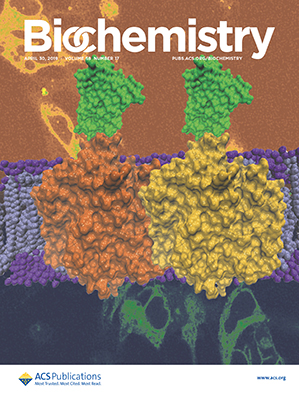
Nitrogenase is the only known enzyme that catalyzes the reduction of dinitrogen to ammonia. The most prevalent isozyme, molybdenum nitrogenase, comprises the catalytic molybdenum–iron protein (MoFeP) and the ATP-dependent reductase iron protein (FeP). Although Mo-nitrogenases are widespread across bacteria and archaea and appear to share conserved mechanistic and structural features, FeP and MoFeP show considerable sequence variability across diazotrophs. This raises questions about the conservation of chemomechanical mechanisms coupling FeP-dependent ATP hydrolysis and electron transfer to MoFeP, and about the functional compatibility of nitrogenase components from divergent species. Previous studies showed that some heterologous FeP−MoFeP pairs can functionally complement each other, whereas other pairs lack catalytic activity, but the absence of structural information on such heterologous pairs has limited mechanistic understanding. To this end, we investigated the functional and structural compatibility of FeP and MoFeP from Azotobacter vinelandii (Av) and Gluconacetobacter diazotrophicus (Gd), two phylogenetically and ecologically distinct species. Building on our prior work with Gd-nitrogenase and recently developed cryogenic electron microscopy (cryoEM) protocols, we determined the ADP·BeFx-trapped structure of the homologous GdFeP–GdMoFeP complex and showed that it adopted the same geometry as its Av counterpart. Activity measurements showed that heterologous Gd/Av combinations retained 60–80% of homologous catalytic activities despite 30–50% sequence divergence in FeP and MoFeP. High-resolution cryoEM structures of GdFeP–AvMoFeP and AvFeP–GdMoFeP corroborated these activities and revealed that functional complementation tolerates substantial sequence variation when the core structural elements supporting ATP binding/hydrolysis, protein–protein interaction, electron transfer, and substrate reduction are conserved.
期刊介绍:
Biochemistry provides an international forum for publishing exceptional, rigorous, high-impact research across all of biological chemistry. This broad scope includes studies on the chemical, physical, mechanistic, and/or structural basis of biological or cell function, and encompasses the fields of chemical biology, synthetic biology, disease biology, cell biology, nucleic acid biology, neuroscience, structural biology, and biophysics. In addition to traditional Research Articles, Biochemistry also publishes Communications, Viewpoints, and Perspectives, as well as From the Bench articles that report new methods of particular interest to the biological chemistry community.


 求助内容:
 应助结果提醒方式:


 京公网安备 11010802042870号


