Qiqi Deng, Jialing Li, Xiaoqing Luo, Ziqi Peng, Wendong Xian, Haixian Xiong, Leiping Ye, Huan Liu, Jie Ren, Jiaxue Wu, Wenjun Li, Pandeng Wang
{"title":"第三代RNA扩增子测序揭示亚热带河口潮汐河段微生物群落动态。","authors":"Qiqi Deng, Jialing Li, Xiaoqing Luo, Ziqi Peng, Wendong Xian, Haixian Xiong, Leiping Ye, Huan Liu, Jie Ren, Jiaxue Wu, Wenjun Li, Pandeng Wang","doi":"10.1007/s00248-026-02804-4","DOIUrl":null,"url":null,"abstract":"<p><p>Estuarine ecosystems are characterized by periodic tidal cycles that induce dynamic salinity fluctuations, yet how these dynamic salinity changes affect microbial diversity, community composition, and network structure remains poorly understood. Answering this question would enhance our understanding of the effects of periodic tides on microbial communities in estuaries. To address this knowledge gap, we collected hourly water samples over a 24-h time series from the tidal reach of the Pearl River Estuary (PRE) and explored the dynamics of both prokaryotic and eukaryotic microbial diversity and their co-occurrence networks during a complete tidal cycle by utilizing RNA-derived cDNA combined with third-generation (PacBio) amplicon sequencing. This approach targets the active microbial community (by using RNA) while providing high taxonomic resolution (by full-length sequencing of 16S rRNA gene / ITS regions). Our results revealed that salinity was the dominant driver of the changes of microbial diversity and community compositions in the tidal reach, with a significant decrease in microbial alpha diversity as salinity increased. Furthermore, we observed a non-linear relationship between salinity and microbial network complexity and stability. Notably, network stability in both single- and cross-domain networks was positively correlated with connectance and P/N (the positive-to-negative edge ratio). Additionally, cross-domain networks exhibited higher complexity (node numbers, total links, and average node degree), but lower network stability (robustness and vulnerability) compared to single-domain co-occurrence networks. Overall, our findings provide comprehensive insights into how periodic salinity fluctuations regulate microbial community structure and cross-domain interactions in dynamic estuarine environments.</p>","PeriodicalId":18708,"journal":{"name":"Microbial Ecology","volume":" ","pages":""},"PeriodicalIF":4.3000,"publicationDate":"2026-06-23","publicationTypes":"Journal Article","fieldsOfStudy":null,"isOpenAccess":false,"openAccessPdf":"","citationCount":"0","resultStr":"{\"title\":\"Third-generation RNA Amplicon Sequencing Reveals the Dynamics of Microbial Communities in the Tidal Reach of a Subtropical Estuary.\",\"authors\":\"Qiqi Deng, Jialing Li, Xiaoqing Luo, Ziqi Peng, Wendong Xian, Haixian Xiong, Leiping Ye, Huan Liu, Jie Ren, Jiaxue Wu, Wenjun Li, Pandeng Wang\",\"doi\":\"10.1007/s00248-026-02804-4\",\"DOIUrl\":null,\"url\":null,\"abstract\":\"<p><p>Estuarine ecosystems are characterized by periodic tidal cycles that induce dynamic salinity fluctuations, yet how these dynamic salinity changes affect microbial diversity, community composition, and network structure remains poorly understood. Answering this question would enhance our understanding of the effects of periodic tides on microbial communities in estuaries. To address this knowledge gap, we collected hourly water samples over a 24-h time series from the tidal reach of the Pearl River Estuary (PRE) and explored the dynamics of both prokaryotic and eukaryotic microbial diversity and their co-occurrence networks during a complete tidal cycle by utilizing RNA-derived cDNA combined with third-generation (PacBio) amplicon sequencing. This approach targets the active microbial community (by using RNA) while providing high taxonomic resolution (by full-length sequencing of 16S rRNA gene / ITS regions). Our results revealed that salinity was the dominant driver of the changes of microbial diversity and community compositions in the tidal reach, with a significant decrease in microbial alpha diversity as salinity increased. Furthermore, we observed a non-linear relationship between salinity and microbial network complexity and stability. Notably, network stability in both single- and cross-domain networks was positively correlated with connectance and P/N (the positive-to-negative edge ratio). Additionally, cross-domain networks exhibited higher complexity (node numbers, total links, and average node degree), but lower network stability (robustness and vulnerability) compared to single-domain co-occurrence networks. Overall, our findings provide comprehensive insights into how periodic salinity fluctuations regulate microbial community structure and cross-domain interactions in dynamic estuarine environments.</p>\",\"PeriodicalId\":18708,\"journal\":{\"name\":\"Microbial Ecology\",\"volume\":\" \",\"pages\":\"\"},\"PeriodicalIF\":4.3000,\"publicationDate\":\"2026-06-23\",\"publicationTypes\":\"Journal Article\",\"fieldsOfStudy\":null,\"isOpenAccess\":false,\"openAccessPdf\":\"\",\"citationCount\":\"0\",\"resultStr\":null,\"platform\":\"Semanticscholar\",\"paperid\":null,\"PeriodicalName\":\"Microbial Ecology\",\"FirstCategoryId\":\"99\",\"ListUrlMain\":\"https://doi.org/10.1007/s00248-026-02804-4\",\"RegionNum\":3,\"RegionCategory\":\"生物学\",\"ArticlePicture\":[],\"TitleCN\":null,\"AbstractTextCN\":null,\"PMCID\":null,\"EPubDate\":\"\",\"PubModel\":\"\",\"JCR\":\"Q2\",\"JCRName\":\"ECOLOGY\",\"Score\":null,\"Total\":0}","platform":"Semanticscholar","paperid":null,"PeriodicalName":"Microbial Ecology","FirstCategoryId":"99","ListUrlMain":"https://doi.org/10.1007/s00248-026-02804-4","RegionNum":3,"RegionCategory":"生物学","ArticlePicture":[],"TitleCN":null,"AbstractTextCN":null,"PMCID":null,"EPubDate":"","PubModel":"","JCR":"Q2","JCRName":"ECOLOGY","Score":null,"Total":0}
Third-generation RNA Amplicon Sequencing Reveals the Dynamics of Microbial Communities in the Tidal Reach of a Subtropical Estuary.
Estuarine ecosystems are characterized by periodic tidal cycles that induce dynamic salinity fluctuations, yet how these dynamic salinity changes affect microbial diversity, community composition, and network structure remains poorly understood. Answering this question would enhance our understanding of the effects of periodic tides on microbial communities in estuaries. To address this knowledge gap, we collected hourly water samples over a 24-h time series from the tidal reach of the Pearl River Estuary (PRE) and explored the dynamics of both prokaryotic and eukaryotic microbial diversity and their co-occurrence networks during a complete tidal cycle by utilizing RNA-derived cDNA combined with third-generation (PacBio) amplicon sequencing. This approach targets the active microbial community (by using RNA) while providing high taxonomic resolution (by full-length sequencing of 16S rRNA gene / ITS regions). Our results revealed that salinity was the dominant driver of the changes of microbial diversity and community compositions in the tidal reach, with a significant decrease in microbial alpha diversity as salinity increased. Furthermore, we observed a non-linear relationship between salinity and microbial network complexity and stability. Notably, network stability in both single- and cross-domain networks was positively correlated with connectance and P/N (the positive-to-negative edge ratio). Additionally, cross-domain networks exhibited higher complexity (node numbers, total links, and average node degree), but lower network stability (robustness and vulnerability) compared to single-domain co-occurrence networks. Overall, our findings provide comprehensive insights into how periodic salinity fluctuations regulate microbial community structure and cross-domain interactions in dynamic estuarine environments.
期刊介绍:
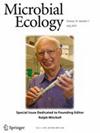
The journal Microbial Ecology was founded more than 50 years ago by Dr. Ralph Mitchell, Gordon McKay Professor of Applied Biology at Harvard University in Cambridge, MA. The journal has evolved to become a premier location for the presentation of manuscripts that represent advances in the field of microbial ecology. The journal has become a dedicated international forum for the presentation of high-quality scientific investigations of how microorganisms interact with their environment, with each other and with their hosts. Microbial Ecology offers articles of original research in full paper and note formats, as well as brief reviews and topical position papers.

 求助内容:
求助内容: 应助结果提醒方式:

 京公网安备 11010802042870号


