Sudharsan Madhavan , Chengcheng Gui , Lando Bosma , Josiah Simeth , Jue Jiang , Nicolas Côté , Nima Hassan Rezaeian , Himanshu Nagar , Victoria Brennan , Neelam Tyagi , Harini Veeraraghavan
{"title":"多域深度学习配准分割正则化训练在磁共振引导前列腺癌放疗中的应用","authors":"Sudharsan Madhavan , Chengcheng Gui , Lando Bosma , Josiah Simeth , Jue Jiang , Nicolas Côté , Nima Hassan Rezaeian , Himanshu Nagar , Victoria Brennan , Neelam Tyagi , Harini Veeraraghavan","doi":"10.1016/j.phro.2026.100989","DOIUrl":null,"url":null,"abstract":"<div><h3>Background and purpose</h3><div>Accurate deformable image registration (DIR) is required for contour propagation and dose accumulation for magnetic resonance guided adaptive radiotherapy (MRgART). The goal of this study was to train segmentation regularized deep learning (DL) DIR and assess domain invariant MR-MR registration.</div></div><div><h3>Materials and methods</h3><div>DL-DIR based progressively refined registration and segmentation (ProRSeg) and VoxelMorph were trained with and without organ weighted segmentation regularization with 262 MR pairs from same domain dataset of longitudinal 3 Tesla MR simulation (MR-Sim) scans of patients with prostate cancer acquired before and every 3 months following radiotherapy. Models were compared against variational DIR by measuring accuracy of organs and clinical target volume (CTV) contour propagation accuracy on same- (58 pairs), cross- (72 1.5 Tesla MR-Linac pairs from consecutive daily treatment fractions), and mixed-domain (42 MRSim planning − MR-Linac first fraction pairs) datasets. Dose accumulation was performed for 42 patients undergoing 5-fraction MRgART on MR-Linac.</div></div><div><h3>Results</h3><div>ProRSeg produced robust DIR on cross- (all organs) and mixed-domain (bladder, CTV) datasets. It was the most accurate method for highly deforming organs including bladder and rectum. Segmentation regularization enhanced accuracy of both ProRSeg and VoxelMorph compared to unregularized versions. Dose accumulation feasibility study with ProRSeg indicated that 83.3% of patients met key institutional constraints for CTV coverage and bladder sparing.</div></div><div><h3>Conclusions</h3><div>ProRSeg was a feasible approach for multi-domain MR-MR registration for prostate cancer patients. Dose accumulation analysis indicated preliminary feasibility to evaluate compliance of delivered treatments to clinical constraints.</div></div>","PeriodicalId":36850,"journal":{"name":"Physics and Imaging in Radiation Oncology","volume":"39 ","pages":"Article 100989"},"PeriodicalIF":3.2000,"publicationDate":"2026-05-01","publicationTypes":"Journal Article","fieldsOfStudy":null,"isOpenAccess":false,"openAccessPdf":"","citationCount":"0","resultStr":"{\"title\":\"Segmentation regularized training for multi-domain deep learning registration applied to magnetic resonance-guided prostate cancer radiotherapy\",\"authors\":\"Sudharsan Madhavan , Chengcheng Gui , Lando Bosma , Josiah Simeth , Jue Jiang , Nicolas Côté , Nima Hassan Rezaeian , Himanshu Nagar , Victoria Brennan , Neelam Tyagi , Harini Veeraraghavan\",\"doi\":\"10.1016/j.phro.2026.100989\",\"DOIUrl\":null,\"url\":null,\"abstract\":\"<div><h3>Background and purpose</h3><div>Accurate deformable image registration (DIR) is required for contour propagation and dose accumulation for magnetic resonance guided adaptive radiotherapy (MRgART). The goal of this study was to train segmentation regularized deep learning (DL) DIR and assess domain invariant MR-MR registration.</div></div><div><h3>Materials and methods</h3><div>DL-DIR based progressively refined registration and segmentation (ProRSeg) and VoxelMorph were trained with and without organ weighted segmentation regularization with 262 MR pairs from same domain dataset of longitudinal 3 Tesla MR simulation (MR-Sim) scans of patients with prostate cancer acquired before and every 3 months following radiotherapy. Models were compared against variational DIR by measuring accuracy of organs and clinical target volume (CTV) contour propagation accuracy on same- (58 pairs), cross- (72 1.5 Tesla MR-Linac pairs from consecutive daily treatment fractions), and mixed-domain (42 MRSim planning − MR-Linac first fraction pairs) datasets. Dose accumulation was performed for 42 patients undergoing 5-fraction MRgART on MR-Linac.</div></div><div><h3>Results</h3><div>ProRSeg produced robust DIR on cross- (all organs) and mixed-domain (bladder, CTV) datasets. It was the most accurate method for highly deforming organs including bladder and rectum. Segmentation regularization enhanced accuracy of both ProRSeg and VoxelMorph compared to unregularized versions. Dose accumulation feasibility study with ProRSeg indicated that 83.3% of patients met key institutional constraints for CTV coverage and bladder sparing.</div></div><div><h3>Conclusions</h3><div>ProRSeg was a feasible approach for multi-domain MR-MR registration for prostate cancer patients. Dose accumulation analysis indicated preliminary feasibility to evaluate compliance of delivered treatments to clinical constraints.</div></div>\",\"PeriodicalId\":36850,\"journal\":{\"name\":\"Physics and Imaging in Radiation Oncology\",\"volume\":\"39 \",\"pages\":\"Article 100989\"},\"PeriodicalIF\":3.2000,\"publicationDate\":\"2026-05-01\",\"publicationTypes\":\"Journal Article\",\"fieldsOfStudy\":null,\"isOpenAccess\":false,\"openAccessPdf\":\"\",\"citationCount\":\"0\",\"resultStr\":null,\"platform\":\"Semanticscholar\",\"paperid\":null,\"PeriodicalName\":\"Physics and Imaging in Radiation Oncology\",\"FirstCategoryId\":\"1085\",\"ListUrlMain\":\"https://www.sciencedirect.com/science/article/pii/S2405631626000898\",\"RegionNum\":0,\"RegionCategory\":null,\"ArticlePicture\":[],\"TitleCN\":null,\"AbstractTextCN\":null,\"PMCID\":null,\"EPubDate\":\"2026/5/9 0:00:00\",\"PubModel\":\"Epub\",\"JCR\":\"Q2\",\"JCRName\":\"ONCOLOGY\",\"Score\":null,\"Total\":0}","platform":"Semanticscholar","paperid":null,"PeriodicalName":"Physics and Imaging in Radiation Oncology","FirstCategoryId":"1085","ListUrlMain":"https://www.sciencedirect.com/science/article/pii/S2405631626000898","RegionNum":0,"RegionCategory":null,"ArticlePicture":[],"TitleCN":null,"AbstractTextCN":null,"PMCID":null,"EPubDate":"2026/5/9 0:00:00","PubModel":"Epub","JCR":"Q2","JCRName":"ONCOLOGY","Score":null,"Total":0}
引用次数: 0
摘要
背景与目的磁共振引导自适应放疗(MRgART)的轮廓传播和剂量积累需要精确的形变图像配准(DIR)。本研究的目的是训练分割正则化深度学习(DL) DIR并评估领域不变的MR-MR配准。材料与方法基于sdl - dir的渐进式精细配准与分割(proseg)和VoxelMorph进行器官加权分割正则化训练,使用放疗前和放疗后每3个月获得的前列腺癌患者纵向3 Tesla MR模拟(MR- sim)扫描同一域数据集的262对MR进行训练。通过测量相同(58对)、交叉(72对来自连续每日治疗分数的1.5 Tesla MR-Linac对)和混合域(42对MRSim规划- MR-Linac第一分数对)数据集上的器官精度和临床靶体积(CTV)轮廓传播精度,将模型与变分DIR进行比较。对42例在MR-Linac上进行5次MRgART的患者进行剂量累积。结果sprorseg在跨(所有器官)和混合域(膀胱、CTV)数据集上产生了鲁棒的DIR。对于膀胱、直肠等高度变形的器官,该方法最准确。与非正则化版本相比,分割正则化提高了proseg和VoxelMorph的精度。proseg的剂量累积可行性研究表明,83.3%的患者符合CTV覆盖和膀胱保留的关键制度限制。结论sprorseg是一种可行的前列腺癌患者多区域MR-MR登记方法。剂量累积分析表明初步可行性评估交付的治疗依从性的临床约束。
Segmentation regularized training for multi-domain deep learning registration applied to magnetic resonance-guided prostate cancer radiotherapy
Background and purpose
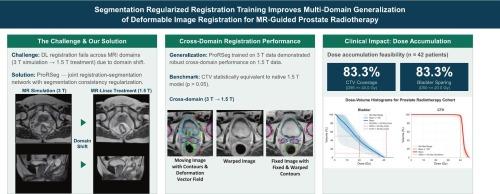
Accurate deformable image registration (DIR) is required for contour propagation and dose accumulation for magnetic resonance guided adaptive radiotherapy (MRgART). The goal of this study was to train segmentation regularized deep learning (DL) DIR and assess domain invariant MR-MR registration.
Materials and methods
DL-DIR based progressively refined registration and segmentation (ProRSeg) and VoxelMorph were trained with and without organ weighted segmentation regularization with 262 MR pairs from same domain dataset of longitudinal 3 Tesla MR simulation (MR-Sim) scans of patients with prostate cancer acquired before and every 3 months following radiotherapy. Models were compared against variational DIR by measuring accuracy of organs and clinical target volume (CTV) contour propagation accuracy on same- (58 pairs), cross- (72 1.5 Tesla MR-Linac pairs from consecutive daily treatment fractions), and mixed-domain (42 MRSim planning − MR-Linac first fraction pairs) datasets. Dose accumulation was performed for 42 patients undergoing 5-fraction MRgART on MR-Linac.
Results
ProRSeg produced robust DIR on cross- (all organs) and mixed-domain (bladder, CTV) datasets. It was the most accurate method for highly deforming organs including bladder and rectum. Segmentation regularization enhanced accuracy of both ProRSeg and VoxelMorph compared to unregularized versions. Dose accumulation feasibility study with ProRSeg indicated that 83.3% of patients met key institutional constraints for CTV coverage and bladder sparing.
Conclusions
ProRSeg was a feasible approach for multi-domain MR-MR registration for prostate cancer patients. Dose accumulation analysis indicated preliminary feasibility to evaluate compliance of delivered treatments to clinical constraints.