{"title":"工业水监测异常数据的多尺度挖掘与重构策略","authors":"Feng Zhang, Qingyang Lu","doi":"10.1007/s10661-026-15410-1","DOIUrl":null,"url":null,"abstract":"<div><p>Improving the quality of water intake monitoring data is an urgent issue in current water management. The industrial water intake monitoring data obtained during the National Water Resources Monitoring Capacity Building Project promotion project was taken as a sample, and the common abnormal categories of water intake monitoring data were summarized, and the strategy of “rough screening–fine identification–reconstruction” was proposed. Considering the seasonal fluctuation law of water monitoring data, the multiscale industrial water monitoring abnormal data identification models were constructed based on segmented 3<i>σ</i> criterion, wavelet transform, and Fourier function. Moreover, the least squares support vector machine (LSSVM) model with adaptive inertia function and particle swarm optimization (PSO) was used to reconstruct the recovered anomaly data. The results indicate that the segmented 3<i>σ</i> criterion performs well for the rough processing of water intake monitoring data, identifying 26 data points that fall outside the corresponding threshold intervals. The Fourier function can effectively reduce the information loss associated with the wavelet transform, thereby improving the accuracy of abnormal data identification; based on verification feedback from monitoring users, 31 of the 38 detected abnormal points were confirmed as “demand-driven anomalies,” yielding an identification accuracy of 81.6%. Furthermore, the inertia function–particle swarm optimization LSSVM model meets the high-precision requirements for abnormal data reconstruction and recovery, and its reconstruction accuracy is higher than that of the LSSVM, the PSO-LSSVM, and the traditional curve fitting method. Specifically, the inertia function–particle swarm optimization LSSVM achieves an average fitting error of 0.0286, representing reductions of 46.2% and 44.4% compared with the LSSVM (0.0532) and PSO-LSSVM (0.0514), respectively; moreover, when compared with the ground-truth values obtained from verification feedback, the reconstruction error rate is below 5%. Overall, the proposed multiscale mining and reconstruction strategy for industrial water intake monitoring abnormal data can provide a valuable methodological reference for enhancing the decision support capability of data in the National Water Resources Monitoring Capacity Building Project.</p></div>","PeriodicalId":544,"journal":{"name":"Environmental Monitoring and Assessment","volume":"198 6","pages":""},"PeriodicalIF":3.0000,"publicationDate":"2026-05-08","publicationTypes":"Journal Article","fieldsOfStudy":null,"isOpenAccess":false,"openAccessPdf":"","citationCount":"0","resultStr":"{\"title\":\"Multiscale mining and reconstruction strategy for industrial water monitoring abnormal data\",\"authors\":\"Feng Zhang, Qingyang Lu\",\"doi\":\"10.1007/s10661-026-15410-1\",\"DOIUrl\":null,\"url\":null,\"abstract\":\"<div><p>Improving the quality of water intake monitoring data is an urgent issue in current water management. The industrial water intake monitoring data obtained during the National Water Resources Monitoring Capacity Building Project promotion project was taken as a sample, and the common abnormal categories of water intake monitoring data were summarized, and the strategy of “rough screening–fine identification–reconstruction” was proposed. Considering the seasonal fluctuation law of water monitoring data, the multiscale industrial water monitoring abnormal data identification models were constructed based on segmented 3<i>σ</i> criterion, wavelet transform, and Fourier function. Moreover, the least squares support vector machine (LSSVM) model with adaptive inertia function and particle swarm optimization (PSO) was used to reconstruct the recovered anomaly data. The results indicate that the segmented 3<i>σ</i> criterion performs well for the rough processing of water intake monitoring data, identifying 26 data points that fall outside the corresponding threshold intervals. The Fourier function can effectively reduce the information loss associated with the wavelet transform, thereby improving the accuracy of abnormal data identification; based on verification feedback from monitoring users, 31 of the 38 detected abnormal points were confirmed as “demand-driven anomalies,” yielding an identification accuracy of 81.6%. Furthermore, the inertia function–particle swarm optimization LSSVM model meets the high-precision requirements for abnormal data reconstruction and recovery, and its reconstruction accuracy is higher than that of the LSSVM, the PSO-LSSVM, and the traditional curve fitting method. Specifically, the inertia function–particle swarm optimization LSSVM achieves an average fitting error of 0.0286, representing reductions of 46.2% and 44.4% compared with the LSSVM (0.0532) and PSO-LSSVM (0.0514), respectively; moreover, when compared with the ground-truth values obtained from verification feedback, the reconstruction error rate is below 5%. Overall, the proposed multiscale mining and reconstruction strategy for industrial water intake monitoring abnormal data can provide a valuable methodological reference for enhancing the decision support capability of data in the National Water Resources Monitoring Capacity Building Project.</p></div>\",\"PeriodicalId\":544,\"journal\":{\"name\":\"Environmental Monitoring and Assessment\",\"volume\":\"198 6\",\"pages\":\"\"},\"PeriodicalIF\":3.0000,\"publicationDate\":\"2026-05-08\",\"publicationTypes\":\"Journal Article\",\"fieldsOfStudy\":null,\"isOpenAccess\":false,\"openAccessPdf\":\"\",\"citationCount\":\"0\",\"resultStr\":null,\"platform\":\"Semanticscholar\",\"paperid\":null,\"PeriodicalName\":\"Environmental Monitoring and Assessment\",\"FirstCategoryId\":\"93\",\"ListUrlMain\":\"https://link.springer.com/article/10.1007/s10661-026-15410-1\",\"RegionNum\":4,\"RegionCategory\":\"环境科学与生态学\",\"ArticlePicture\":[],\"TitleCN\":null,\"AbstractTextCN\":null,\"PMCID\":null,\"EPubDate\":\"\",\"PubModel\":\"\",\"JCR\":\"Q3\",\"JCRName\":\"ENVIRONMENTAL SCIENCES\",\"Score\":null,\"Total\":0}","platform":"Semanticscholar","paperid":null,"PeriodicalName":"Environmental Monitoring and Assessment","FirstCategoryId":"93","ListUrlMain":"https://link.springer.com/article/10.1007/s10661-026-15410-1","RegionNum":4,"RegionCategory":"环境科学与生态学","ArticlePicture":[],"TitleCN":null,"AbstractTextCN":null,"PMCID":null,"EPubDate":"","PubModel":"","JCR":"Q3","JCRName":"ENVIRONMENTAL SCIENCES","Score":null,"Total":0}
Multiscale mining and reconstruction strategy for industrial water monitoring abnormal data
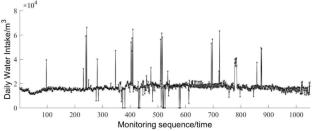
Improving the quality of water intake monitoring data is an urgent issue in current water management. The industrial water intake monitoring data obtained during the National Water Resources Monitoring Capacity Building Project promotion project was taken as a sample, and the common abnormal categories of water intake monitoring data were summarized, and the strategy of “rough screening–fine identification–reconstruction” was proposed. Considering the seasonal fluctuation law of water monitoring data, the multiscale industrial water monitoring abnormal data identification models were constructed based on segmented 3σ criterion, wavelet transform, and Fourier function. Moreover, the least squares support vector machine (LSSVM) model with adaptive inertia function and particle swarm optimization (PSO) was used to reconstruct the recovered anomaly data. The results indicate that the segmented 3σ criterion performs well for the rough processing of water intake monitoring data, identifying 26 data points that fall outside the corresponding threshold intervals. The Fourier function can effectively reduce the information loss associated with the wavelet transform, thereby improving the accuracy of abnormal data identification; based on verification feedback from monitoring users, 31 of the 38 detected abnormal points were confirmed as “demand-driven anomalies,” yielding an identification accuracy of 81.6%. Furthermore, the inertia function–particle swarm optimization LSSVM model meets the high-precision requirements for abnormal data reconstruction and recovery, and its reconstruction accuracy is higher than that of the LSSVM, the PSO-LSSVM, and the traditional curve fitting method. Specifically, the inertia function–particle swarm optimization LSSVM achieves an average fitting error of 0.0286, representing reductions of 46.2% and 44.4% compared with the LSSVM (0.0532) and PSO-LSSVM (0.0514), respectively; moreover, when compared with the ground-truth values obtained from verification feedback, the reconstruction error rate is below 5%. Overall, the proposed multiscale mining and reconstruction strategy for industrial water intake monitoring abnormal data can provide a valuable methodological reference for enhancing the decision support capability of data in the National Water Resources Monitoring Capacity Building Project.
期刊介绍:
Environmental Monitoring and Assessment emphasizes technical developments and data arising from environmental monitoring and assessment, the use of scientific principles in the design of monitoring systems at the local, regional and global scales, and the use of monitoring data in assessing the consequences of natural resource management actions and pollution risks to man and the environment.


 求助内容:
求助内容: 应助结果提醒方式:

 京公网安备 11010802042870号


