A. S. Kirillov, V. F. Tarasenko, N. P. Vinogradov, V. A. Kirillov
{"title":"0.03-1 Torr气压下分子氮三重态B3Πg和C3Πu动力学研究","authors":"A. S. Kirillov, V. F. Tarasenko, N. P. Vinogradov, V. A. Kirillov","doi":"10.1134/S1062873825715442","DOIUrl":null,"url":null,"abstract":"<p>The kinetics of triplet states of molecular nitrogen and the emission of bands of the first positive system (1PG) and second positive system (2PG) were studied for air pressures at which red sprites are observed. The spectral energy densities <i>W</i> of the emission of six 1PG bands and three 2PG bands were measured experimentally in a pulsed discharge with plasma diffuse jets at pressures of 0.03–1 Torr. The populations of various vibrational levels of the triplet states of molecular nitrogen and the spectral energy density ratios <i>W</i><sub>1PG</sub>/<i>W</i><sub>2PG</sub> were calculated in the pressure range considered. Good agreement was obtained between the calculated and experimental values of the <i>W</i><sub>1PG</sub>/<i>W</i><sub>2PG</sub> ratio. The spectral energy density ratio <i>W</i><sub>1PG</sub>/<i>W</i><sub>2PG</sub> was shown to decrease with increasing pressure, which is explained by a rise of the quenching rates of the <i>B</i><sup>3</sup>Π<sub><i>g</i></sub> state with increasing density of the medium.</p>","PeriodicalId":504,"journal":{"name":"Bulletin of the Russian Academy of Sciences: Physics","volume":"90 3","pages":"406 - 414"},"PeriodicalIF":0.4800,"publicationDate":"2026-05-08","publicationTypes":"Journal Article","fieldsOfStudy":null,"isOpenAccess":false,"openAccessPdf":"","citationCount":"0","resultStr":"{\"title\":\"The Study of the Kinetics of the Triplet States B3Πg and C3Πu of Molecular Nitrogen at Air Pressures of 0.03–1 Torr\",\"authors\":\"A. S. Kirillov, V. F. Tarasenko, N. P. Vinogradov, V. A. Kirillov\",\"doi\":\"10.1134/S1062873825715442\",\"DOIUrl\":null,\"url\":null,\"abstract\":\"<p>The kinetics of triplet states of molecular nitrogen and the emission of bands of the first positive system (1PG) and second positive system (2PG) were studied for air pressures at which red sprites are observed. The spectral energy densities <i>W</i> of the emission of six 1PG bands and three 2PG bands were measured experimentally in a pulsed discharge with plasma diffuse jets at pressures of 0.03–1 Torr. The populations of various vibrational levels of the triplet states of molecular nitrogen and the spectral energy density ratios <i>W</i><sub>1PG</sub>/<i>W</i><sub>2PG</sub> were calculated in the pressure range considered. Good agreement was obtained between the calculated and experimental values of the <i>W</i><sub>1PG</sub>/<i>W</i><sub>2PG</sub> ratio. The spectral energy density ratio <i>W</i><sub>1PG</sub>/<i>W</i><sub>2PG</sub> was shown to decrease with increasing pressure, which is explained by a rise of the quenching rates of the <i>B</i><sup>3</sup>Π<sub><i>g</i></sub> state with increasing density of the medium.</p>\",\"PeriodicalId\":504,\"journal\":{\"name\":\"Bulletin of the Russian Academy of Sciences: Physics\",\"volume\":\"90 3\",\"pages\":\"406 - 414\"},\"PeriodicalIF\":0.4800,\"publicationDate\":\"2026-05-08\",\"publicationTypes\":\"Journal Article\",\"fieldsOfStudy\":null,\"isOpenAccess\":false,\"openAccessPdf\":\"\",\"citationCount\":\"0\",\"resultStr\":null,\"platform\":\"Semanticscholar\",\"paperid\":null,\"PeriodicalName\":\"Bulletin of the Russian Academy of Sciences: Physics\",\"FirstCategoryId\":\"1085\",\"ListUrlMain\":\"https://link.springer.com/article/10.1134/S1062873825715442\",\"RegionNum\":0,\"RegionCategory\":null,\"ArticlePicture\":[],\"TitleCN\":null,\"AbstractTextCN\":null,\"PMCID\":null,\"EPubDate\":\"\",\"PubModel\":\"\",\"JCR\":\"Q4\",\"JCRName\":\"Physics and Astronomy\",\"Score\":null,\"Total\":0}","platform":"Semanticscholar","paperid":null,"PeriodicalName":"Bulletin of the Russian Academy of Sciences: Physics","FirstCategoryId":"1085","ListUrlMain":"https://link.springer.com/article/10.1134/S1062873825715442","RegionNum":0,"RegionCategory":null,"ArticlePicture":[],"TitleCN":null,"AbstractTextCN":null,"PMCID":null,"EPubDate":"","PubModel":"","JCR":"Q4","JCRName":"Physics and Astronomy","Score":null,"Total":0}
The Study of the Kinetics of the Triplet States B3Πg and C3Πu of Molecular Nitrogen at Air Pressures of 0.03–1 Torr
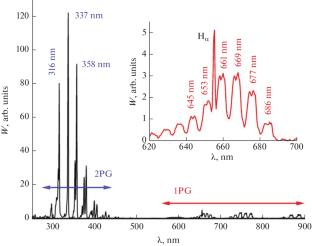
The kinetics of triplet states of molecular nitrogen and the emission of bands of the first positive system (1PG) and second positive system (2PG) were studied for air pressures at which red sprites are observed. The spectral energy densities W of the emission of six 1PG bands and three 2PG bands were measured experimentally in a pulsed discharge with plasma diffuse jets at pressures of 0.03–1 Torr. The populations of various vibrational levels of the triplet states of molecular nitrogen and the spectral energy density ratios W1PG/W2PG were calculated in the pressure range considered. Good agreement was obtained between the calculated and experimental values of the W1PG/W2PG ratio. The spectral energy density ratio W1PG/W2PG was shown to decrease with increasing pressure, which is explained by a rise of the quenching rates of the B3Πg state with increasing density of the medium.
期刊介绍:
Bulletin of the Russian Academy of Sciences: Physics is an international peer reviewed journal published with the participation of the Russian Academy of Sciences. It presents full-text articles (regular, letters to the editor, reviews) with the most recent results in miscellaneous fields of physics and astronomy: nuclear physics, cosmic rays, condensed matter physics, plasma physics, optics and photonics, nanotechnologies, solar and astrophysics, physical applications in material sciences, life sciences, etc. Bulletin of the Russian Academy of Sciences: Physics focuses on the most relevant multidisciplinary topics in natural sciences, both fundamental and applied. Manuscripts can be submitted in Russian and English languages and are subject to peer review. Accepted articles are usually combined in thematic issues on certain topics according to the journal editorial policy. Authors featured in the journal represent renowned scientific laboratories and institutes from different countries, including large international collaborations. There are globally recognized researchers among the authors: Nobel laureates and recipients of other awards, and members of national academies of sciences and international scientific societies.

 求助内容:
求助内容: 应助结果提醒方式:

 京公网安备 11010802042870号


