{"title":"配水管网风动抽水系统的建模与仿真","authors":"Ahmed AbuElwan, Hassan Mansour, Yahia M. Fouda","doi":"10.1186/s13705-026-00575-x","DOIUrl":null,"url":null,"abstract":"<div><h3>Background</h3><p>Providing a reliable water supply to remote, off-grid communities is a significant challenge in arid and semi-arid regions due to the high cost of extending the electrical infrastructure. Although wind energy offers a sustainable option, conventional wind-electric systems often require high maintenance and result in energy conversion losses. The aim of this study is to model and evaluate a mechanically coupled wind pumping system as a cost-effective and robust alternative for residential water distribution in such environments.</p><h3>Methods</h3><p>A comprehensive mathematical model was developed to simulate the dynamic performance of a horizontal axis wind turbine (HAWT) mechanically coupled to a centrifugal pump via a gearbox. The system was designed to lift water from a surface water source to a storage tank, thereby overcoming the intermittency of wind power. The simulation integrated the blade element momentum (BEM) theory for the turbine and affinity laws for the pump. A dynamic simulation was conducted using the hourly wind and water demand data for a case study in Ras Gharib, Egypt. In order to identify the optimal configuration for water reliability, two turbine design strategies were compared: Method A, which prioritized minimizing the starting wind speed, and Method B, which prioritized maximizing the aerodynamic efficiency.</p><h3>Results</h3><p>The simulation results showed that coupling the turbine and the pump directly would effectively meet the community’s water demand. However, the parametric analysis revealed a trade-off between reliability and efficiency; some configurations achieved a water demand fulfillment rate of up to 99.7%, while others reached a peak efficiency of 37%, which were associated with varying design constraints. When using Method B to balance performance metrics, the optimal configuration achieved 89.6% demand fulfillment and 32% efficiency with a compact 2.3 m turbine radius. The sensitivity analysis further revealed that the reliability of the system is most sensitive to the sizing of the hydraulic load, particularly the diameter of the pipeline and the design speed of the pump.</p><h3>Conclusions</h3><p>This study confirms that mechanical wind pumping systems are a viable, sustainable solution for off-grid water distribution. The developed model provides a valuable planning tool that helps engineers and policymakers size and optimize the infrastructure in remote areas for potential agricultural and mixed-use applications.</p></div>","PeriodicalId":539,"journal":{"name":"Energy, Sustainability and Society","volume":"16 1","pages":""},"PeriodicalIF":5.1000,"publicationDate":"2026-04-03","publicationTypes":"Journal Article","fieldsOfStudy":null,"isOpenAccess":false,"openAccessPdf":"https://link.springer.com/content/pdf/10.1186/s13705-026-00575-x.pdf","citationCount":"0","resultStr":"{\"title\":\"Modelling and simulation of a wind-driven pumping system for water distribution networks\",\"authors\":\"Ahmed AbuElwan, Hassan Mansour, Yahia M. Fouda\",\"doi\":\"10.1186/s13705-026-00575-x\",\"DOIUrl\":null,\"url\":null,\"abstract\":\"<div><h3>Background</h3><p>Providing a reliable water supply to remote, off-grid communities is a significant challenge in arid and semi-arid regions due to the high cost of extending the electrical infrastructure. Although wind energy offers a sustainable option, conventional wind-electric systems often require high maintenance and result in energy conversion losses. The aim of this study is to model and evaluate a mechanically coupled wind pumping system as a cost-effective and robust alternative for residential water distribution in such environments.</p><h3>Methods</h3><p>A comprehensive mathematical model was developed to simulate the dynamic performance of a horizontal axis wind turbine (HAWT) mechanically coupled to a centrifugal pump via a gearbox. The system was designed to lift water from a surface water source to a storage tank, thereby overcoming the intermittency of wind power. The simulation integrated the blade element momentum (BEM) theory for the turbine and affinity laws for the pump. A dynamic simulation was conducted using the hourly wind and water demand data for a case study in Ras Gharib, Egypt. In order to identify the optimal configuration for water reliability, two turbine design strategies were compared: Method A, which prioritized minimizing the starting wind speed, and Method B, which prioritized maximizing the aerodynamic efficiency.</p><h3>Results</h3><p>The simulation results showed that coupling the turbine and the pump directly would effectively meet the community’s water demand. However, the parametric analysis revealed a trade-off between reliability and efficiency; some configurations achieved a water demand fulfillment rate of up to 99.7%, while others reached a peak efficiency of 37%, which were associated with varying design constraints. When using Method B to balance performance metrics, the optimal configuration achieved 89.6% demand fulfillment and 32% efficiency with a compact 2.3 m turbine radius. The sensitivity analysis further revealed that the reliability of the system is most sensitive to the sizing of the hydraulic load, particularly the diameter of the pipeline and the design speed of the pump.</p><h3>Conclusions</h3><p>This study confirms that mechanical wind pumping systems are a viable, sustainable solution for off-grid water distribution. The developed model provides a valuable planning tool that helps engineers and policymakers size and optimize the infrastructure in remote areas for potential agricultural and mixed-use applications.</p></div>\",\"PeriodicalId\":539,\"journal\":{\"name\":\"Energy, Sustainability and Society\",\"volume\":\"16 1\",\"pages\":\"\"},\"PeriodicalIF\":5.1000,\"publicationDate\":\"2026-04-03\",\"publicationTypes\":\"Journal Article\",\"fieldsOfStudy\":null,\"isOpenAccess\":false,\"openAccessPdf\":\"https://link.springer.com/content/pdf/10.1186/s13705-026-00575-x.pdf\",\"citationCount\":\"0\",\"resultStr\":null,\"platform\":\"Semanticscholar\",\"paperid\":null,\"PeriodicalName\":\"Energy, Sustainability and Society\",\"FirstCategoryId\":\"5\",\"ListUrlMain\":\"https://link.springer.com/article/10.1186/s13705-026-00575-x\",\"RegionNum\":3,\"RegionCategory\":\"工程技术\",\"ArticlePicture\":[],\"TitleCN\":null,\"AbstractTextCN\":null,\"PMCID\":null,\"EPubDate\":\"2026/4/9 0:00:00\",\"PubModel\":\"Epub\",\"JCR\":\"Q2\",\"JCRName\":\"ENERGY & FUELS\",\"Score\":null,\"Total\":0}","platform":"Semanticscholar","paperid":null,"PeriodicalName":"Energy, Sustainability and Society","FirstCategoryId":"5","ListUrlMain":"https://link.springer.com/article/10.1186/s13705-026-00575-x","RegionNum":3,"RegionCategory":"工程技术","ArticlePicture":[],"TitleCN":null,"AbstractTextCN":null,"PMCID":null,"EPubDate":"2026/4/9 0:00:00","PubModel":"Epub","JCR":"Q2","JCRName":"ENERGY & FUELS","Score":null,"Total":0}
Modelling and simulation of a wind-driven pumping system for water distribution networks
Background
Providing a reliable water supply to remote, off-grid communities is a significant challenge in arid and semi-arid regions due to the high cost of extending the electrical infrastructure. Although wind energy offers a sustainable option, conventional wind-electric systems often require high maintenance and result in energy conversion losses. The aim of this study is to model and evaluate a mechanically coupled wind pumping system as a cost-effective and robust alternative for residential water distribution in such environments.
Methods
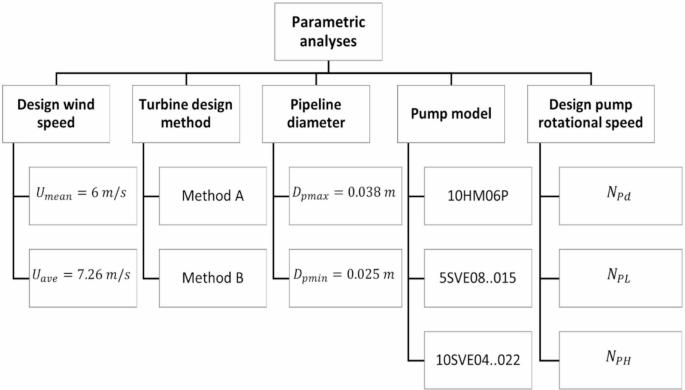
A comprehensive mathematical model was developed to simulate the dynamic performance of a horizontal axis wind turbine (HAWT) mechanically coupled to a centrifugal pump via a gearbox. The system was designed to lift water from a surface water source to a storage tank, thereby overcoming the intermittency of wind power. The simulation integrated the blade element momentum (BEM) theory for the turbine and affinity laws for the pump. A dynamic simulation was conducted using the hourly wind and water demand data for a case study in Ras Gharib, Egypt. In order to identify the optimal configuration for water reliability, two turbine design strategies were compared: Method A, which prioritized minimizing the starting wind speed, and Method B, which prioritized maximizing the aerodynamic efficiency.
Results
The simulation results showed that coupling the turbine and the pump directly would effectively meet the community’s water demand. However, the parametric analysis revealed a trade-off between reliability and efficiency; some configurations achieved a water demand fulfillment rate of up to 99.7%, while others reached a peak efficiency of 37%, which were associated with varying design constraints. When using Method B to balance performance metrics, the optimal configuration achieved 89.6% demand fulfillment and 32% efficiency with a compact 2.3 m turbine radius. The sensitivity analysis further revealed that the reliability of the system is most sensitive to the sizing of the hydraulic load, particularly the diameter of the pipeline and the design speed of the pump.
Conclusions
This study confirms that mechanical wind pumping systems are a viable, sustainable solution for off-grid water distribution. The developed model provides a valuable planning tool that helps engineers and policymakers size and optimize the infrastructure in remote areas for potential agricultural and mixed-use applications.
期刊介绍:
Energy, Sustainability and Society is a peer-reviewed open access journal published under the brand SpringerOpen. It covers topics ranging from scientific research to innovative approaches for technology implementation to analysis of economic, social and environmental impacts of sustainable energy systems.


 求助内容:
求助内容: 应助结果提醒方式:

 京公网安备 11010802042870号


